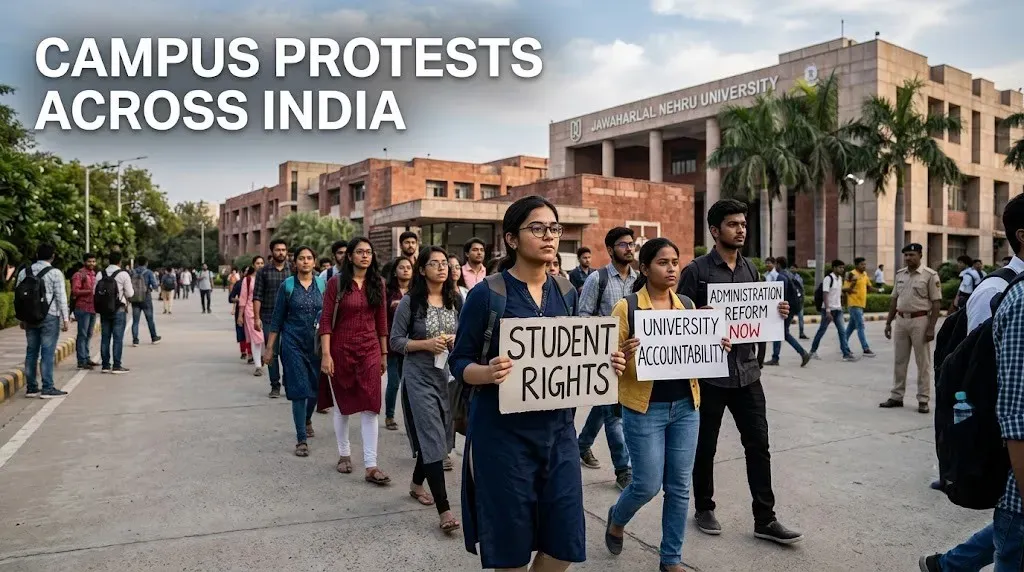
August 2026 has been an unusually tense month on some of India's best-known campuses. Students at NALSAR, NLSIU, IIT Delhi, Jamia Millia Islamia and IISER Pune have taken part in protests over very different incidents, yet the complaints keep returning to a familiar question: what happens when students believe the institution has failed to listen?
The issues range from a disputed convocation decision to student welfare, admissions and disciplinary action. Some protests have already produced administrative responses, while others remain unresolved. The common feature is that students have moved beyond private complaints and chosen collective action on campus.
| Campus | What triggered the protest |
|---|---|
| NALSAR, Hyderabad | Students objected to Chief Justice of India Surya Kant being proposed as convocation chief guest, citing his handling of proceedings concerning alleged police excesses against protesters. |
| NLSIU, Bengaluru | Students and alumni backed NALSAR students and opposed the participation of the CJI and BCI chairman at their convocation. |
| IIT Delhi | Students protested after the death of MSc Physics student Rishikesh Kumar, demanding an independent inquiry and accountability. |
| Jamia Millia Islamia | Students protested over alleged admission irregularities and questions surrounding the spot-admission process. |
| IISER Pune | Students launched an indefinite sit-in over mental-health policies, hostel restrictions and disciplinary action against a student representative. |
The NALSAR controversy became the most visible legal dispute. More than 400 students objected to the proposed invitation of CJI Surya Kant for the university's convocation. The disagreement escalated after the Bar Council of India directed state bar councils not to enrol NALSAR's 2026 graduates as advocates. The BCI later withdrew that direction, while the Supreme Court intervened and restrained punitive action as the dispute was examined.
The NLSIU episode showed how quickly a campus dispute can spread beyond one university. More than 700 students, graduates and alumni signed a statement supporting NALSAR students and questioning the presence of the CJI and BCI chairman at their own convocation. NLSIU subsequently cancelled its 2026 annual convocation, citing unavoidable circumstances.
At IIT Delhi, the trigger was much more personal and serious. Students began protesting after the death of 31-year-old MSc Physics student Rishikesh Kumar. They demanded an external inquiry, action where responsibility is established and improvements to student welfare. The institute reconstituted its inquiry panel under retired Delhi High Court judge Justice Mukta Gupta, and students later paused their on-ground protest while waiting for the report.
Jamia's dispute was about something much more routine but equally important to students: admissions. Students questioned the university's 2026-27 spot-admission process and alleged irregularities in seat allocation. The university suspended four students involved in an unauthorised sit-in and barred them from campus for different periods, turning an admissions dispute into a separate debate about disciplinary action and the right to protest.
At IISER Pune, the focus has been student welfare and disciplinary policy. Students launched an indefinite sit-in over mental-health policies, hostel restrictions and the suspension of student council general secretary Raj Bagwe. The protest followed an earlier campus incident involving allegations of a strip search of students, making the dispute part of a wider argument about how institutions handle sensitive welfare and disciplinary matters.
What connects these cases is not one political ideology or one student organisation. In each case, students have challenged a decision or response that they believe affects their academic life, professional future or basic sense of safety and dignity. That is why the recent protests are worth watching even when the individual disputes remain very different.
For universities, the difficult part comes after the protest. Announcing a committee or issuing a clarification can calm a campus temporarily, but students increasingly want to know what happens after the committee submits its report or the administration finishes its review. August's protests suggest that the next phase of campus accountability may be measured less by the response to a demonstration and more by what institutions actually change afterwards.