Government Schools Are Now Teaching AI – Private Students Are Behind?
The Great Leap: Why Government Schools Are Redefining AI Education in 2026
For decades, the narrative in Indian education was simple: if you wanted "tech-ready" children, you paid for expensive private schooling. However, as we enter the 2026-27 academic session, that script is being flipped. Under the National Curriculum Framework for School Education (NCF-SE) 2023, the Ministry of Education has officially launched a nationwide rollout of AI and Computational Thinking (CT) starting from Class 3. This isn't just an elective or a "computer lab" period; it is being treated as a foundational pillar alongside Mathematics and Literacy.
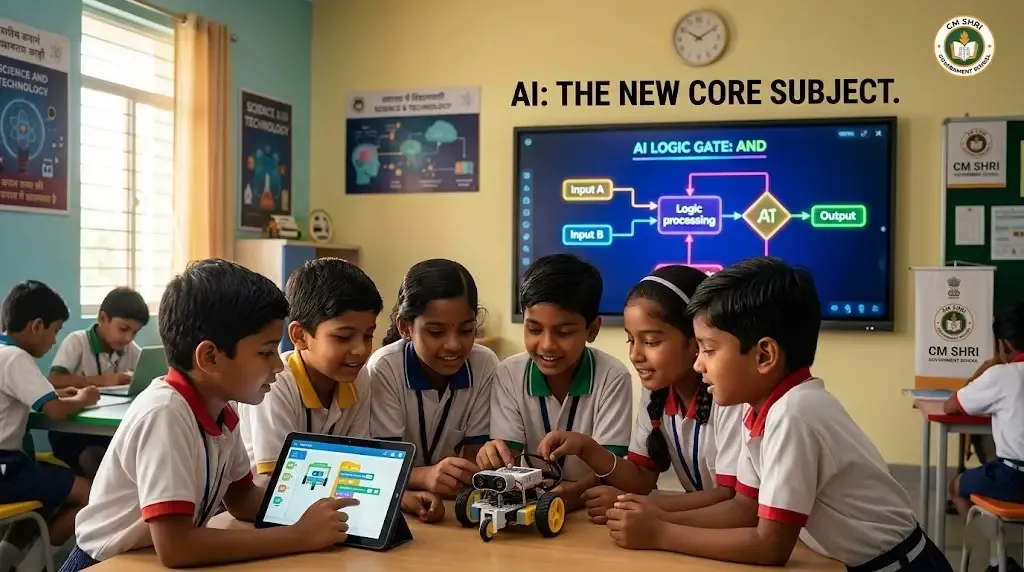
While many high-end private schools are still debating which "AI-tool" to subscribe to, government-backed initiatives like the CM SHRI and PM SHRI schools have already installed thousands of AI-enabled interactive boards and multisectoral skill labs. These labs aren't just for coding; they are spaces where 8-year-olds are learning the ethics of data, the logic of algorithms, and the basics of mechatronics. The "Digital Divide" is suddenly looking very different.
Comparison: AI Integration in 2026
| Feature | Government Schools (PM/CM SHRI) | Traditional Private Schools |
|---|---|---|
| Curriculum Status | Core Subject (From Class 3) | Often an Elective or "Skill Module" |
| Focus Area | Computational Thinking & AI Ethics | Application usage & Digital Literacy |
| Hardware Access | Standardized Skill Labs & Robotics Kits | Varies; often relies on student-owned devices |
| Cost to Student | Free (Government Funded) | High (Included in Lab/Tech Fees) |
The "Foundational Stage" Advantage
The decision to start AI education at the age of 8 (Class 3) is a calculated move to embed logic and machine intelligence understanding before rote learning habits set in. Government schools are using the "The World Around Us" (TWAU) concept, where AI learning is linked to real-life social and environmental problems. This multidisciplinary approach ensures that students don't just "use" AI, but understand its impact on the public good.
"AI literacy is the new electricity. In 2026, understanding how an algorithm makes a decision is as vital as knowing how to multiply-and our government schools are making sure no child is left in the dark."
The Private School Dilemma: Lagging in Structure?
Private schools are facing a unique challenge in 2026. While they have the infrastructure, their curricula are often fragmented. Many wait until Class 6 or 9 to introduce AI as a specialized vocational subject. In contrast, the government’s systematic, age-appropriate rollout-moving from AI literacy (Class 3-5) to AI model building (Class 9-12)-is creating a more cohesive learning path. Private education experts are now calling for a "Budget 2026 recalibration" to close this structural gap.
Official Links & Resources
| Organization | Official Website |
|---|---|
| Ministry of Education (India) | education.gov.in |
| PM SHRI Schools Portal | pmshrischools.gov.in |
| CBSE Academic (AI Section) | cbseacademic.nic.in |
Conclusion
The 2026 academic landscape is proving that innovation doesn't always follow the money. By making AI a core part of the public school curriculum, the government is leapfrogging the traditional digital divide. For private school students to keep up, institutions will need to move beyond "smart-boards" and adopt the same rigorous, foundational approach to computational thinking. As these young students from CM SHRI schools graduate to the next level, they won't just be tech-users-they will be tech-creators. The race to be "future-ready" has officially begun, and for the first time in history, the lead might be coming from the government classroom.

Written by
Palak PatelEducation writer Palak Patel covers the latest education news, board exam updates, results, and career opportunities.