
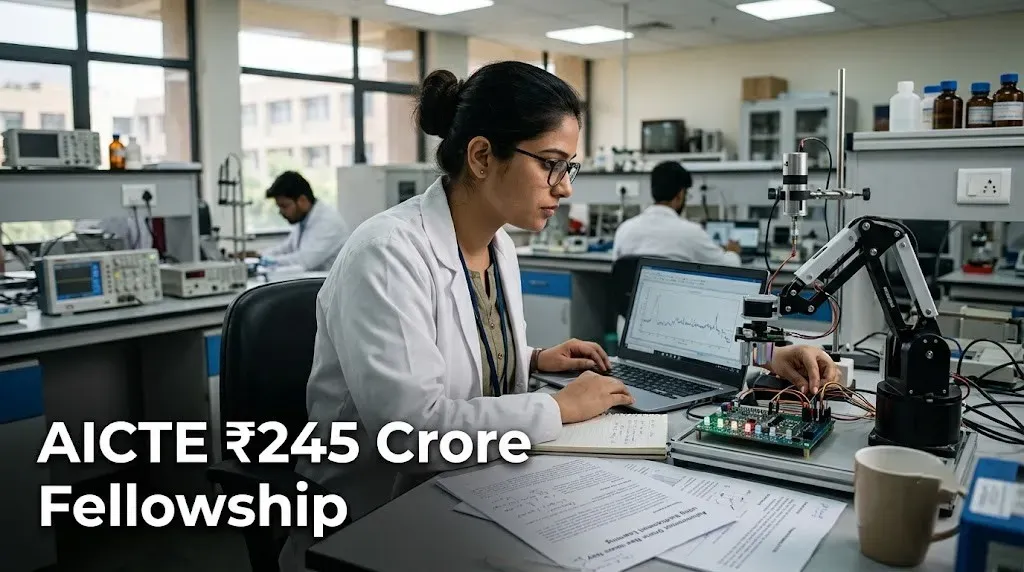
PhD research is getting a new push from the All India Council for Technical Education (AICTE). The council has launched the AICTE Innovation and Entrepreneurship Doctoral Fellowship Programme (AIEDFP), with a projected budget of ₹245 crore over five years. The programme will support 150 doctoral fellowships.
The interesting part is where AICTE wants this research to go. The fellowship is aimed at scholars working on practical problems where research could eventually lead to a product, technology, policy solution, startup, technology transfer or measurable social impact. The programme covers both technological and non-technological research areas.
| Support | What scholars can receive |
|---|---|
| Years 1–3 | ₹60,000 per month + applicable HRA |
| Years 4–5 | ₹70,000 per month + applicable HRA |
| Innovation Grant | Up to ₹10 lakh per scholar |
The Innovation Grant could be particularly useful for researchers who need money beyond their regular fellowship. It can support prototype development, testing, field trials, data collection, travel and other work needed to turn research into something that can actually be used.
AICTE also plans to connect scholars with industry, startups, research organisations and incubators. Selected researchers may get the option of six to 12 months of industrial exposure, where they can work on development, testing and validation with partner organisations.
So, who can apply? The programme is meant for eligible PhD research scholars, but AICTE's launch announcement does not yet provide the complete application notification with detailed eligibility criteria, application dates and selection procedure. Candidates should therefore wait for the formal call for applications instead of assuming that every PhD student will automatically qualify.
Another useful point is that AICTE is not limiting the idea of innovation to engineering. Social science research can also qualify when it produces meaningful policy impact, community-level interventions or social innovation. That makes the new fellowship broader than a conventional technical research funding programme.