
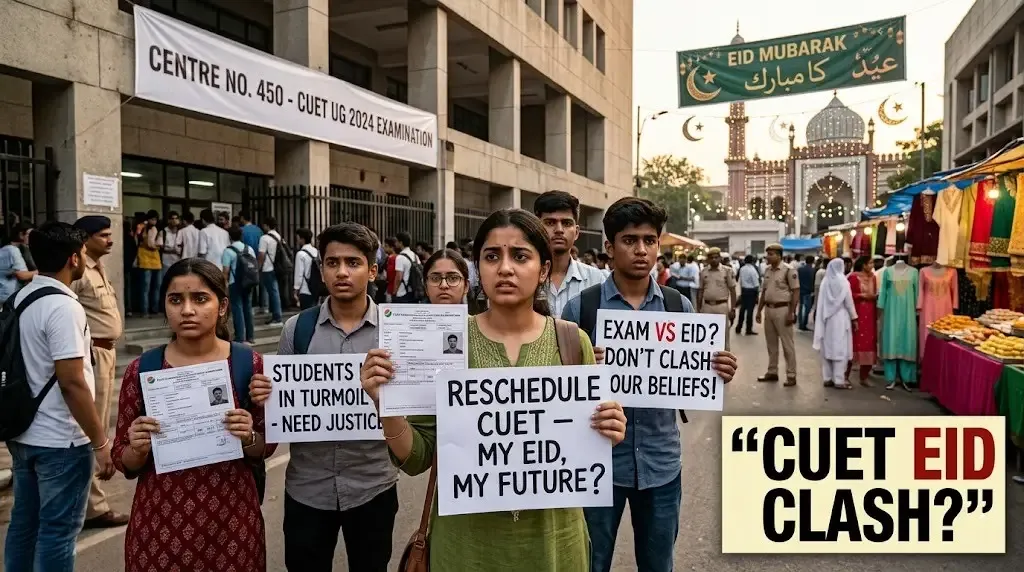
Demand Grows to Postpone CUET Exam Due to Eid Clash
Demand Grows to Postpone CUET Exam Due to Eid Clash
Pressure is growing on authorities to reconsider parts of the CUET examination schedule after student organizations raised concerns about dates overlapping with Eid-ul-Adha celebrations.
Students across several regions say the clash could create serious travel, accessibility, and logistical difficulties - especially for candidates appearing at centers far from their hometowns.
As discussions intensify online, the issue is quickly turning into another major exam scheduling debate during an already stressful admission season.
And for many students, the concern is not only about the festival itself.
It’s about whether large national entrance exams are being planned with enough practical consideration for students across different regions and communities.
Why Students Are Requesting a CUET Date Change
Student groups say the overlap may create multiple difficulties for candidates and families.
| Main Concern | Why Students Are Worried |
|---|---|
| Festival Travel | Students may need to travel long distances |
| Transport Availability | Heavy travel rush expected |
| Accessibility Issues | Exam centers may be difficult to reach |
| Family Obligations | Festival responsibilities create pressure |
| Exam Stress | Students fear unnecessary anxiety |
Many students appearing for CUET already travel between cities or states for examination centers.
During major festivals, transportation and accommodation challenges can increase sharply.
1. Students Say Scheduling Flexibility Is Possible
Student organizations argue that shifting dates slightly could avoid unnecessary complications entirely.
Some believe authorities should maintain buffer periods around major national festivals during large-scale entrance examinations.
The argument gaining traction online is simple:
If rescheduling is operationally possible, why create avoidable stress for lakhs of students?
Social media discussions around the issue have grown rapidly as students share concerns about travel and timing.
2. Travel Concerns Are Becoming a Major Issue
This is one of the biggest practical problems students mention repeatedly.
Many CUET candidates receive examination centers outside their home districts or cities.
During festival periods, students fear:
- Train crowding
- Higher ticket costs
- Road congestion
- Accommodation shortages
- Last-minute travel uncertainty
For students from smaller towns especially, reaching centers smoothly during heavy festival movement can become extremely difficult.
| Possible Travel Problem | Impact on Students |
|---|---|
| Transport delays | Risk of late arrival |
| Ticket availability issues | Higher travel stress |
| Crowded public transport | Longer travel time |
| Intercity travel pressure | Mental fatigue before exam |
3. Students Are Already Exhausted by Continuous Exam Uncertainty
The broader education environment is already tense right now.
Students across India are dealing with:
- Counselling delays
- Schedule revisions
- Exam controversies
- Admission uncertainty
- Changing timelines
Because of that, even small scheduling controversies quickly become emotionally charged online.
Many students say they simply want stability and predictability during entrance exam season.
4. Online Debate Around “Accessibility” Is Growing
Another important angle emerging in discussions is accessibility.
Student groups argue that national entrance examinations should account for practical realities affecting candidates from different social, religious, and geographic backgrounds.
Some students online say the issue is less about politics and more about equal convenience during high-pressure exams.
Others argue that rescheduling large national exams creates operational complications affecting millions of candidates.
The debate is becoming increasingly polarized online.
5. Authorities Face a Difficult Balancing Problem
Large-scale entrance exams involve enormous logistical coordination.
Changing schedules can affect:
- Examination centers
- Invigilator staffing
- Security arrangements
- University timelines
- Result processing
- Admission calendars
That’s why authorities often avoid last-minute modifications unless pressure becomes very strong.
Still, student organizations believe accommodation should remain possible when accessibility concerns affect large numbers of candidates.
| If Dates Stay Same | If Dates Change |
|---|---|
| Students face travel stress | Authorities face logistical adjustments |
| Festival overlap concerns remain | Exam timelines may shift |
| Accessibility debate continues | Operational planning becomes harder |
6. Social Media Is Amplifying Student Voices Rapidly
Hashtags and student discussions around CUET scheduling concerns are spreading quickly across platforms.
Students are using:
- X discussions
- Instagram pages
- Telegram groups
- Student union accounts
- YouTube commentary
to push for greater flexibility.
This reflects a larger change in Indian education debates.
Students now organize and amplify concerns online much faster than before.
7. The Bigger Issue Is Exam Planning Sensitivity
The controversy highlights a larger conversation around national entrance exam planning.
Students increasingly expect examination authorities to account for:
- Festival calendars
- Regional accessibility
- Travel realities
- Mental stress
- Logistical convenience
during scheduling decisions.
Many believe exam systems need more student-centric planning as competition and pressure continue rising every year.
Conclusion
The demand to postpone parts of the CUET exam schedule due to Eid-ul-Adha overlap is quickly becoming another major education debate.
Student organizations argue that travel difficulties, accessibility concerns, and festival-related pressure could unfairly affect candidates appearing for one of India’s biggest entrance exams.
Authorities now face a difficult balancing act between operational logistics and student convenience.
But one thing is already clear:
Students increasingly expect national exam systems to become more flexible, transparent, and sensitive to real-world challenges affecting candidates.
Written by
MonishMonish is an education writer covering exams, student rights, academic awareness, and other education-related topics, with practical guidance for students.