
Supreme Court to Hear Petition Challenging CBSE’s Three-Language Policy for Class 9 Next Week
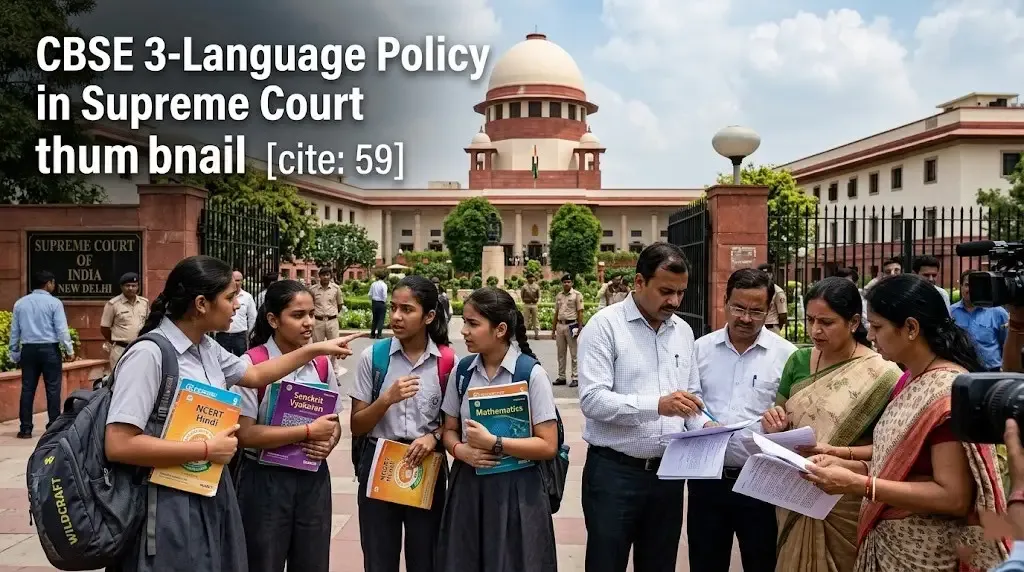
Supreme Court to Hear Petition Against CBSE’s New Three-Language Policy
The debate around CBSE’s new three-language policy has now officially reached the Supreme Court. A petition challenging the policy was mentioned before the apex court this week, and the matter is expected to be heard next week.
The issue started after CBSE announced that from the 2026–27 academic session, Class 9 students would have to study three languages, with at least two being Indian languages. The decision immediately triggered criticism from parents, teachers, and education groups in several states.
Many people are not even arguing against learning languages itself. Their concern is the timing. Schools have already started academic sessions, students have chosen subjects, and suddenly changing language requirements in Class 9 feels rushed to many families.
Senior advocate Mukul Rohatgi, while mentioning the matter before the court, reportedly argued that introducing additional compulsory languages at this stage could create “chaos” for students preparing for board examinations.
What Exactly Is the New CBSE Rule?
According to the new CBSE circular, students entering Class 9 from July 2026 will have to study three languages. Out of those three, at least two must be native Indian languages.
| Policy Detail | New Requirement |
|---|---|
| Applicable Class | Class 9 onwards |
| Implementation Year | 2026–27 Session |
| Total Languages Required | Three |
| Indian Languages Requirement | At least two Indian languages |
| Policy Basis | NEP 2020 and NCF 2023 |
CBSE says the move follows the National Education Policy (NEP) 2020 and aims to promote multilingual learning and cultural understanding among students.
Why Are Parents and Teachers Opposing It?
The opposition is mostly about implementation, not language learning itself.
Parents say students entering Class 9 are already under pressure because board exam preparation starts becoming serious from this stage. Adding another compulsory language suddenly could increase stress levels.
Teachers and school administrators are also worried about practical problems. Many schools may not have trained teachers for multiple regional languages. Textbooks, schedules, and exam structures may also need major adjustments within a short period.
The petition reportedly claims the sudden change may negatively affect academic stability and create confusion for students across CBSE-affiliated schools.
States Like Tamil Nadu Are Watching Closely
The issue has also become politically sensitive in some states, especially Tamil Nadu, where language policies have historically triggered strong reactions.
Critics there see the move as another attempt at centralised language control. Supporters of the policy, however, argue that multilingual education can help students connect better with India’s linguistic diversity.
What makes this debate complicated is that both sides believe they are protecting students’ interests. One side talks about educational flexibility and cultural exposure. The other talks about academic pressure and practical feasibility.
What Happens Next?
The Supreme Court has agreed to list the matter for hearing next week after an urgent request was made before the bench.
The court is expected to examine whether the sudden implementation of the policy violates students’ academic interests or whether CBSE acted within its powers under NEP 2020.
For now, schools, parents, and students are waiting for clarity. Many schools are unsure whether they should begin restructuring language options immediately or wait for further directions.
Why This Case Matters Beyond CBSE
This is not just about one circular anymore. The case touches a much larger national debate — how education reforms should actually be implemented in India.
Big policy changes often sound good on paper. But schools operate in the real world, where teacher shortages, timetable limitations, and student pressure are daily realities.
The Supreme Court hearing next week could become an important moment in deciding how future education reforms are rolled out across the country.

Written by
Palak PatelEducation writer Palak Patel covers the latest education news, board exam updates, results, and career opportunities.
Comments
No comments yet. Be the first!