
NTA Casually Ignored Supreme Court’s Warning After 2024 Paper Leak Crisis
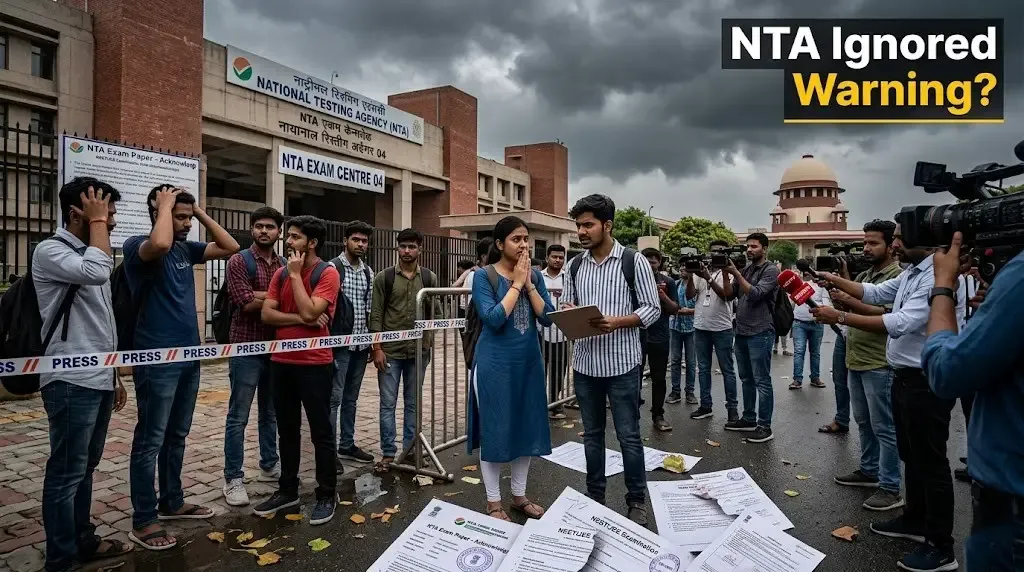
NTA Was Asked To Fix The System. Students Say Almost Nothing Changed.
When the 2024 exam leak controversy exploded across India, millions of students expected one thing afterward - accountability.
Instead, what followed was a strange mix of silence, defensive press statements, and promises that never fully translated into visible reforms. The National Testing Agency, which conducts some of India’s biggest entrance exams including NEET and CUET, came under massive public pressure after allegations of paper leaks, irregularities, and questionable exam management surfaced nationwide.
The issue became so serious that the Supreme Court of India itself stepped in. During hearings related to the NEET controversy, the court made it clear that even a small breach in such examinations damages trust in the entire education system.
That line hit students hard. Because honestly, most aspirants already knew that trust was collapsing.
For lakhs of families, competitive exams are not just tests. They are years of savings, coaching fees, sleepless nights, pressure from relatives, and sometimes the only escape from financial struggle. So when reports of leaks and unfairness emerge, students don’t see it as “an incident.” They see it as betrayal.
The Supreme Court’s Message Was Direct
After the controversy, the court pushed for stronger examination safeguards, better digital monitoring, stricter handling of question papers, and structural improvements in the system.
Legal experts and education observers expected the NTA to immediately begin a visible overhaul. Some thought there would be major technological reforms, stricter transparency rules, independent audits, or even a restructuring of how sensitive exams are conducted.
But months later, many students and teachers say the visible changes feel surprisingly limited.
| Major Concerns Raised in 2024 | Status Students Expected | Public Perception Now |
|---|---|---|
| Paper leak allegations | Complete security overhaul | Unclear visible reforms |
| Transparency concerns | Public audit mechanisms | Limited communication |
| Exam center irregularities | Stricter monitoring | Mixed confidence among students |
| Grace marks controversy | Clear policy disclosure | Confusion still remains |
That gap between what people expected and what actually happened is exactly why criticism has returned again.
Students Are Not Just Angry. They’re Exhausted.
One thing many policymakers still underestimate is how emotionally draining these controversies become for students.
A NEET or JEE aspirant already studies under brutal pressure. Coaching institutes dominate entire cities like Kota. Families spend huge portions of their income preparing children for a single exam day. Mental health issues among aspirants are openly discussed now in a way they were not five years ago.
So when authorities appear casual after a nationwide controversy, students notice it immediately.
On social media platforms, many aspirants have repeatedly questioned why large-scale reforms have not been publicly demonstrated with full transparency. Some demanded independent cyber-security audits. Others asked why responsibility rarely seems to reach senior administrative levels.
And to be fair, this frustration did not appear from nowhere.
The Trust Problem Is Bigger Than One Exam
India’s competitive exam ecosystem runs almost entirely on belief. Students believe the exam is fair. Parents believe hard work still matters. Coaching institutes market themselves around that belief too.
The moment students begin thinking the system itself may be compromised, the entire structure weakens.
That is why many education experts argued the 2024 controversy should have become a turning point for exam governance in India. Not just damage control for one cycle.
Instead, critics argue the response looked reactive rather than transformational.
Several students online even joked that every year authorities promise “strict measures” while the same concerns return in slightly different forms. It sounds sarcastic, but underneath the jokes there is real distrust growing.
Technology Alone Cannot Fix This
Some people immediately suggest AI surveillance, encrypted papers, biometric verification, or stricter digital systems. Those tools may help. But experts say the deeper issue is institutional accountability.
If students do not clearly see consequences after failures, public confidence does not recover.
That is partly why the Supreme Court’s intervention mattered so much. The court essentially signaled that examination integrity is now a national concern, not merely an administrative inconvenience.
| What Students Want | Why It Matters |
|---|---|
| Transparent investigation reports | Restores public trust |
| Clear accountability | Shows consequences exist |
| Improved exam security | Prevents future controversies |
| Better communication from NTA | Reduces panic and misinformation |
The Bigger Question Now
The uncomfortable question many students are asking today is simple: if a crisis of this scale did not force major visible reform, then what exactly will?
Because from the outside, it increasingly feels like outrage comes in waves, headlines trend for a few weeks, hearings happen, statements are released, and eventually the system moves on while students remain stuck with the same uncertainty.
And that uncertainty is dangerous for any education system.
India produces some of the world’s most competitive exam environments. But competition only works when students believe the rules apply equally to everyone.
Right now, that belief looks weaker than it should.
Conclusion
The 2024 controversy was supposed to be a wake-up call for India’s examination system. The Supreme Court clearly signaled that public trust cannot be treated casually when millions of careers are involved.
Yet many students today feel the urgency shown in court never truly translated into visible structural reform on the ground.
Whether the NTA eventually restores confidence will depend less on official statements and more on whether future exams genuinely look safer, fairer, and more transparent than before.
Because after what happened in 2024, students are no longer willing to trust the system blindly.

Written by
MonishMonish is an education writer covering exams, student rights, academic awareness, and other education-related topics, with practical guidance for students.