
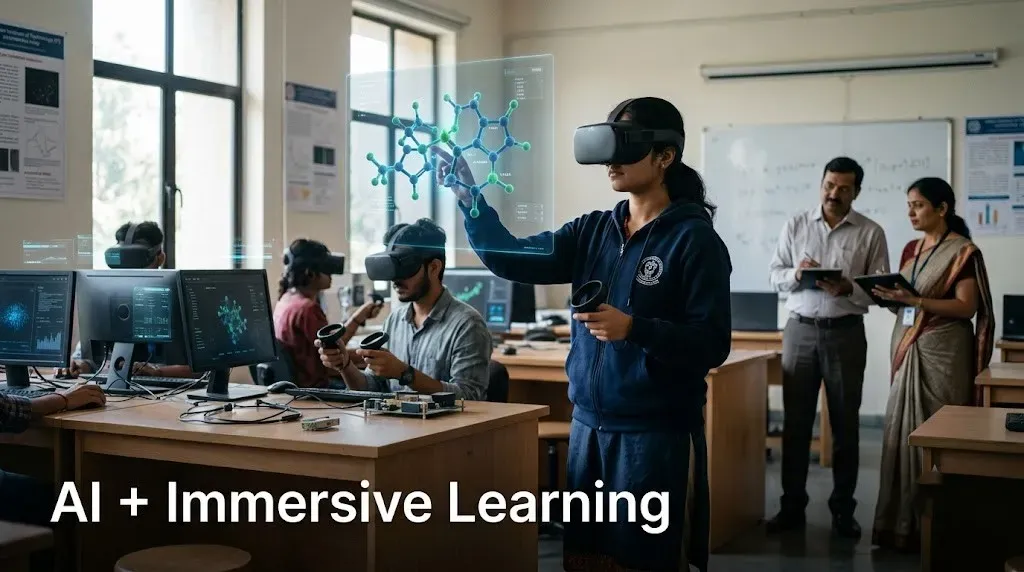
IIT Madras and UNESCO's Mahatma Gandhi Institute of Education for Peace and Sustainable Development are bringing together two areas that are quickly changing education, artificial intelligence and immersive technology. The focus is on exploring ways technology can make learning more interactive while keeping human skills such as empathy, judgement and communication at the centre.
For students, this could eventually mean learning environments that feel very different from a conventional classroom. Instead of only reading about a scientific process or watching a video, learners could interact with digital environments through virtual or extended reality and use AI-supported tools to explore concepts at their own pace.
| Technology | Possible learning use |
|---|---|
| Artificial Intelligence | Personalised feedback, learning support and tools that adapt content to individual students. |
| Virtual and Extended Reality | Students can explore simulated environments and concepts that are difficult to experience inside a normal classroom. |
| Multimodal learning | Lessons can combine visual, interactive and practical elements instead of depending entirely on text. |
| Social and emotional learning | Technology can be designed around empathy, reflection and collaboration rather than academic scores alone. |
The connection makes sense because both organisations are already working in related areas. IIT Madras' Experiential Technology Innovation Center, or XTIC, focuses on VR, AR, MR and haptics, while UNESCO MGIEP has spent years developing digital pedagogies and AI-supported learning platforms. At an IIT Madras XR symposium, UNESCO MGIEP Director Dr Obijiofor Aginam highlighted the need for emerging technologies to complement human guidance rather than replace it.
That human-centred part is worth paying attention to. AI can provide explanations quickly, generate practice material and give students feedback, but it also has limitations. UNESCO MGIEP has warned that AI-generated information can be inaccurate and that excessive dependence on AI can reduce opportunities for students to develop their own reading, writing and critical-thinking abilities.
Immersive technology brings a different advantage. A student learning about a complex machine, for example, could potentially inspect a virtual model from different angles instead of relying on a static diagram. IIT Madras' XTIC already operates an AR/VR Studio and Haptics Lab where students can work with immersive technologies and develop projects.
The combination of AI and XR could make these experiences more responsive. IIT Madras' XTIC says it is exploring the integration of AI and machine learning with XR so that virtual environments can become more personalised, responsive and intelligent. That could eventually allow educational simulations to react to what a learner does instead of simply presenting the same sequence to everyone.
There is also a practical challenge. Advanced headsets, computing equipment and well-designed digital content can be expensive, so the technology will have limited educational value if only a small group of well-funded institutions can use it. UNESCO MGIEP's work on digital pedagogy has repeatedly focused on scalable learning experiences, while IIT Madras has been developing programmes aimed at spreading XR skills beyond its own campus.
For students, the most interesting outcome will therefore be what comes out of the research and collaboration in the form of actual learning tools, courses and experiences. AI and immersive technology are already available. The harder task is designing them so that students learn more deeply rather than simply spending more time looking at a screen.