
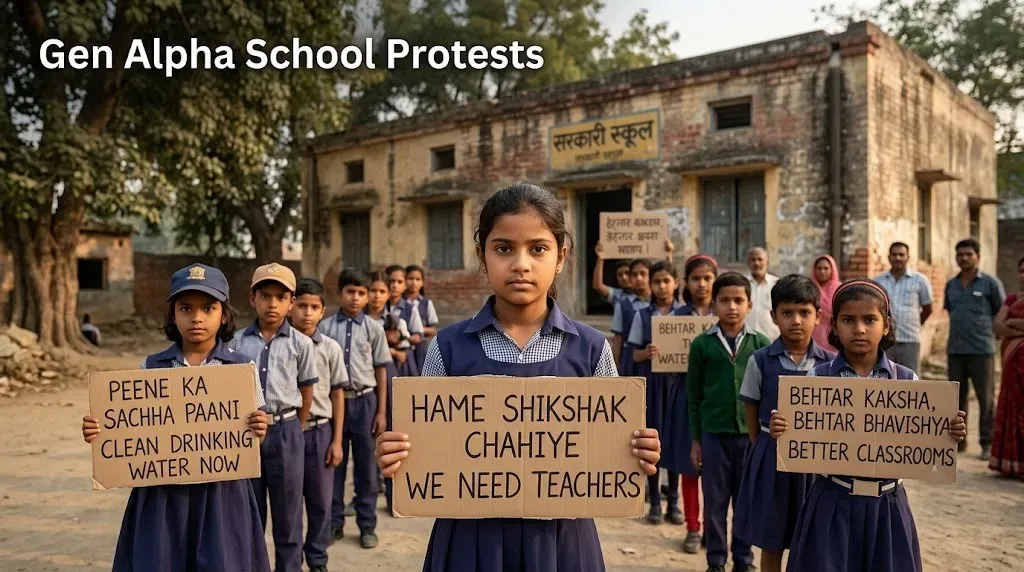
School students across Uttar Pradesh, Rajasthan, Bihar, Madhya Pradesh and other parts of India have been taking their complaints outside the classroom. These recent Gen Alpha protests are focused on things students encounter every day, missing teachers, poor-quality food, unsafe buildings, dirty toilets, unreliable electricity and the absence of basic learning facilities.
The protests have taken different forms. Some students boycotted classes, others blocked roads or marched to government offices, while students at one residential school in Kannauj locked themselves inside their hostel rooms after complaining about the quality of food. The common thread is that students say repeated complaints did not produce quick enough action.
| Where students protested | Main concern raised |
|---|---|
| Fatehpur, Uttar Pradesh | Around 1,500 students demanded clean drinking water, working fans, furniture and better school facilities. |
| Lucknow, Uttar Pradesh | Students protested over missing subject teachers, poor food and other basic problems affecting their studies. |
| Kishanpur, Uttar Pradesh | Students from Classes 6 to 12 raised concerns about drinking water, toilets, electricity, fans, furniture and the lack of a computer lab and library. |
| Jaipur, Rajasthan | Students with hearing and speech disabilities protested over unhygienic toilets, drinking-water shortages and the condition of their school building. |
Teacher shortages have become one of the most repeated complaints. In Lucknow, students at Jai Prakash Narayan Sarvodaya Vidyalaya said their science stream had only one chemistry teacher, with no teachers for physics and biology. With board examinations approaching, students said the shortage was directly affecting their preparation and even their ability to follow online classes.
The problem is not limited to one school. Students at Smith Inter College in Azamgarh also protested over vacancies in Physics, Chemistry and Mathematics, with students alleging that the school had been without regular Chemistry and Physics teachers for years. In Unnao, students raised teacher shortages alongside complaints about food and drinking water.
Buildings and basic infrastructure are another recurring issue. In Bhatpurwa Samuhi village in Uttar Pradesh, students protested after part of their existing primary-school building was demolished and a replacement had remained pending. In Rajasthan, students at a school for deaf students complained about a dilapidated building along with sanitation and drinking-water problems.
Government data shows why these complaints deserve attention beyond the individual schools involved. The latest UDISE+ system tracks infrastructure and staffing across India's school system. The Ministry of Education's UDISE+ portal provides the official school-education data used to assess these gaps. The 2024-25 data, for example, records more than 14.7 lakh schools and over one crore teachers across India.
One reason the recent protests stand out is how quickly local school problems are becoming public issues. Students are using demonstrations, videos and social media to draw attention when conversations inside the school do not appear to work. Some protests have already produced action, including assurances on repairs, drinking water and other facilities.
The bigger test will come after the cameras leave. A promise to appoint teachers or repair a building matters only when students actually see the change in their classrooms. For children preparing for board examinations, even a few months without the right teacher can have consequences that a later administrative order cannot easily undo.