
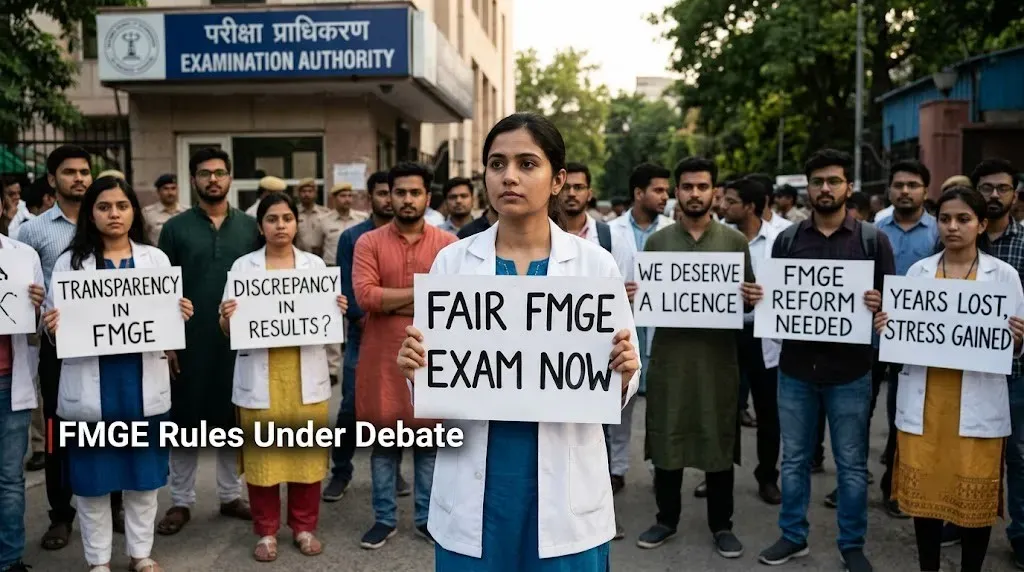
Foreign medical graduates have been protesting over the June 2026 Foreign Medical Graduate Examination after just 12.38% of the 37,448 candidates who appeared were declared qualified. Students have raised concerns about the difficulty of the paper, the introduction of video-based questions and the transparency of the evaluation process.
The protests continued in Delhi even after the National Board of Examinations in Medical Sciences agreed to examine the complaints. Candidates were particularly unhappy that the review process did not recommend compensation or grace marks for those who appeared in the June examination. The latest discussions have now produced several changes for future FMGE attempts.
| Issue raised by FMGs | Latest position |
|---|---|
| Difficulty of the June paper | NBEMS has agreed to rationalise the difficulty level in future examinations. |
| Video-based questions | Future use of multimedia questions is expected to come with advance information for candidates. |
| Number of exam opportunities | An additional FMGE will be held by the end of October 2026, taking the number of attempts in the year to three. |
| June 2026 compensation | No grace marks or lowering of the qualifying standard has been announced for the June batch. |
The video-question issue became one of the biggest flashpoints. Protesters said candidates encountered clinical questions containing video or multimedia material without enough advance information. Their argument was that watching the clip, reading the question and analysing the options could take valuable time in an examination where candidates already have to move quickly through the paper.
An independent committee examining the complaints recommended that candidates should be informed sufficiently in advance if multimedia questions are included. It also recommended deferring the reintroduction of video-based questions for at least a year. For students, that recommendation has become an important part of the argument that the examination format needs clearer communication before candidates enter the test centre.
The protesters have also demanded greater transparency around the examination. Candidates sought access to the answer key and response information so that disputed questions could be examined properly. NBEMS has maintained that the competency standard cannot be lowered because FMGE is a licensing screening test for doctors who want to practise medicine in India.
That distinction matters. The latest agreement does not mean the June 2026 candidates have been declared qualified or that the passing requirement has been reduced. NBEMS has instead moved towards changing the examination process for future candidates while keeping the existing qualifying standard in place.
One major change is the addition of another FMGE attempt in 2026. NBEMS will conduct the extra examination by the end of October, giving eligible candidates an earlier opportunity to appear instead of waiting for the next regular cycle. The examination will subsequently move to three attempts a year, according to the latest announcement.
The dispute also highlights a longer-running problem for foreign medical graduates. Passing FMGE is only one stage before registration and medical practice in India. Candidates can also face issues around internship requirements, recognition of training and regulatory documentation. The National Medical Commission has published separate clarifications and rules for FMGs, including requirements connected with Compulsory Rotating Medical Internship.
Students preparing for FMGE should therefore follow notices from NBEMS FMGE and the National Medical Commission rather than relying on social-media updates. The October opportunity gives some candidates more time, but the qualifying bar itself remains in place.