
Colleges Are Suddenly Promoting AI Campuses Instead of Placements
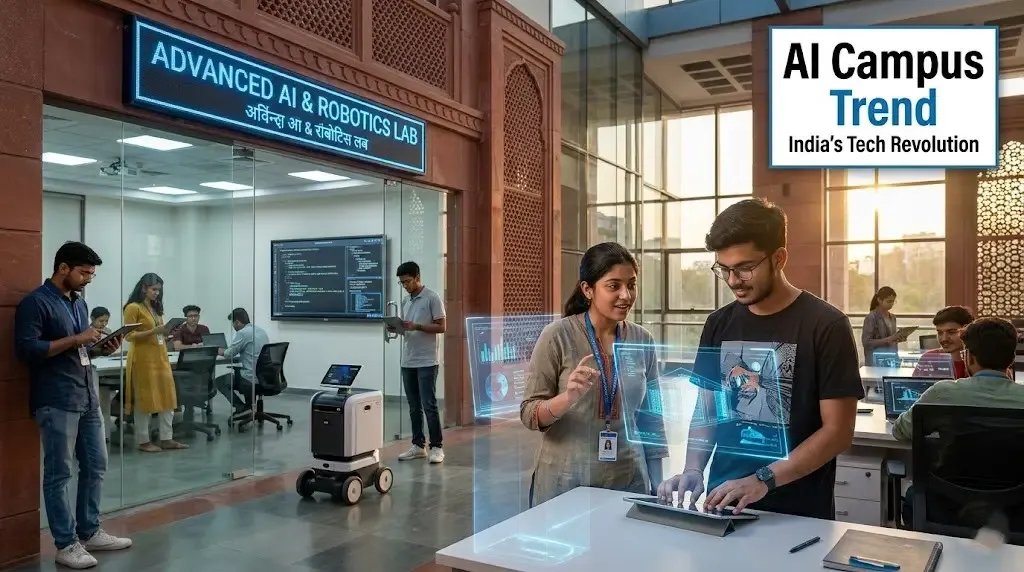
Colleges Are Suddenly Promoting AI Campuses Instead of Placements
Something changed in college advertisements recently.
For years, Indian universities mainly sold one dream:
Placements.
Huge salary packages, recruiter logos, and “100% placement” banners dominated admission campaigns everywhere.
Now a different trend is appearing rapidly.
Suddenly colleges are talking about:
- AI-powered campuses
- Smart classrooms
- Artificial intelligence labs
- Tech partnerships
- Automation learning
- Future-ready education
The word “AI” is now everywhere in university marketing.
And students are starting to wonder:
Is this genuine innovation?
Or simply the newest admissions buzzword?
The New AI Branding Wave in Colleges
| Old College Marketing | New College Marketing |
|---|---|
| Highest packages | AI-ready campuses |
| Recruiter logos | Tech partnerships |
| Placement percentages | Innovation ecosystems |
| Corporate tie-ups | AI labs & automation centers |
The shift is happening surprisingly fast.
AI became one of the strongest keywords in education marketing almost overnight.
1. AI Became the New “Future-Proof” Selling Point
Colleges understand something important now.
Students are increasingly anxious about the future.
Automation, ChatGPT, AI-generated coding, and changing hiring trends created fear around traditional careers.
So universities are positioning themselves as “future-ready” institutions prepared for the AI era.
The message is subtle but powerful:
“Join us, and you won’t become outdated.”
That marketing works because students genuinely worry about employability now.
2. Smart Classrooms and AI Labs Are Everywhere Suddenly
Many campuses now promote:
- AI innovation labs
- Digital classrooms
- Automation systems
- Virtual simulation centers
- Machine learning courses
- Cloud computing infrastructure
Some institutions genuinely invest heavily in modern infrastructure.
Others appear to be adding AI branding much faster than actual curriculum transformation.
Students often struggle to judge the difference during admission season.
| Common AI Campus Feature | Student Appeal |
|---|---|
| AI Labs | Feels industry-oriented |
| Smart Boards | Modern classroom image |
| Industry Tie-Ups | Career relevance perception |
| AI Certifications | Future-proof career hope |
3. Placement Marketing Became More Difficult Recently
This shift is not happening randomly.
Placement discussions became more controversial over the past few years.
Students increasingly question:
- Average package reality
- Median salaries
- Placement transparency
- Mass recruiter dependence
- Low in-hand salaries
Because of that, colleges may find AI branding safer and more aspirational than aggressive placement claims alone.
AI creates excitement without requiring direct salary comparisons immediately.
4. Students Now Expect AI Exposure From Colleges
This expectation changed incredibly fast.
A few years ago, students mainly looked for:
- Placements
- Infrastructure
- Hostels
- Fees
- Location
Now many students actively ask:
- Do they teach AI?
- Are there machine learning labs?
- Do students get AI projects?
- Any tech partnerships?
- Does the curriculum include automation tools?
AI became a major admission factor almost unexpectedly.
5. Some AI Campuses Are More Branding Than Reality
This is where skepticism appears.
Students increasingly wonder whether every “AI-powered campus” actually delivers meaningful education changes.
Sometimes the reality may involve:
- One AI lab room
- Short certification programs
- Basic chatbot demonstrations
- Marketing-heavy partnerships
- Minimal curriculum integration
Meanwhile advertisements create extremely futuristic impressions.
That gap is already becoming a discussion topic across student communities.
| Possible AI Marketing Problem | Student Concern |
|---|---|
| Buzzword usage | Little actual implementation |
| Outdated faculty training | Weak practical exposure |
| Limited real projects | Surface-level AI education |
| Marketing-first approach | Mismatch between ads and reality |
6. AI Partnerships Became Prestige Symbols
Universities now aggressively announce collaborations with:
- Tech companies
- Cloud providers
- AI certification platforms
- Automation startups
- EdTech firms
These partnerships help institutions appear modern and industry-connected.
For students, the perception matters psychologically.
Colleges want to signal they are not stuck teaching outdated curriculum anymore.
7. The Bigger Fear Is Becoming Outdated
The AI campus trend reflects something deeper.
Students increasingly fear graduating into a world changing faster than traditional education systems.
That fear explains why:
- Cybersecurity exploded
- AI courses became popular
- Freelancing increased
- Online certifications matter more
- Skill-based learning grew rapidly
Colleges understand students now want proof that education remains relevant.
AI branding became a shortcut to communicate that relevance.
8. The Real Question Is Whether Curriculum Actually Changes
Smart classrooms alone do not automatically create strong education.
The real test is whether colleges genuinely improve:
- Industry alignment
- Practical projects
- Faculty training
- Modern tools
- AI integration
- Career readiness
Students are becoming much smarter about spotting the difference between real innovation and admission marketing.
That skepticism will probably grow stronger over time.
Conclusion
Indian colleges are rapidly shifting from traditional placement-focused marketing toward AI-driven campus branding.
Smart classrooms, AI labs, automation partnerships, and “future-ready” education are becoming major admission selling points across universities.
Partly because students genuinely want modern skills.
And partly because AI became one of the strongest psychological trends in education right now.
Some colleges are making real technological investments.
Others may simply be racing to look “AI ready” before competitors do.
The challenge for students now is separating genuine innovation from futuristic branding hype.

Written by
MonishMonish is an education writer covering exams, student rights, academic awareness, and other education-related topics, with practical guidance for students.