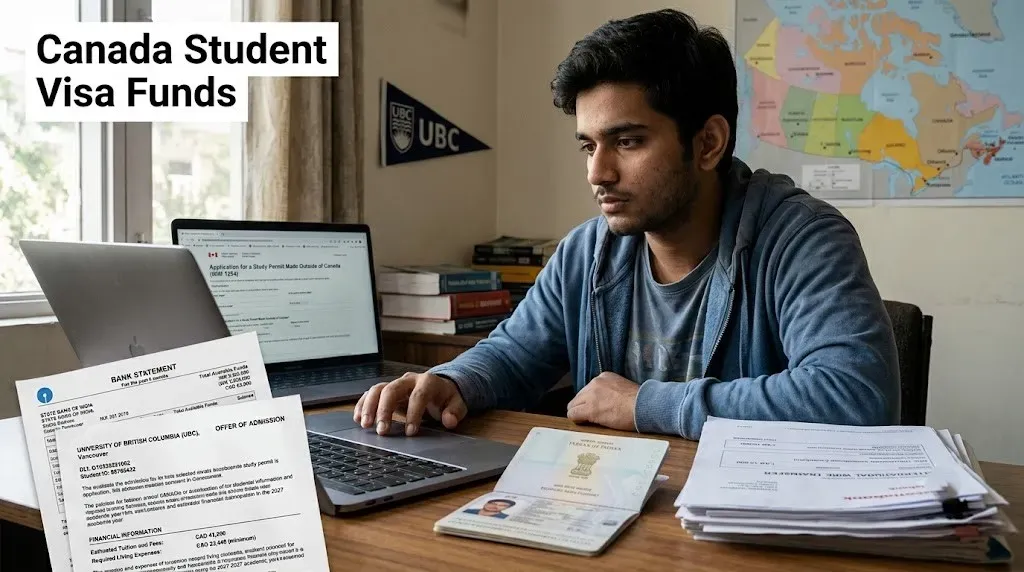
Canada has increased the amount international students must show for living expenses when applying for a study permit. From September 1, 2026, a single student applying to study outside Quebec needs to demonstrate CAN$23,448 for one year of living expenses, compared with CAN$22,895 under the previous requirement.
For Indian students planning to study in Canada, the change means the financial documents submitted with a new study permit application need to reflect the updated amount. The figure covers living expenses only. Tuition fees and transportation costs are separate and must also be accounted for.
| Application timing | Living funds required for 1 student |
|---|---|
| January 1, 2025 to August 31, 2026 | CAN$22,895 |
| From September 1, 2026 | CAN$23,448 |
| Increase | CAN$553, before tuition and travel costs |
The updated requirement applies to applications made on or after September 1. Canada reviews these amounts every year using cost-of-living data, so the threshold is not a fixed figure that stays unchanged for the entire duration of a student's degree. The official Canadian government financial-support guidance now lists CAN$23,448 for one applicant outside Quebec.
Students should also understand what this number does not cover. Paying the first year's tuition does not remove the living-expense requirement, and showing CAN$23,448 does not by itself cover airfare or other transportation costs. IRCC says applicants must demonstrate funds for tuition, living expenses and transportation.
The financial requirement also increases when family members accompany the student. For two people, the new annual living-expense amount is CAN$29,192. For a family of four, it rises to CAN$43,572, again excluding tuition and transportation.
This does not mean students have to keep the entire amount sitting in one bank account. IRCC accepts different forms of financial evidence, including bank statements, education loans, scholarships and proof of financial support. The department also assesses the source of the funds, so applicants need documents that make the financial position understandable rather than simply showing a large unexplained balance.
For longer programmes, there is another detail that applicants sometimes overlook. IRCC asks students to show enough resources for the first year and explain how they plan to finance the remaining years of the programme. A scholarship covering more than one year, parental employment or other continuing financial support can be used as evidence.
The higher threshold is part of Canada's broader effort to reduce financial vulnerability among international students. The government has been adjusting the international student programme, including study-permit application controls and measures intended to ensure students have enough money to support themselves while studying.