
Smart Classrooms vs. Traditional Classrooms: The 2026 Educational Showdown
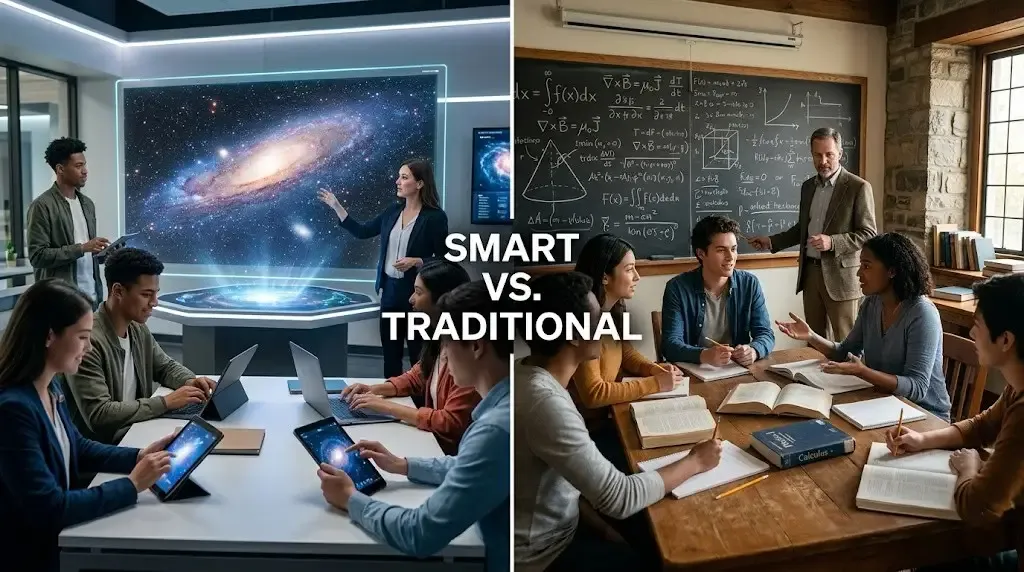
The Evolution of Learning: Smart Classes vs. Traditional Chalk-and-Talk
Education has undergone a massive transformation over the last decade. In 2026, the question is no longer just "what" we learn, but "how" we learn it. Traditional Classrooms, with their physical textbooks and face-to-face lectures, have been the backbone of society for centuries. On the other hand, Smart Classrooms-integrated with AI, VR, and interactive displays-offer a futuristic approach that caters to the "digital native" generation.
But does a high-tech screen always lead to better grades? Or is there something irreplaceable about the scratch of a pen on paper and the immediate emotional connection of a live teacher? To understand which is "better," we need to look at how they perform in real-world scenarios, from student engagement to the retention of complex concepts.
Head-to-Head Comparison: Smart vs. Traditional
| Feature | Smart Classrooms | Traditional Classrooms |
|---|---|---|
| Engagement | High; uses multimedia, gamification, and 3D visuals. | Moderate; relies on the teacher's storytelling and charisma. |
| Pacing | Personalized; AI can adapt speed to individual students. | Uniform; the whole class moves at one speed. |
| Resources | Infinite; access to global databases and virtual labs. | Limited; relies on physical books and local equipment. |
| Social Interaction | Digital; collaboration often happens via software. | Deep; emphasizes eye contact, body language, and physical teamwork. |
| Distractions | High potential; students can stray to non-educational sites. | Low; focus is strictly on the physical teacher and text. |
The Case for Smart Classrooms
Smart classrooms aren't just about "fancy screens." They are about accessibility and visualization. For instance, explaining the solar system is easier when students can "fly" through it in Virtual Reality. In 2026, these classrooms are also equipped with AI assistants that help teachers identify which students are struggling in real-time, allowing for instant intervention before a child falls behind.
"Smart classrooms bridge the gap between abstract theory and visual reality, making learning an experience rather than a chore."
The Strength of Traditional Education
Despite the tech boom, many elite schools are returning to "low-tech" roots. Why? Because Traditional Classrooms foster discipline and critical thinking without the crutch of Google. They prioritize the human element-mentorship, empathy, and social ethics-which are hard to replicate through a screen. Furthermore, traditional methods help improve fine motor skills and long-term memory through the physical act of writing.
The Final Verdict: Is One Truly Better?
In 2026, the consensus among education experts is moving toward the Hybrid Model. The "better" classroom is one that uses Smart Technology for visualization and data-tracking but retains Traditional methods for social interaction and deep, focused study. Technology should be a tool used to enhance the teacher, not replace the human connection that defines true education.
Conclusion
Whether you prefer the high-speed interactivity of a Smart Classroom or the grounded, focused nature of a Traditional one, the goal remains the same: preparing students for a world that requires both tech-savviness and human intelligence. For most institutions, the perfect balance lies somewhere in the middle-leveraging the best of both worlds to create a holistic learning environment.

Written by
Palak PatelEducation writer Palak Patel covers the latest education news, board exam updates, results, and career opportunities.