Fake Degree Colleges 2026: How to Check If a University Is Genuine or Not
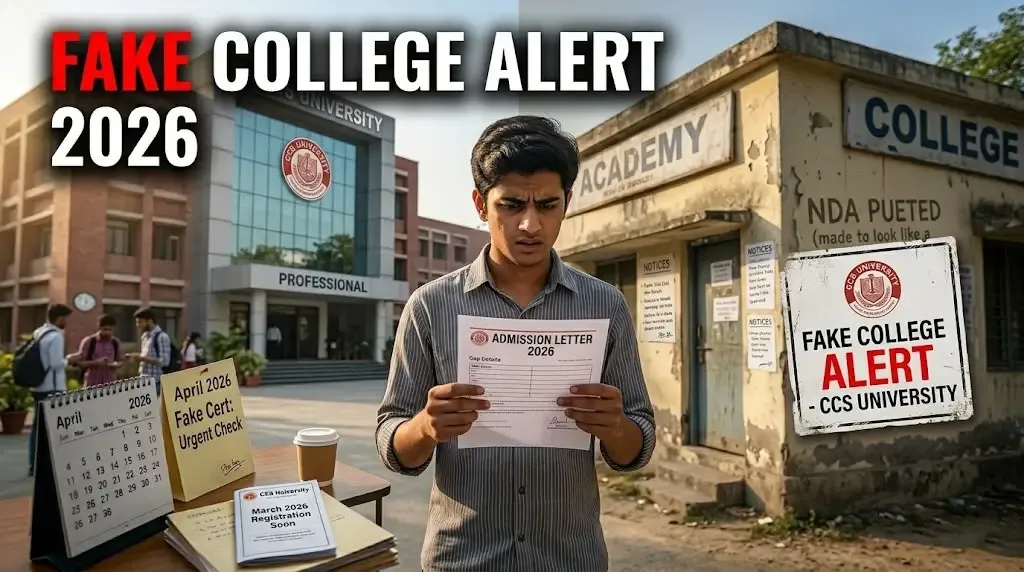
It still happens in 2026. Students pay fees, attend classes for months, and then discover the degree isn’t even valid.
The scary part? Most fake colleges don’t look fake. They have websites, offices, even “admission counselors” who sound convincing.
So how do you actually spot the difference before it’s too late?
What Exactly Is a Fake College?
A fake college or university is one that is not approved by official education authorities but still offers degrees.
These institutions operate without recognition, meaning their degrees are not valid for jobs, higher studies, or government exams.
Quick Checklist to Identify Approved Universities
| Check Point | What to Verify |
|---|---|
| UGC Approval | Must be listed on official UGC website |
| AICTE Approval (for technical courses) | Required for engineering, MBA, etc. |
| NAAC Accreditation | Shows quality rating |
| Official Website | Check domain authenticity (.edu / official links) |
If even one of these is missing, pause and verify properly.
How to Verify a College in 2026 (Step-by-Step)
Don’t rely on ads or agents. Do your own check:
1. Visit the official UGC website and search the university name
2. Check AICTE approval if it’s a technical course
3. Look for NAAC grade (optional but important)
4. Search the college name + “fake or scam” on Google
Yes, that last step sounds simple-but it has saved many students.
Red Flags You Should Never Ignore
Some signs are almost always a warning:
- “100% admission guarantee” claims
- No entrance exam or eligibility checks
- Heavy discounts or pressure to pay quickly
- No proper campus or infrastructure
If it feels rushed or too easy, something is off.
Common Fake Degree Scams in India
| Type of Scam | How It Works |
|---|---|
| Distance Learning Scam | Offers degrees without classes or exams |
| Fake Affiliation | Claims tie-up with known universities |
| Duplicate Websites | Copies real college websites |
| Agent-Based Admission | Agents promise “direct admission” |
These scams evolve every year-but the pattern stays similar.
Real Consequences Students Face
This is where things get serious.
- Degree becomes useless
- Not eligible for government jobs
- Problems in higher education admissions
- Complete loss of time and money
Many students only realize this after 2–3 years. By then, it’s too late.
Smart Tips Before Taking Admission
- Always verify from official websites, not WhatsApp messages
- Visit the campus if possible
- Talk to current students
- Never rush fee payment
Taking one extra day to verify can save years of regret.
Conclusion
Fake colleges don’t look fake anymore-that’s the real danger.
The responsibility is now on students to verify before trusting any institution.
Simple rule: if the degree is real, the approval proof will also be real.