
Top 10 AI Tools for Solving Mathematics and Engineering Problems
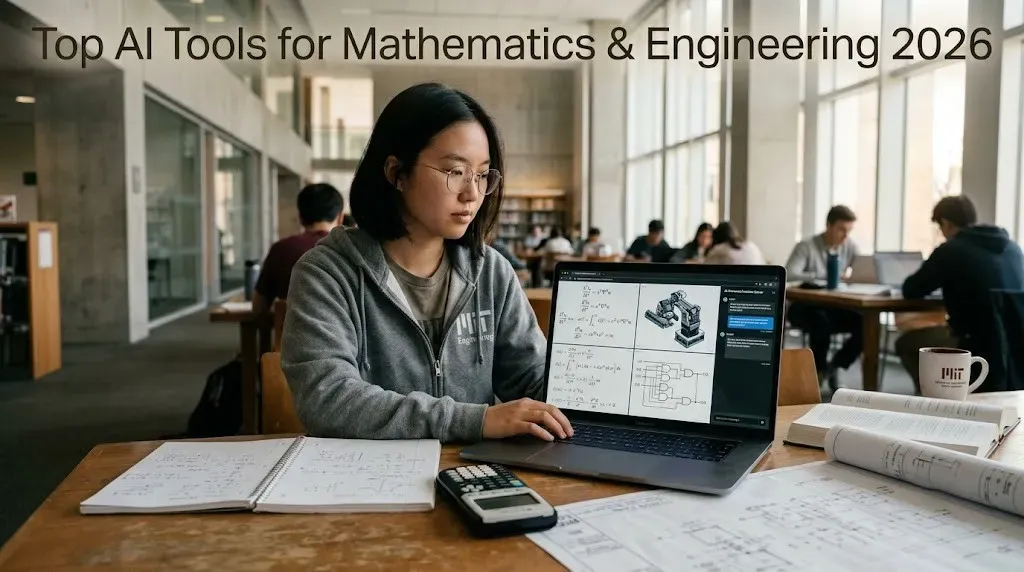
Top 10 AI Tools for Solving Mathematics and Engineering Problems
Students no longer spend hours searching for a single formula or debugging lengthy calculations. Modern AI tools can explain mathematical concepts, solve engineering equations, generate code, interpret handwritten problems and even assist with technical documentation. The challenge is choosing the right tool because each one specializes in different tasks.
Top AI tools compared
| AI Tool | Best For | Ideal Users |
|---|---|---|
| ChatGPT | Step by step explanations and coding | Students and Engineers |
| Wolfram Alpha | Advanced mathematics and symbolic computation | Math Students |
| Microsoft Math Solver | School and college mathematics | Beginners |
| Photomath | Handwritten equation solving | School Students |
| Mathway | Algebra and Calculus | College Students |
| Claude | Technical explanations and long reasoning | Researchers |
| Gemini | Research and multimodal problem solving | Engineering Students |
| MATLAB AI Assistant | Engineering simulations | Engineering Professionals |
| GitHub Copilot | Programming and algorithm development | Software Engineers |
| GeoGebra AI Tools | Geometry and graph visualization | Mathematics Learners |
One tool cannot solve everything
A common mistake is expecting one AI assistant to outperform every competitor across all subjects. That rarely happens. ChatGPT is excellent for explanations, coding and solving multidisciplinary engineering questions. Wolfram Alpha remains stronger for symbolic mathematics and exact computations, while MATLAB AI Assistant is designed for engineering simulations and numerical analysis.
Choosing the right tool based on your subject
| Subject | Recommended AI Tool |
|---|---|
| Calculus | Wolfram Alpha |
| Linear Algebra | ChatGPT and Wolfram Alpha |
| Engineering Mathematics | ChatGPT |
| Mechanical Engineering | MATLAB AI Assistant |
| Programming | GitHub Copilot |
| Circuit Analysis | ChatGPT and Gemini |
| Geometry | GeoGebra |
What many comparison articles miss
Accuracy depends on verification. AI tools can occasionally produce incorrect calculations or make assumptions when a question is ambiguous. Engineering students should always verify critical results using textbooks, standard formulas, simulation software or instructor guidance before using them in assignments or professional work.
Another overlooked point is that AI works best when the question includes all known values, units and constraints. Better prompts generally produce more reliable solutions.
Free versus paid versions
Most popular AI platforms offer free access with limitations. Paid subscriptions usually provide faster responses, better reasoning, larger context windows, advanced models and additional engineering or coding capabilities. Students should evaluate whether those extra features are necessary before subscribing.
Frequently asked questions
Can AI replace engineering textbooks?
No. AI is an excellent learning assistant, but textbooks and academic references remain essential for understanding theory and verified methods.
Which AI tool is best for engineering students?
Many students combine ChatGPT for explanations, Wolfram Alpha for exact mathematics, GitHub Copilot for programming and MATLAB for simulations rather than relying on a single platform.
Can AI solve handwritten equations?
Yes. Tools like Microsoft Math Solver and Photomath can recognize handwritten equations and provide step by step solutions for many mathematical problems.
The strongest approach is not choosing the most popular AI tool. It is building a workflow where different platforms complement one another. Students who learn when to switch between explanation, computation, simulation and coding tools tend to solve problems faster and develop a deeper understanding of mathematics and engineering concepts.

Written by
Palak PatelEducation writer Palak Patel covers the latest education news, board exam updates, results, and career opportunities.