
Degrees That AI Will Kill First
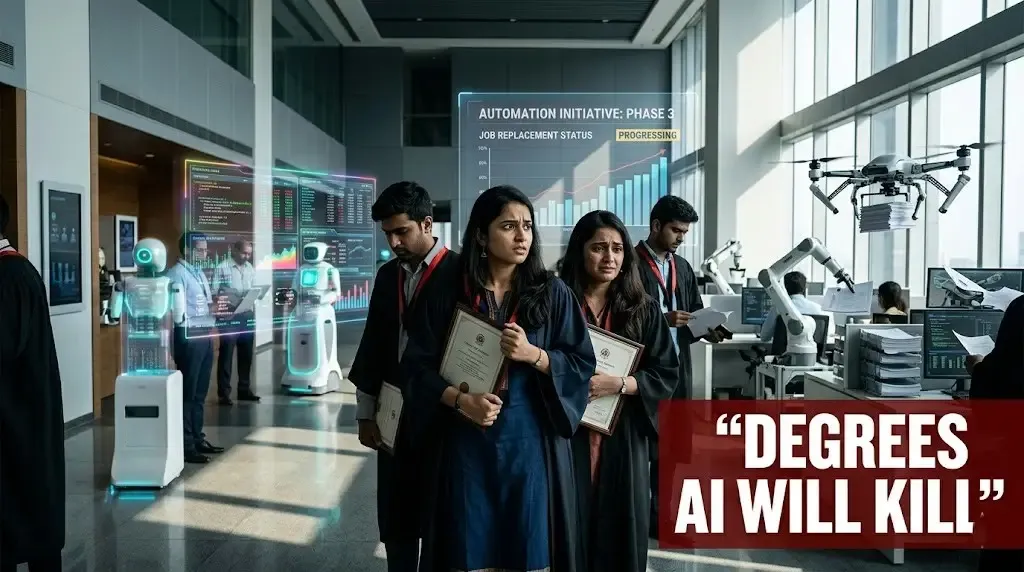
Degrees That AI Will Kill First
Students across India are starting to ask a scary question:
Will my degree even matter after AI becomes mainstream?
And honestly, the fear is not completely irrational anymore.
Artificial intelligence already writes emails, creates presentations, generates code, analyzes data, answers customer queries, edits videos, and automates repetitive office work faster than many entry-level employees.
Companies are noticing it too.
Hiring patterns are quietly changing. Recruiters increasingly prefer people who can work alongside AI instead of doing repetitive tasks AI can already automate.
This does not mean entire professions disappear overnight.
But some degrees clearly face much higher automation pressure than others.
Why Some Degrees Are More Vulnerable to AI
| High-Risk Factor | Why AI Can Replace It |
|---|---|
| Repetitive Work | Easy for automation systems |
| Rule-Based Tasks | AI handles structured workflows well |
| Basic Content Creation | Generative AI already performs it |
| Low-Skill Data Processing | Automation reduces manual need |
| Minimal Human Interaction | AI chat systems replacing support roles |
The more repetitive a job becomes, the more vulnerable it usually is to AI disruption.
1. Generic Computer Degrees Without Real Skills
This sounds surprising because AI itself belongs to technology.
But entry-level tech jobs are already changing rapidly.
Students who only memorize theory without building practical coding, AI, cloud, or cybersecurity skills may struggle badly.
AI coding assistants now generate simple programs, debug errors, and automate repetitive development tasks.
Companies increasingly expect engineers to supervise AI systems rather than manually write basic code all day.
| Traditional Tech Task | AI Impact |
|---|---|
| Basic coding | AI-assisted generation growing |
| Debugging | Automation improving rapidly |
| Simple websites | AI builders emerging |
| Routine documentation | Generated automatically |
Students who stay generic may face problems. Specialists probably won’t.
2. Degrees Focused Only on Administrative Work
Administrative roles face heavy automation pressure globally.
Many office workflows now use AI for:
- Email drafting
- Scheduling
- Data entry
- Documentation
- Customer responses
- Report generation
Degrees leading mainly toward repetitive clerical work may become riskier over time.
Especially when companies aggressively optimize costs.
3. Basic Content & Writing Roles Are Already Changing
This shift happened incredibly fast.
AI tools can now generate:
- Blog drafts
- Product descriptions
- Social captions
- Basic news summaries
- SEO outlines
- Email campaigns
That does not mean writers disappear completely.
But low-level repetitive content work is absolutely becoming cheaper and more automated.
Writers who bring originality, storytelling, strategy, research depth, or strong personal voice remain valuable.
Generic writing alone looks increasingly risky.
4. Degrees Without Practical Exposure
This is becoming one of the biggest employability problems in India.
Students completing purely theory-heavy degrees without:
- Projects
- Internships
- Communication skills
- Modern software tools
- Practical specialization
often struggle because AI already performs many basic knowledge tasks instantly.
The market increasingly rewards execution instead of memorization.
5. Customer Support Careers Are Facing AI Pressure
Chatbots and AI customer systems improved dramatically.
Companies increasingly automate first-level support interactions because AI can answer repetitive customer queries continuously.
| Customer Support Task | AI Replacement Risk |
|---|---|
| Basic FAQs | Very high |
| Simple troubleshooting | High |
| Ticket routing | Already automated widely |
| Human escalation support | Still important |
This especially affects degrees leading mainly into routine BPO-style work.
6. AI Is Rewarding Specialists More Than Generalists
This trend appears repeatedly in hiring discussions now.
People with deep expertise remain valuable because AI still struggles with:
- Complex decision-making
- Leadership
- Human psychology
- Advanced engineering
- High-level strategy
- Creative originality
- Relationship management
Meanwhile generic low-skill tasks face increasing automation pressure.
That means future-proof careers probably depend more on specialization than ever before.
7. Degrees That Still Look Strong in the AI Era
| Growing Area | Why Demand Stays Strong |
|---|---|
| Cybersecurity | AI also creates security threats |
| Healthcare | Human interaction remains critical |
| AI & Data Science | Building and managing AI systems |
| Cloud Infrastructure | Digital expansion continues |
| Psychology & Counseling | Human trust still matters heavily |
Students increasingly choose careers combining technology with human expertise because that balance looks safer long-term.
8. The Bigger Risk Is Not AI - It’s Staying Average
This is probably the most important point.
AI usually replaces repetitive average-level work first.
Students who continuously improve skills, build portfolios, learn AI tools, communicate well, and adapt quickly will probably remain valuable.
The danger is staying dependent on outdated curriculum while industries change rapidly.
That’s where many graduates may struggle.
Conclusion
AI is already reshaping hiring patterns faster than many colleges expected.
Degrees focused mainly on repetitive, low-skill, or purely theoretical work face the highest risk as automation expands.
But AI probably will not eliminate careers completely.
Instead, it will change which skills remain valuable.
Students who adapt, specialize, and learn how to work with AI systems will likely stay competitive.
The real danger now is not choosing the “wrong degree.”
It’s graduating without skills the AI era still genuinely needs.

Written by
MonishMonish is an education writer covering exams, student rights, academic awareness, and other education-related topics, with practical guidance for students.