ChatGPT Is Doing Students’ Assignments - Colleges Don’t Know What to Do
ChatGPT Is Doing Students’ Assignments - Colleges Don’t Know What to Do
Something dramatic changed inside classrooms after AI tools became mainstream.
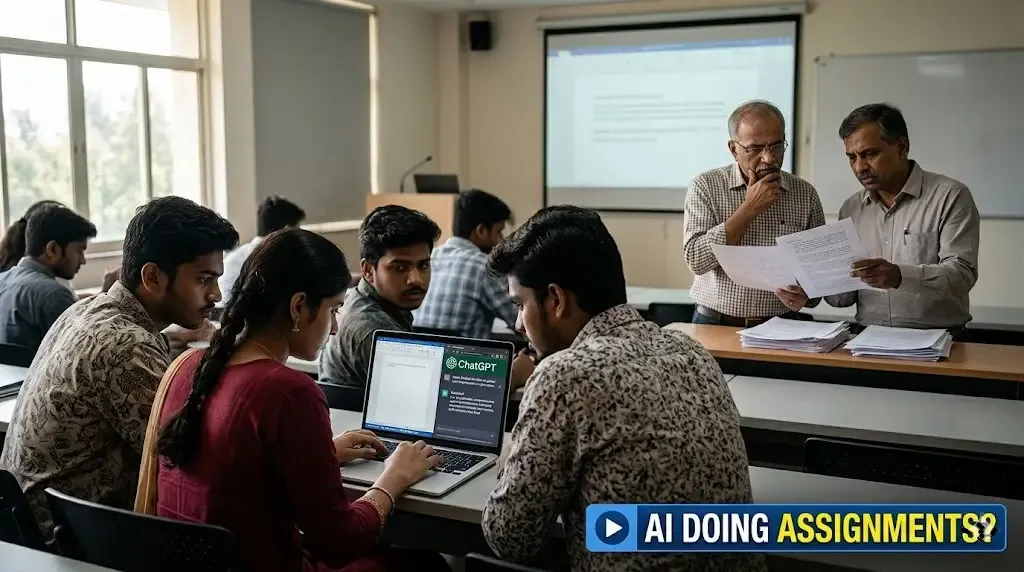
Students now finish assignments in minutes that previously took entire weekends.
Essays, coding tasks, presentations, research summaries, reports, cover letters, lab explanations - ChatGPT can generate them almost instantly.
And colleges are struggling to react.
Because the problem is no longer limited to a few students secretly copying homework.
AI-assisted assignments are becoming normal across campuses globally.
Professors know it’s happening. Students know everyone uses it. Universities know traditional academic rules suddenly look outdated.
But nobody fully agrees on what should happen next.
How Students Are Using ChatGPT in Colleges
| Student Use Case | How AI Is Being Used |
|---|---|
| Essay Writing | Generating complete drafts instantly |
| Coding Assignments | Debugging and writing programs |
| Research Summaries | Condensing large articles quickly |
| Presentations | Creating slides and speaking points |
| Lab Reports | Writing formatted observations and analysis |
For many students, AI tools already became part of normal academic workflow.
That’s exactly why universities are worried.
1. Colleges Can’t Easily Detect AI Work Anymore
This is the biggest issue.
Early AI-generated content often looked robotic and repetitive.
Now the quality improved dramatically.
Students can rewrite AI outputs, mix human edits, personalize responses, and bypass basic plagiarism systems easily.
Even many professors admit privately that distinguishing between student-written and AI-assisted work has become extremely difficult.
| Traditional Cheating Detection | AI Era Problem |
|---|---|
| Plagiarism tools | AI generates original wording |
| Copy-paste detection | Content appears unique |
| Writing style analysis | Students edit AI outputs manually |
| Homework comparison | AI creates varied answers quickly |
That uncertainty created panic in many academic institutions.
2. Students Say the Education System Forced This Shift
Interestingly, many students defend AI usage strongly.
Their argument is simple:
If assignments mostly test formatting, memorization, repetitive writing, or generic theory explanation, why wouldn’t students automate them?
Some students openly say AI exposed how outdated many assignment systems already were.
Instead of deep thinking, many tasks became repetitive academic routines focused on submission volume rather than actual learning.
AI simply accelerated that reality.
3. Coding Education Changed Completely
Computer science departments especially face major disruption.
Students now use ChatGPT for:
- Writing code
- Fixing bugs
- Explaining algorithms
- Building projects
- Completing lab work
- Preparing interview questions
Some professors worry students may stop learning fundamentals properly.
Others argue future developers must learn how to work with AI tools anyway because the software industry itself already uses them heavily.
This debate is becoming intense across engineering colleges.
4. AI Detection Tools Are Also Controversial
Universities tried responding with AI detection software.
But many tools produce inconsistent results.
Students complain innocent work sometimes gets flagged incorrectly while AI-generated content occasionally passes without issues.
| AI Detection Problem | Why Colleges Struggle |
|---|---|
| False Positives | Human writing flagged unfairly |
| Inconsistent Accuracy | Detection reliability weak |
| Edited AI Content | Harder to identify |
| Rapid AI Improvement | Detection tools fall behind quickly |
That uncertainty makes strict punishment difficult for colleges legally and academically.
5. Professors Are Divided About AI
Not all educators see AI as purely harmful.
Some professors now actively encourage responsible AI usage.
They compare ChatGPT to calculators, Google search, or coding autocomplete tools - technologies that initially created fear but eventually became normal.
Others strongly disagree.
They worry AI dependency may destroy critical thinking, writing ability, problem-solving skills, and independent learning habits.
Both sides have valid arguments.
6. Universities Are Quietly Changing Assessments
Many colleges already started modifying evaluation systems because take-home assignments became harder to trust.
Some institutions now prefer:
- Oral exams
- Live coding rounds
- Classroom presentations
- Handwritten assessments
- Project demonstrations
- Real-time practical tasks
The idea is simple:
If AI can easily complete homework remotely, assessments must become harder to automate.
This shift may permanently change college evaluation systems.
7. The Bigger Fear Is Skill Dependency
The real concern is probably not cheating itself.
It’s dependency.
Some educators fear students may lose the ability to think independently if AI handles every difficult task instantly.
Writing, coding, research, communication, and analytical thinking still matter professionally.
If students outsource too much learning to AI, long-term capability may weaken.
At the same time, ignoring AI completely also looks unrealistic because workplaces increasingly expect employees to use these tools efficiently.
| Student Concern | Professor Concern |
|---|---|
| Saving time | Loss of learning depth |
| Better productivity | Overdependence on AI |
| Assignment completion pressure | Academic integrity problems |
| Career relevance | Skill degradation |
8. Education May Never Return to Pre-AI Normal
This is becoming increasingly obvious.
Even if colleges ban ChatGPT officially, students will continue using AI tools privately.
The technology is already too accessible.
That means universities probably need to redesign education itself instead of simply trying to stop AI completely.
The old assignment system was built for a world where instant AI assistance did not exist.
That world is gone now.
Conclusion
ChatGPT created one of the biggest academic disruptions modern colleges have faced.
Students increasingly use AI for assignments, coding, research, presentations, and learning support - often faster than universities can adapt.
Colleges now face a difficult challenge:
How do you maintain academic integrity when AI can generate high-quality work instantly?
Some institutions will resist aggressively.
Others will adapt and redesign education around AI-assisted learning.
But one thing already feels clear.
The traditional assignment system may never work the same way again.

Written by
MonishMonish is an education writer covering exams, student rights, academic awareness, and other education-related topics, with practical guidance for students.