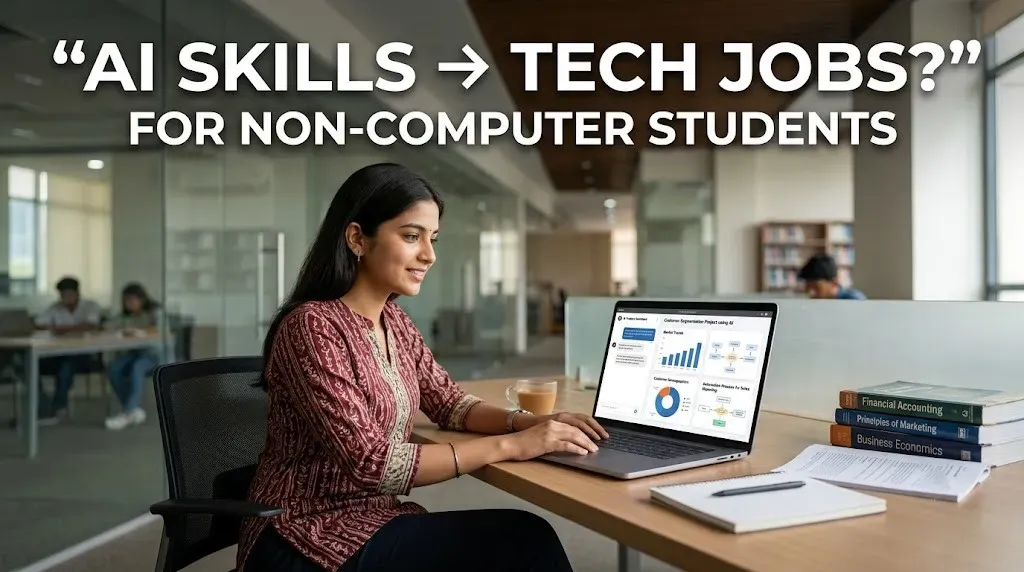
Yes, but learning AI alone does not automatically qualify someone for a tech job. For students from commerce, management, arts or other non-computer backgrounds, AI can become a useful entry point when it is combined with a practical skill and some proof of what they can actually do.
The shift is already visible in hiring. A 2026 TeamLease EdTech report found that employers are giving more attention to AI fluency, data skills, digital readiness and proof of work when hiring freshers. Technology skills are also spreading into areas such as marketing, operations and finance.
For a non-computer student, the first step does not have to be learning advanced programming. Understanding generative AI tools, writing effective prompts, checking AI-generated information, working with spreadsheets and basic data analysis can be a more realistic starting point. From there, students can move toward automation, analytics, cloud tools or coding if a particular job requires it.
| Background | Possible AI-Related Direction |
|---|---|
| Commerce or finance | Data analysis and AI-assisted finance work |
| Management or business | AI automation and business analytics |
| Arts or humanities | AI-assisted content, research and digital roles |
There is also growing evidence that AI learning is moving beyond traditional engineering. A 2026 report cited by Business Standard found that about one in four people learning AI in India came from non-technical backgrounds.
Still, students should be realistic about the type of job they are targeting. A software developer role may require programming and computer science fundamentals, while an AI-enabled marketing, operations or analytics role may place greater weight on domain knowledge plus digital skills. The World Economic Forum also expects AI, big data and technological literacy to grow in importance, alongside analytical thinking, creativity and adaptability.
The smartest route is to combine your existing subject knowledge with AI. Build two or three small projects, document your work, complete a relevant certification if useful and apply for roles where your original degree and new technology skills fit together. That combination can make the transition into tech much more practical.