
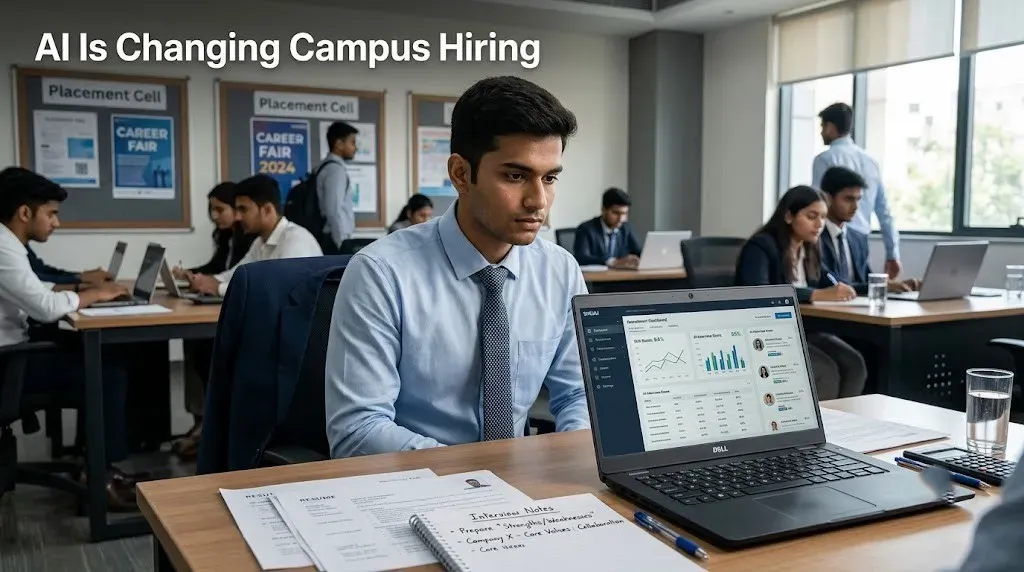
Campus placements are getting more technology-driven, and fresh graduates are already feeling the difference. Deloitte India's Campus Workforce Trends 2026 report found that 86% of organisations said AI or Agentic AI is transforming their recruitment processes in FY26, up from around 79% the previous year.
The interesting part is what happens after AI enters the hiring process. Companies are using it to screen resumes, assess candidates and manage recruitment workflows, which means simply having a degree and a long list of certificates may not be enough to stand out during campus hiring.
| What is changing | What it means for freshers |
|---|---|
| AI-based resume screening | Your projects, skills and certifications need to match the role clearly instead of relying only on a generic resume. |
| AI-assisted assessments | Technical preparation still matters, but candidates are increasingly being evaluated through structured digital assessments. |
| Skills-based shortlisting | Employers are paying closer attention to what a candidate can actually do. |
| Internship-led hiring | Internships are becoming a stronger route into full-time employment as companies use them to judge candidates before making offers. |
Resume screening is currently the biggest use of AI in recruitment, with 72% of organisations reporting that they use it. AI-based assessments are used by 48%, while candidate engagement and predictive hiring tools follow behind. For students, this makes the basic resume more important than it looks. A recruiter or hiring system needs to quickly understand the candidate's actual skills and project experience.
There is also some good news for freshers. AI is not simply reducing entry-level opportunities in the survey. Around 35% of organisations said AI adoption is creating new entry-level roles or skill requirements, up from about 21% in FY25. That means the job titles and work expected from graduates are changing alongside the technology.
The skills attracting the biggest hiring premium are also becoming clearer. Deloitte reports that AI and data capabilities are associated with premiums of around 20% to 25%, while analytical thinking and problem-solving carry premiums of 10% to 15%. A fresher does not necessarily need to become an AI engineer, but understanding how AI tools work in their own field is becoming increasingly useful.
For students, this changes the order in which preparation should happen. Learning one tool for a certificate is less useful than building something with it and being able to explain what you actually did. A BCA student, for example, will have a stronger placement conversation after completing a working application and explaining the decisions behind it than after collecting several unrelated course certificates.
Internships deserve particular attention. Deloitte found that pre-placement offer conversions improved across the degree categories covered in its study, while employers ranked behavioural competencies and learning agility highly when assessing the chances of an intern receiving a full-time offer. For students still in college, an internship can therefore provide something a classroom project cannot easily replicate, evidence that they have worked in a real environment.
The report is based on 257 organisations and 505 campuses across several sectors and degree categories. Students can read the official Deloitte India findings for the full breakdown.