
Memory Techniques Used by Toppers to Remember Long Answers Fast
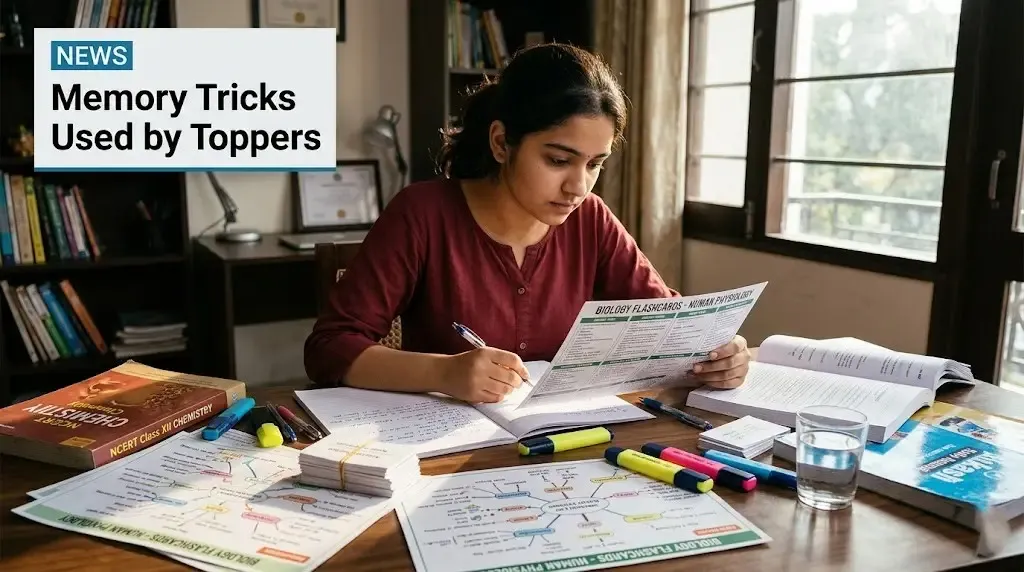
Memory Techniques Used by Toppers to Remember Long Answers Fast
One thing students often misunderstand about toppers is this - most of them are not sitting with books 18 hours a day memorising entire chapters word by word.
What many toppers actually do better is memory management. They use specific techniques that help the brain retain information faster and recall it more easily during exams.
And honestly, this matters more than raw study hours.
Because every student has experienced the same frustration at least once: spending hours reading an answer only to completely forget it inside the exam hall.
1. Active Recall Instead of Passive Reading
This is probably the biggest difference between average students and high scorers.
Most students keep rereading notes repeatedly. Toppers usually close the book and force themselves to recall the answer from memory.
| Passive Study Method | Active Recall Method |
|---|---|
| Reading notes repeatedly | Testing yourself without notes |
| Feels easier | Feels difficult but improves memory |
| Short-term familiarity | Long-term retention |
| Low recall during exams | Better exam recall |
Many toppers say if you cannot explain an answer without looking at the book, you probably have not learned it properly yet.
2. Memory Linking and Story Technique
Long answers become easier when information is connected like a story instead of random lines.
For example, history toppers often connect events emotionally or visually instead of memorising dates separately. Biology students sometimes turn processes into mini stories happening step by step.
The brain naturally remembers connected information better than isolated facts.
3. The Blurting Method Is Becoming Popular
This technique has become extremely popular among students preparing for UPSC, NEET, and board exams.
The method is simple:
| Blurting Process | What Students Do |
|---|---|
| Step 1 | Read topic carefully once |
| Step 2 | Close the book completely |
| Step 3 | Write everything remembered on paper |
| Step 4 | Compare with original answer |
| Step 5 | Repeat weak areas only |
It feels messy at first, but it trains the brain to retrieve information quickly instead of just recognising it while reading.
4. Mind Maps Help Reduce Overwhelm
Many toppers avoid writing huge paragraphs in notes. Instead, they create mind maps with arrows, keywords, and branches.
This works because the human brain processes visual structure faster than dense text blocks.
One page containing connected keywords often becomes easier to remember than ten pages of plain notes.
5. Spaced Revision Beats Last-Minute Cramming
One major mistake students make is revising everything only once before exams.
Toppers usually revise smaller portions repeatedly over time.
| Revision Timing | Purpose |
|---|---|
| Same Day | Initial reinforcement |
| Next Day | Strengthen memory |
| After 1 Week | Long-term retention |
| Before Exams | Final recall boost |
This technique is called spaced repetition, and research consistently shows it improves memory retention significantly.
6. Teaching Others Secretly Improves Memory
Many toppers revise by explaining chapters to friends, siblings, or sometimes even imaginary students.
Sounds strange, but teaching forces the brain to organise information clearly.
If you get stuck while explaining, that usually reveals weak understanding immediately.
7. Short Keywords Instead of Full Sentences
Trying to memorise entire textbook paragraphs is exhausting.
Instead, toppers often memorise trigger words or keyword chains that automatically help reconstruct the full answer during exams.
| Weak Method | Smarter Method |
|---|---|
| Memorising full paragraph | Remembering key triggers |
| Hard to retain | Easier brain association |
| Slower revision | Faster revision |
This is especially useful for subjects like political science, biology, economics, and history.
Sleep and Stress Also Affect Memory
Students often ignore this part completely.
Memory retention drops sharply when sleep is poor. Stress and anxiety also reduce recall speed during exams.
That is why students sometimes “know” the answer at home but suddenly blank out inside the exam hall.
Many toppers actually prioritise proper sleep during final revision weeks because exhausted brains retain less information.
The Biggest Myth About Toppers
Probably the biggest myth is that toppers have naturally extraordinary memory.
In reality, many simply use smarter revision systems consistently. They test themselves more, revise strategically, and avoid wasting time on passive reading.
And honestly, most memory improvement techniques are learnable. Students do not need a “genius brain” to remember answers better - they usually just need better study methods.

Written by
Palak PatelEducation writer Palak Patel covers the latest education news, board exam updates, results, and career opportunities.