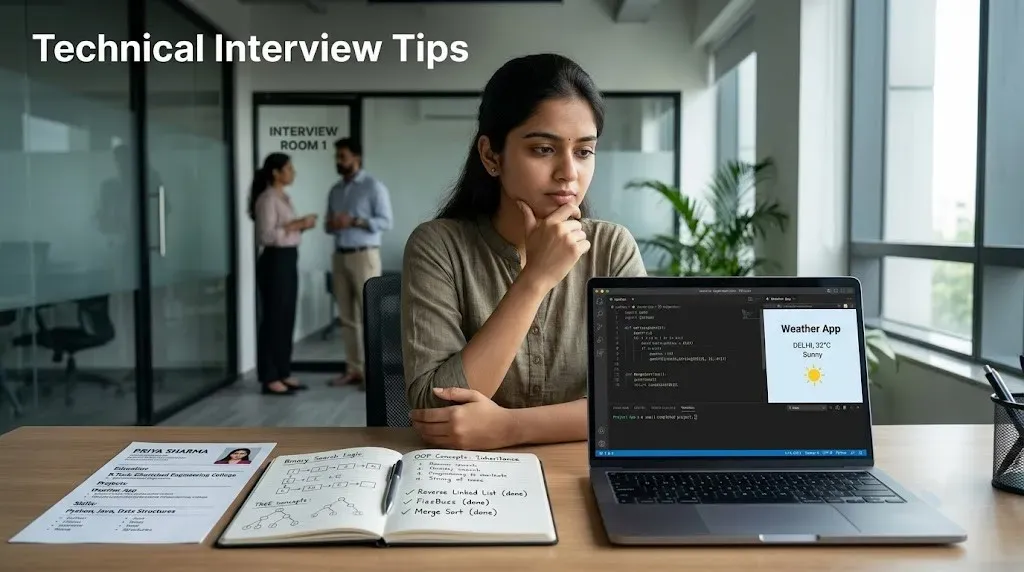
The hardest part of a first technical interview is often the feeling that everyone else has something impressive to discuss. They have internships, previous jobs or long resumes. You may have none of those, but a well-built college project can still give the interviewer something concrete to evaluate.
Start by choosing one project you know properly. Be ready to explain why you built it, which technology you used, what went wrong during development and how you fixed one real problem. Saying “I used React” is weak on its own. Explaining how you handled API data or fixed a component that was repeatedly failing gives the interviewer evidence of actual problem-solving.
| Prepare this | What to practise |
|---|---|
| Your best project | Explain the architecture, your contribution and one problem you had to solve. |
| Programming basics | Revise the language you have mentioned on your resume and practise writing small solutions without copying code. |
| Resume questions | Assume the interviewer can ask about every technology, project or certificate you have listed. |
Coding practice should be focused rather than endless. For a fresher role, revise the fundamentals you are most likely to use, then solve problems involving arrays, strings, loops, functions and basic data structures. More importantly, practise explaining your approach before writing the code. Interviewers are watching how you think when the answer is not immediately obvious.
Do not hide the fact that you are a fresher. If you have never worked in a company, say so and move the conversation towards what you have done independently. A college project, open-source contribution or serious personal application can show initiative when you can clearly explain your decisions and the work behind it.
One useful exercise is to record yourself answering common questions. “Tell me about your project”, “Why did you choose this technology?” and “What would you improve now?” sound simple until you have to answer them without reading from notes. Keep the answers conversational and specific instead of memorising a paragraph.
Finally, check your resume line by line before the interview. If you have written “JavaScript”, expect questions on JavaScript. If you have listed an e-commerce project, be prepared to explain how products, users or data move through it. For a fresher, a short resume that you can defend confidently is usually more useful than a crowded one filled with technologies you barely remember.