
Write limitations of switch case.
Palak Patel08 May 2026
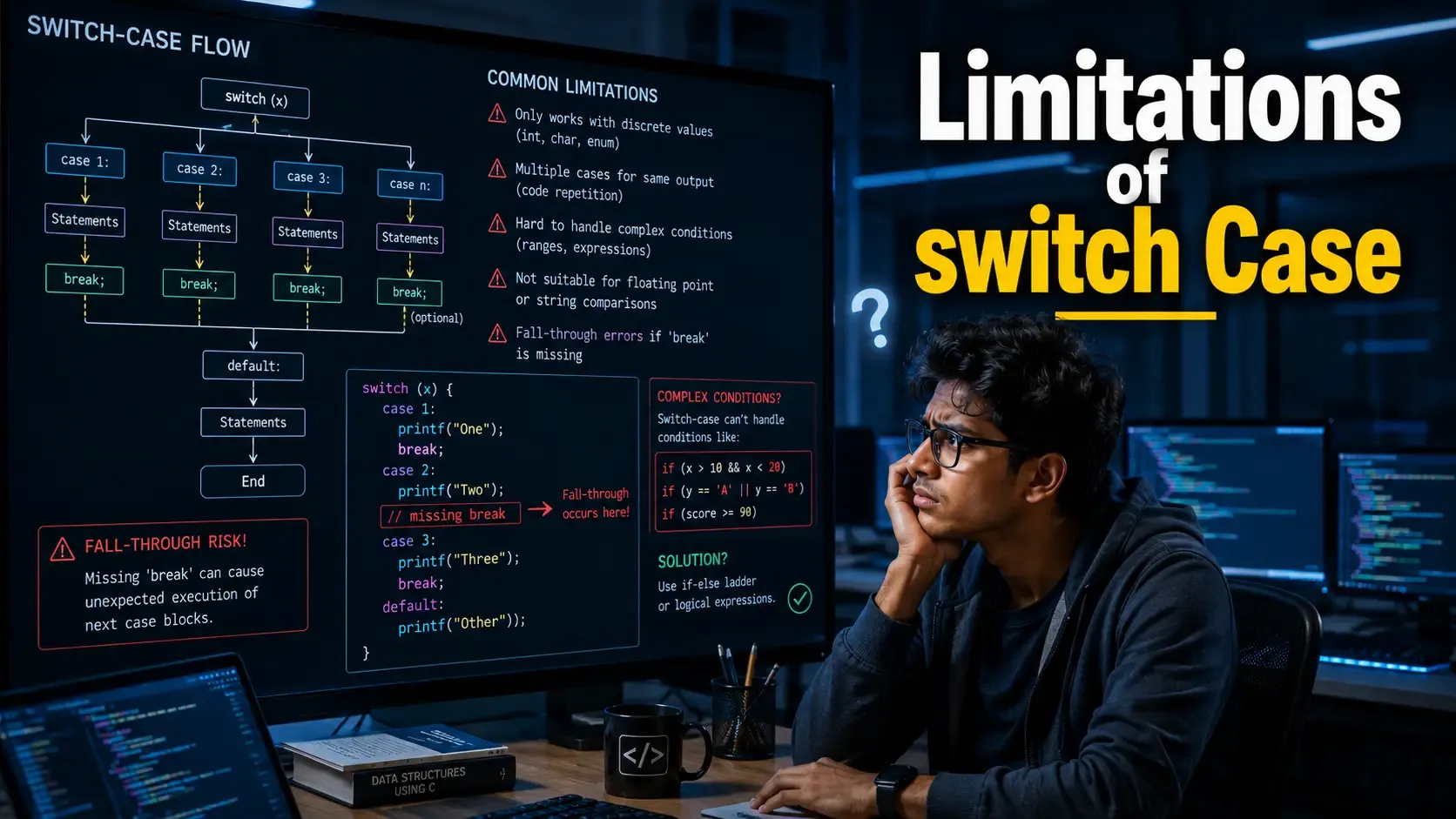
Limitations of switch Case in C Programming
The switch case statement is used for multiple decision-making in C programming.
Although it is useful for handling many choices, it also has several limitations.
Main Limitations of switch Case
-
Works Only with Integer or Character Values
The switch statement does not directly support float or double data types. -
Cannot Use Relational Operators
Operators like >, <, and >= cannot be used inside case labels. -
Case Values Must Be Constant
Variables and runtime expressions are not allowed as case labels. -
Only Equality Checking Is Possible
Switch compares values only for equality. -
Duplicate Case Values Are Not Allowed
Each case label must contain a unique value. -
Break Statement Is Necessary
Without break, execution continues to the next case automatically.
Example of switch Case
#include <stdio.h>

int main()
{
    int choice = 2;

    switch(choice)
    {
        case 1:
            printf("One");
            break;

        case 2:
            printf("Two");
            break;

        default:
            printf("Invalid Choice");
    }

    return 0;
}
Conclusion
The switch case statement is useful for simple menu-driven programs.
However, it cannot handle complex conditions and advanced comparisons.
Therefore, programmers often prefer if-else statements for complicated decision-making.

Written by
Palak PatelEducation writer Palak Patel covers the latest education news, board exam updates, results, and career opportunities.