
Define recursive function. Write a program to find factorial of a number with recursive function.
Palak Patel08 May 2026
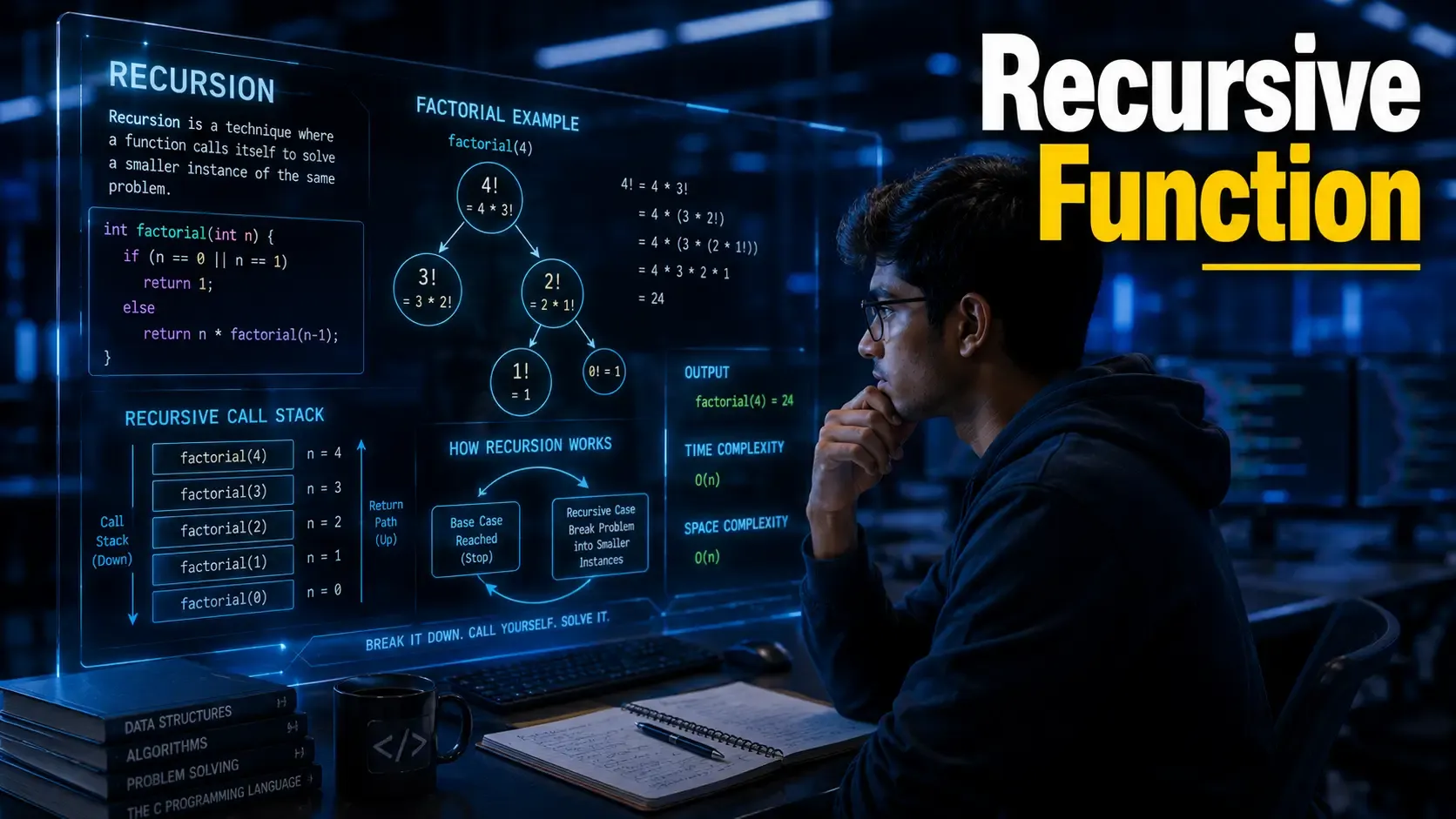
Define Recursive Function. Write a Program to Find Factorial of a Number Using Recursive Function
A recursive function is a function that calls itself repeatedly until a stopping condition is reached.
Recursion is commonly used to solve problems that can be divided into smaller similar subproblems.
Factorial Formula
The factorial of a number is calculated as:
n! = n × (n - 1)!
Example:
5! = 5 × 4 × 3 × 2 × 1 = 120
Algorithm
- Take a number as input.
- Create a recursive function named factorial().
- If the number is 0 or 1, return 1.
- Otherwise, return n × factorial(n - 1).
- Display the factorial result.
C Program Using Recursive Function
#include <stdio.h>

int factorial(int n)
{
    if(n == 0 || n == 1)
    {
        return 1;
    }
    else
    {
        return n * factorial(n - 1);
    }
}

int main()
{
    int num;

    printf("Enter a number: ");
    scanf("%d", &num);

    printf("Factorial of %d = %d", num, factorial(num));

    return 0;
}
Output Example
Enter a number: 5
Factorial of 5 = 120
Explanation of Program
| Statement | Purpose |
|---|---|
| factorial(n - 1) | Function calls itself |
| if(n == 0 || n == 1) | Stopping condition |
| return n * factorial(n - 1) | Calculates factorial recursively |
Advantages of Recursive Function
- Code becomes shorter and cleaner.
- Useful for mathematical and tree-based problems.
- Easy to solve repetitive subproblems.
Conclusion
Recursive functions are powerful tools in programming for solving repetitive problems.
The factorial program is one of the most common examples used to understand recursion in C programming.

Written by
Palak PatelEducation writer Palak Patel covers the latest education news, board exam updates, results, and career opportunities.