
Objective vs Subjective Exams: Which Format Benefits Students More?
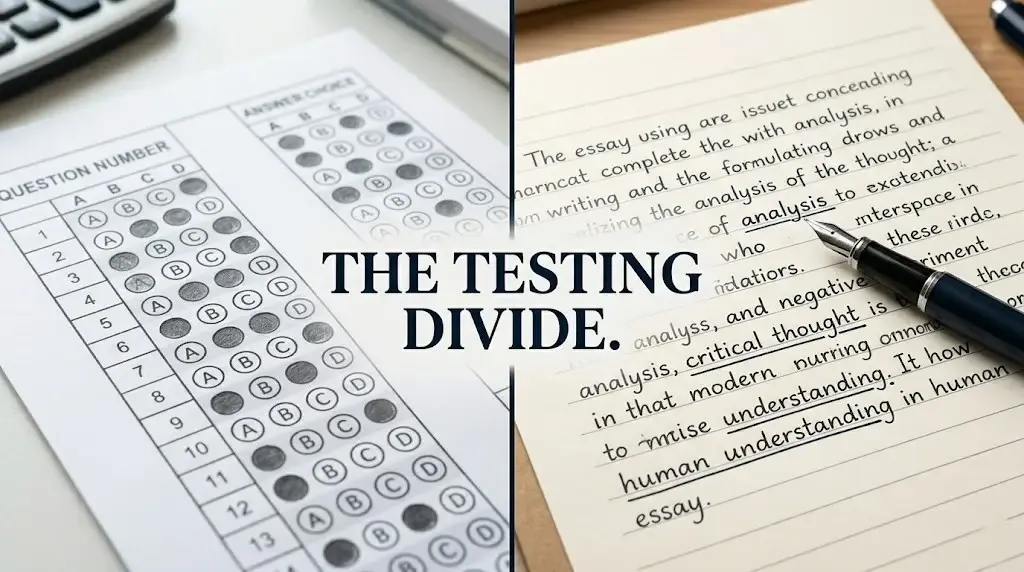
The Great Testing Dilemma: Beyond the Bubble Sheet
Every student has a "favorite" type of exam. Some love the binary certainty of a multiple-choice question-you're either right or you're wrong. Others find that restrictive and prefer the freedom of an essay where they can argue their point, even if they can't remember a specific date or formula. But which one is actually better for learning?
In reality, neither format is perfect. They test different parts of the brain. Objective exams focus on recognition and speed, while subjective exams focus on recall and synthesis. To understand which benefits you more, we have to look at what happens after the pen hits the paper.
Quick Comparison of Formats
| Feature | Objective (MCQs, T/F) | Subjective (Essays, Short Answer) |
|---|---|---|
| Grading | Instant, unbiased, and automated. | Slow, potentially biased, and human. |
| Skill Tested | Fact recognition and elimination. | Critical thinking and communication. |
| Guessing | High "lucky guess" potential. | Impossible to "guess" your way through. |
| Depth | Broad coverage of the syllabus. | Deep dive into specific topics. |
1. Objective Exams: The Fair Efficiency Machines
Objective exams are the backbone of competitive testing. Why? Because a computer doesn't care if you have bad handwriting or if it’s having a bad day. The results are purely about the data you provide. They are excellent for testing a massive range of topics in a very short time.
However, the downside is "Recognition vs. Knowledge." You might be able to pick the right answer from a list of four without actually being able to explain why it’s right if someone asked you in person.
The "Coffee Shop" Explanation: It's like a trivia night. You don't need to be an expert on the history of coffee; you just need to recognize the name "Ethiopia" when the host asks where Arabica originated.
2. Subjective Exams: The True Measure of Mastery
If you want to know if a student really understands a concept, make them write about it. Subjective exams require you to organize your thoughts, build an argument, and use evidence. This is where "higher-order thinking" happens.
While these are much harder to grade fairly-one teacher might love your writing style while another finds it wordy-they prepare students for the real world. In most jobs, your boss won't give you four options and ask you to pick one; they’ll ask you to write a report or explain a strategy.
Which Format Benefits the Student More?
| Student Goal | Preferred Format |
|---|---|
| Quickly identifying gaps in basic knowledge. | Objective |
| Developing persuasive communication skills. | Subjective |
| Preparing for high-stakes entrance exams (JEE, NEET). | Objective |
| Preparing for management or research roles. | Subjective |
The Psychological Impact
The Stress Factor: Objective exams often create a "high-pressure" environment because one tiny mistake (bubbling the wrong row) can ruin a score. Subjective exams offer "partial credit," which can lower anxiety for students who understand the gist but struggle with exact details.
The Study Habit: Research shows students study differently for each. For objective tests, students focus on memorizing definitions. For subjective tests, they focus on finding connections between themes. The latter usually leads to better long-term memory retention.
Conclusion
If we only used objective tests, we'd produce human calculators. If we only used subjective tests, grading would be a chaotic mess of personal opinions. The best "benefit" for a student actually comes from a hybrid approach.
A student who can navigate both-the precision of the objective and the nuance of the subjective-is the one who is truly ready for the complexities of the modern workforce. Don't run away from your "weak" format; lean into it, because that’s where the real growth happens.

Written by
Palak PatelEducation writer Palak Patel covers the latest education news, board exam updates, results, and career opportunities.