
How Smart Factories Are Creating New Opportunities for Engineers
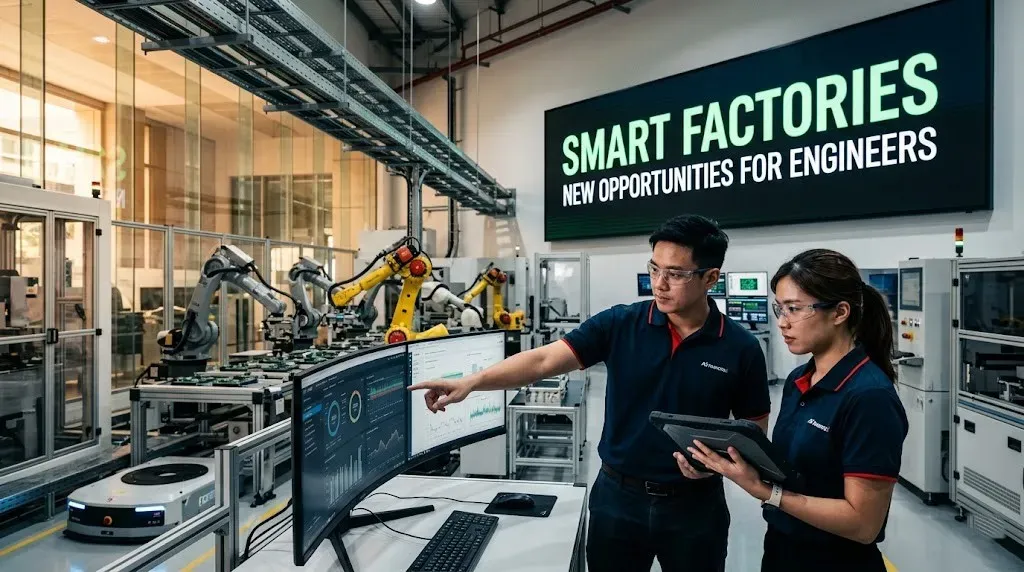
How Smart Factories Are Creating New Opportunities for Engineers
The rise of Industry 4.0 is revolutionizing the manufacturing sector. Smart factories, powered by technologies such as artificial intelligence (AI), robotics, the Industrial Internet of Things (IIoT), and big data analytics, are changing the way products are designed, manufactured, and delivered. As industries embrace digital transformation, engineers are witnessing the emergence of exciting new career opportunities.
Unlike traditional manufacturing facilities, smart factories rely on interconnected systems, intelligent machines, and real-time data to improve productivity, reduce costs, and enhance quality. This shift is creating demand for engineers with multidisciplinary skills.
What Is a Smart Factory?
| Feature | Purpose |
|---|---|
| Industrial IoT Sensors | Collect real-time data |
| Robotics and Automation | Increase productivity and precision |
| Artificial Intelligence | Predict maintenance and optimize processes |
| Cloud Computing | Enable remote monitoring and analytics |
| Digital Twins | Simulate manufacturing systems |
New Career Opportunities for Engineers
| Role | Area of Work |
|---|---|
| Automation Engineer | Industrial control systems and robotics |
| Robotics Engineer | Design and programming of robots |
| Data Engineer | Industrial data analytics |
| IoT Engineer | Connected devices and sensors |
| AI Engineer | Predictive maintenance and machine learning |
| Cybersecurity Engineer | Protection of industrial networks |
| Digital Manufacturing Engineer | Smart production systems |
Industries Adopting Smart Factories
| Industry | Applications |
|---|---|
| Automobile Manufacturing | Robotic assembly and quality inspection |
| Electronics | Precision manufacturing |
| Pharmaceuticals | Automated packaging and monitoring |
| Aerospace | Advanced manufacturing systems |
| Food Processing | Smart packaging and supply chain management |
Skills Engineers Need
Modern engineering careers increasingly require knowledge of programming, data analytics, machine learning, robotics, PLC systems, cloud computing, and cybersecurity. Engineers who combine traditional technical expertise with digital skills will have a significant advantage in the Industry 4.0 era.
Courses in Python, IoT, AI, industrial automation, and CAD/CAM technologies can help students prepare for these emerging roles.
Salary and Growth Prospects
As demand for Industry 4.0 professionals rises, companies are offering attractive salary packages. Fresh graduates entering automation, robotics, or AI-related domains can expect competitive salaries, while experienced engineers with specialized skills may command significantly higher compensation.
Global consulting firms predict that smart manufacturing will generate millions of new jobs worldwide over the next decade.
Conclusion
Smart factories are not replacing engineers—they are redefining engineering careers. The integration of AI, robotics, and digital technologies is creating new opportunities across manufacturing sectors. Engineers who embrace Industry 4.0 skills and continuous learning will be well-positioned to thrive in the future workplace.

Written by
Palak PatelEducation writer Palak Patel covers the latest education news, board exam updates, results, and career opportunities.