
Final Year Projects Becoming More Practical in 2026
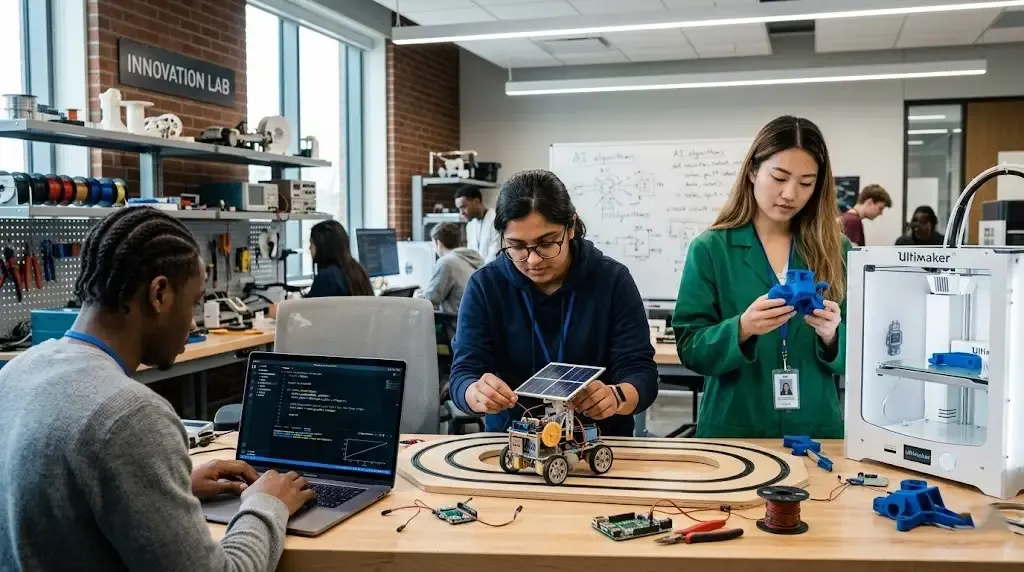
From Paper to Prototype: The Practical Revolution of 2026 Projects
Remember when a "Final Year Project" meant a 100-page spiral-bound document that mostly sat in a dusty library? Those days are effectively over. In 2026, the higher education landscape has undergone a massive shift toward skill-first education. Universities are now being judged not just by graduation rates, but by how well their students can actually apply what they’ve learned to real-world problems.
The "Practicality Push" is driven by a labor market that is honestly tired of training fresh graduates from scratch. Employers in 2026 are demanding "job-ready" talent who can prove they've built something that works. This has led to the mainstreaming of industry-integrated curricula, where companies and startups actually help co-design project prompts.
Key Project Trends in 2026
| Trend | Focus Area | Why It Matters |
|---|---|---|
| AI-Embedded Everything | Health, Finance, Logistics | AI literacy is now a foundational skill across all disciplines, not just CS. |
| Simulation Learning | STEM & Technical Skills | VR and AR allow students to practice complex tasks safely before building them. |
| Interdisciplinary Teams | Smart Cities, Climate Action | Solving India’s challenges requires mixing Tech, Liberal Arts, and Public Policy. |
| Sustainability & Mobility | Green Tech, Autonomous Systems | Projects are focusing on lightweight materials and self-driving delivery robots. |
1. The "Agentic AI" Influence
In 2026, project goals have moved past simple analysis. Students are now building Agentic AI-systems that don't just "suggest" but actually automate complex workflows. Whether it's a "Smart Canteen Solution" that automates food service or an "AI-Based Personal Finance Manager," the emphasis is on creating tools that deliver measurable business or social value.
2. Health-Tech and Public Safety
A huge chunk of the most innovative 2026 projects are tackling public safety and healthcare. We're seeing students develop :
- Disease Prediction Models: Using patient data to guess risks for diabetes or heart issues.
- Smart Safety Gear: Helmets with crash-detection sensors that send GPS coordinates to emergency services.
- Biomedical Breakthroughs: Wearable devices with miniaturized sensors for real-time patient monitoring.
3. Sustainability and Rural Solutions
Projects aren't just for big cities anymore. There’s a renewed focus on local relevance. Examples include :
- Smart Watering Systems: Using solar power and sensors to optimize farming.
- Energy Harvesting: Designing floor systems that grab energy from human footsteps in public places.
- Rural Accessibility: Wheelchairs controlled by hand gestures for people with mobility issues.
Industry Collaboration: The New Standard
Colleges are no longer silos. Programs like UNESCO’s TECH SPARK are linking universities with EdTech firms to use simulation learning to boost employability. In India, joint innovation calls with countries like Finland and the Netherlands are pushing students toward high-stakes areas like hydrogen fuel and Applied Mathematics.
The takeaway for students? Your 2026 final project isn't just an academic hurdle-it's your first professional portfolio piece. The more "practical" it is, the more valuable your degree becomes in a labor market that values skills over certificates.
Conclusion
If you're starting your final year, skip the generic topics. Look for a workflow that's broken, a community problem that's ignored, or a manual task that needs an AI agent. The best projects this year aren't the ones with the most pages, but the ones with the most proof that they actually work.
Written by
Palak PatelEducation writer Palak Patel covers the latest education news, board exam updates, results, and career opportunities.