
Core vs IT Jobs for Engineering Students 2026: What to Choose?
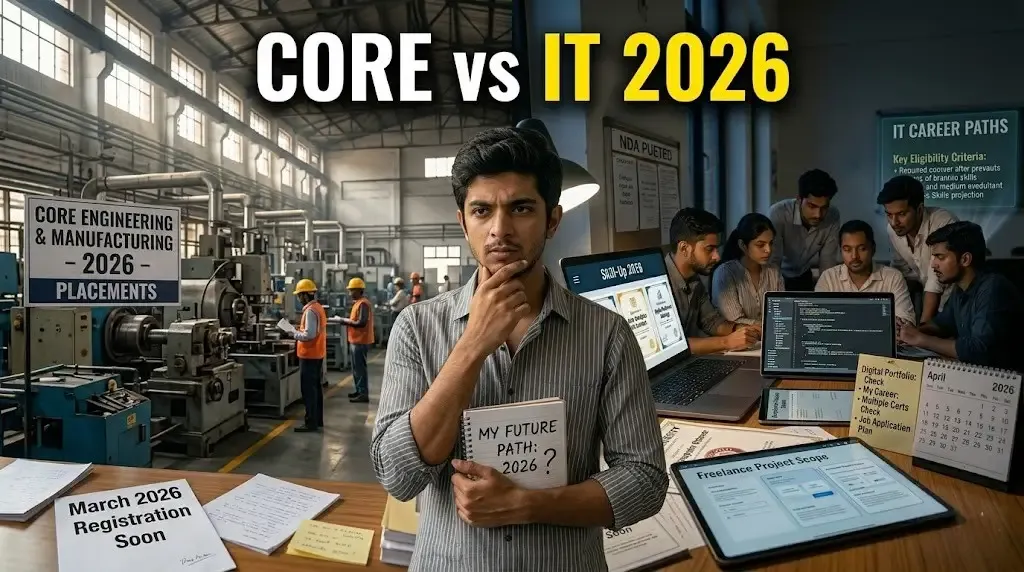
Core vs IT Jobs in 2026: The Real Choice Engineering Students Are Facing
Ask any engineering student today, and you’ll hear the same confusion-should you stick to your core branch or switch to IT?
Mechanical, civil, electrical… many students start with a clear path. But by the final year, IT placements start looking more attractive.
So what actually makes more sense in 2026?
What Are Core Jobs?
Core jobs are directly related to your engineering branch.
For example:
- Mechanical → manufacturing, production
- Civil → construction, site engineering
- Electrical → power systems, maintenance
These roles focus on technical, field-based, or industry-specific work.
What Are IT Jobs?
IT jobs involve software, coding, data, or tech-based services.
Even non-CS students can enter IT by learning programming, web development, or data skills.
Core vs IT Jobs (Direct Comparison)
| Factor | Core Jobs | IT Jobs |
|---|---|---|
| Starting Salary | Usually lower | Generally higher |
| Work Type | Field + practical work | Office + computer-based |
| Skill Requirement | Branch-specific knowledge | Coding and tech skills |
| Growth Speed | Slower but stable | Faster (if skilled) |
This is why many students shift toward IT-it offers quicker entry and higher initial pay.
Why Students Are Moving to IT in 2026
There are a few clear reasons:
- More job openings compared to core sectors
- Easier entry through skill-based learning
- Work-from-home opportunities
- Faster salary growth in early years
But this doesn’t mean IT is automatically better.
Where Core Jobs Still Have an Advantage
Core jobs offer:
- Strong technical expertise in your field
- Long-term stability in industries like infrastructure and energy
- Less competition compared to IT entry-level roles
If you are genuinely interested in your branch, core can be very rewarding.
Big Reality Students Often Ignore
Switching to IT without interest is risky.
Many students learn basic coding just to get a job-but struggle later because they don’t enjoy the work.
Similarly, some students stick to core without upgrading skills and face limited opportunities.
How to Decide What’s Right for You
Instead of following trends, ask yourself:
- Do I enjoy technical fieldwork or computer-based work?
- Am I ready to learn coding seriously?
- Do I want quick growth or long-term stability?
Your answers will make the decision clearer.
Common Mistakes to Avoid
- Choosing IT just because “everyone is doing it”
- Ignoring skill development in both paths
- Assuming core jobs have no scope
Both paths have opportunities-if you build the right skills.
Conclusion
Core vs IT is not about which is better. It’s about which is better for you.
IT offers faster growth and higher initial salary. Core offers stability and specialization.
The smartest choice in 2026 is simple-choose the path where you can actually build strong skills, not just follow the crowd.

Written by
Palak PatelEducation writer Palak Patel covers the latest education news, board exam updates, results, and career opportunities.