
Agile vs Waterfall: Complete Comparison
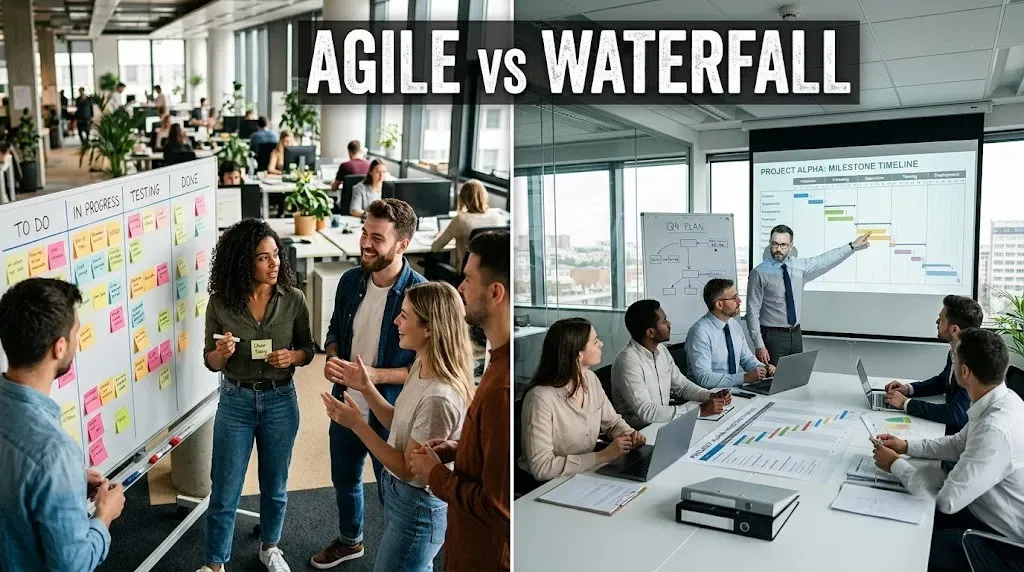
Agile vs Waterfall Complete Comparison Which Project Management Method Works Better in 2026
Agile and Waterfall are often presented as competing project management methods, but experienced teams know the decision is rarely that simple. A startup building a mobile app faces very different challenges than a government agency developing a banking system. Choosing the wrong approach can lead to delays, budget overruns, and products that no longer meet customer needs.
This comparison explains not only how Agile and Waterfall work, but also when each one is the smarter choice.
Understanding Agile and Waterfall
Waterfall follows a sequential process. Each phase such as planning, design, development, testing, and deployment is completed before moving to the next stage.
Agile divides the project into small iterations called sprints. Teams release working software regularly, gather feedback, and improve the product throughout development.
| Feature | Agile | Waterfall |
|---|---|---|
| Development Style | Iterative | Sequential |
| Requirement Changes | Easy to accommodate | Difficult after planning |
| Customer Feedback | Continuous | Mainly at milestones |
| Software Delivery | Frequent releases | Usually one final release |
| Documentation | Moderate | Extensive |
Where Waterfall still makes sense
Many articles suggest Waterfall is outdated. That overlooks industries where strict documentation, compliance, and predictable requirements are essential. Government projects, aerospace systems, medical devices, and infrastructure software often benefit from detailed planning before development begins.
If changing requirements later would be expensive or risky, Waterfall can reduce uncertainty.
Why Agile became popular
Modern software products rarely remain unchanged after launch. Customer expectations evolve, competitors introduce new features, and market conditions shift. Agile allows teams to respond to these changes without restarting the entire project.
Instead of waiting months for one large release, Agile teams deliver improvements every few weeks.
Real world comparison
| Project | Better Choice | Reason |
|---|---|---|
| Mobile Startup App | Agile | Requirements change frequently |
| Government Payroll System | Waterfall | Strict regulations and approvals |
| Ecommerce Website | Agile | Regular feature updates |
| Hospital Management Software | Hybrid | Planning with iterative improvements |
The hidden cost people rarely discuss
Agile offers flexibility, but it also demands continuous customer involvement. If stakeholders cannot review sprint results regularly, development may move in the wrong direction despite frequent releases.
Waterfall requires less day to day client participation, but mistakes discovered near the end can become expensive because changes affect completed phases.
Budget and timeline differences
| Factor | Agile | Waterfall |
|---|---|---|
| Budget Predictability | Moderate | High initially |
| Scope Flexibility | High | Low |
| Early Product Delivery | Yes | No |
| Risk of Late Changes | Lower | Higher |
A common misconception
Many teams believe Agile means no planning. In reality, successful Agile projects begin with clear goals, prioritized requirements, and realistic sprint planning. The difference is that planning continues throughout the project instead of ending before development starts.
When neither methodology is enough
Many organizations now use hybrid project management. Core system architecture and compliance requirements are planned using Waterfall principles, while user interface improvements and feature enhancements are delivered through Agile sprints. This approach combines stability with flexibility and is increasingly common in enterprise software development.
Advantages and disadvantages
| Method | Advantages | Limitations |
|---|---|---|
| Agile | Fast feedback, flexible scope, continuous improvement | Requires active customer involvement and experienced teams |
| Waterfall | Clear documentation, predictable milestones, easier compliance | Less adaptable to changing requirements |
Questions to ask before choosing
If your project requirements are well understood, regulations are strict, and changes are unlikely, Waterfall is often the safer option.
If customer feedback is essential, innovation is expected, or requirements may evolve during development, Agile usually delivers better results.
Official resources for deeper learning
The Agile Manifesto explains the principles behind Agile development, while the Project Management Institute and Scrum Alliance provide guidance on project management frameworks and certifications. Teams working in regulated industries should also follow their sector specific compliance requirements alongside any development methodology.
Agile and Waterfall should not be viewed as rivals. They are tools designed for different situations. The strongest project managers understand the trade offs, evaluate the project's risks, and choose the methodology that fits the work instead of following industry trends.

Written by
Palak PatelEducation writer Palak Patel covers the latest education news, board exam updates, results, and career opportunities.