
University vs. College vs. Institute: Understanding the Key Differences for 2026 Students
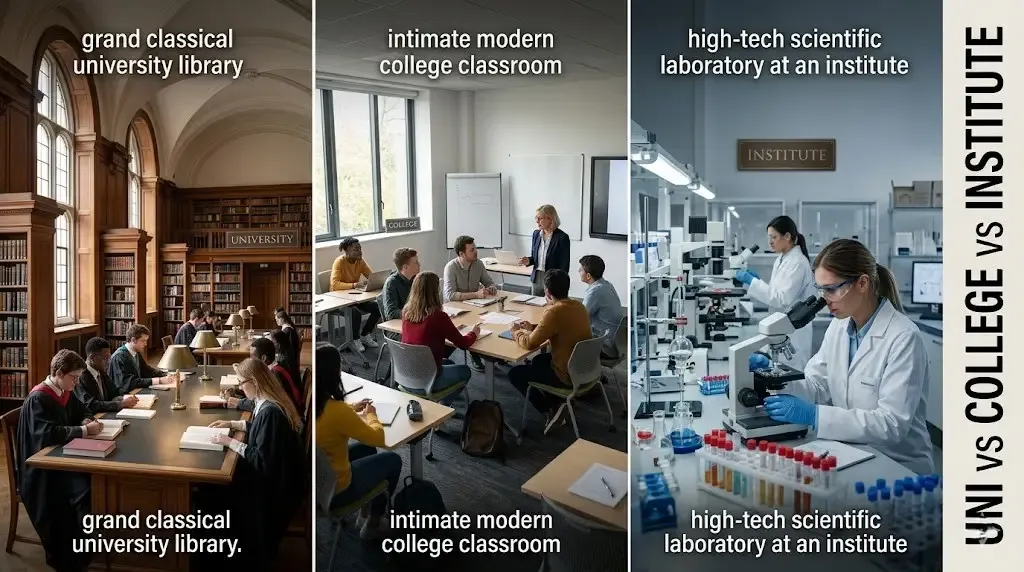
University, College, or Institute? Navigating Higher Education Terminology
As the 2026 admission season approaches, many students find themselves puzzled by academic titles. While in everyday conversation we might say we are "going to college," the technical differences between a university, a college, and an institute can impact your degree options, the type of research you do, and even your future career path. Understanding these nuances is essential for selecting an environment that aligns with your goals.
In general, the distinction lies in the scope of study and the level of degrees offered. A university is typically a broad "academic buffet," a college is often a "focused community," and an institute is a "technical specialist." Here is a deep dive into how these three types of institutions function globally.
Quick Comparison: Features at a Glance
| Feature | University | College | Institute |
|---|---|---|---|
| Primary Focus | Research & Diversity | Teaching & Undergraduate | Technical Specialization |
| Degree Levels | UG, Masters, PhD | Primarily UG (Bachelors) | Specialized UG & Grad |
| Campus Size | Large / Multi-disciplinary | Small to Medium | Medium / Niche |
| Examples | Oxford, Stanford, Harvard | Dartmouth, Williams, Amherst | MIT, Caltech, IIT |
1. The University: Broad and Research-Driven
A university is a large-scale institution that typically houses several different colleges or schools within it (e.g., College of Law, College of Medicine). The primary goal of a university is usually two-fold: high-level research and diverse degree offerings. Professors at universities are often world-renowned researchers who divide their time between teaching and expanding the boundaries of their field.
- Pros: Vast resources, massive libraries, networking with PhD students, and high global brand recognition.
- Cons: Large class sizes and less one-on-one time with senior professors.
2. The College: Focused on the Student Experience
In many education systems, a "college" refers to an institution that focuses primarily on undergraduate education. Unlike universities, which prioritize research, colleges often prioritize the quality of teaching. Many liberal arts colleges, for instance, encourage students to explore multiple subjects across the humanities and sciences before picking a major.
- Pros: Smaller class sizes, a tight-knit community, and a focus on personalized mentorship.
- Cons: Fewer postgraduate (Masters/PhD) options and potentially smaller budgets for specialized research labs.
3. The Institute: Specialized Mastery
An institute is an institution that focuses on a specific cluster of subjects, most commonly in STEM (Science, Technology, Engineering, and Math) or the performing arts. While an institute like MIT functions like a university in terms of funding and research, it remains laser-focused on technical and professional mastery. You won't typically find a massive Renaissance History department at an Institute of Technology.
- Pros: Elite facilities for specific niches, a peer group with similar technical interests, and direct pipelines to specific industries.
- Cons: A more narrow academic environment with fewer opportunities for multi-disciplinary study outside your field.
Conclusion
Whether you choose a university, college, or institute depends on what you want out of your student life. If you want a massive campus with every possible major, a university is for you. If you prefer small classes and a focus on teaching, look at colleges. If you are already certain about a technical or artistic career and want the best specialized tools, an institute is the way to go. As you prepare for the 2026 intake, remember that the quality of the specific program is often more important than the title on the building. Good luck with your applications!