
Skills Companies Want More Than Degrees in Today’s Job Market
Skills Companies Want More Than Degrees in Today’s Job Market
There was a time when simply having a degree gave students a huge advantage.
Today, recruiters ask a different question first:
“What can this person actually do?”
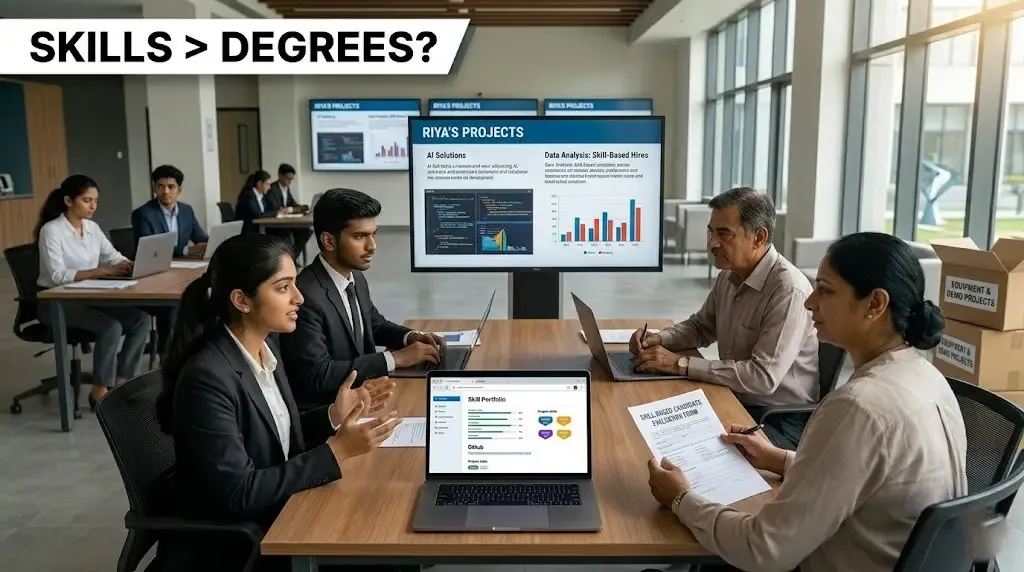
That shift is becoming visible across almost every industry. Companies still ask for degrees in job descriptions, but during actual hiring, practical ability often matters much more.
A student with strong projects, communication skills, internships, and problem-solving ability can sometimes outperform someone with better marks but weaker practical exposure.
This is one reason students are feeling confused lately.
Colleges still focus heavily on exams and theory, while recruiters increasingly focus on execution, adaptability, and real-world skills.
Why Recruiters Are Changing Their Hiring Priorities
| Old Hiring Focus | New Hiring Focus |
|---|---|
| Marks and CGPA | Practical problem-solving |
| Degree reputation | Portfolio and projects |
| Theory knowledge | Adaptability and communication |
| Memorization | Real execution ability |
| Academic performance | Internships and experience |
Part of this happened because industries now change faster than college curriculums.
By the time some universities update their syllabus, companies have already moved to newer tools, workflows, and technologies.
So recruiters increasingly test candidates directly instead of trusting degrees alone.
1. Communication Skills
This sounds basic, but recruiters mention it constantly.
Many students know technical concepts reasonably well but struggle to explain ideas clearly during interviews or teamwork situations.
Companies now heavily value candidates who can communicate confidently with clients, managers, teammates, and customers.
And no, this is not only about speaking English fluently.
Clear thinking, listening ability, confidence, and structured communication matter far more.
| Communication Skill | Why Recruiters Care |
|---|---|
| Presentation Skills | Client and team interactions |
| Email Writing | Professional communication |
| Interview Confidence | Shows clarity and preparedness |
| Listening Skills | Better teamwork and problem-solving |
Recruiters often say they can train technical tools faster than they can fix poor communication habits.
2. Problem-Solving Ability
Companies increasingly want employees who can handle unfamiliar situations calmly.
This is why interview rounds now include case studies, coding challenges, practical tasks, or scenario-based questions.
Recruiters are trying to measure how candidates think under pressure.
Even non-technical jobs now expect analytical thinking.
A marketing company may ask how you would improve engagement. A sales company may test how you handle objections. A tech company may give debugging problems.
The degree becomes secondary if the candidate demonstrates strong reasoning ability.
3. Digital and Technical Skills
Almost every industry now expects some level of digital comfort.
Even traditional sectors increasingly rely on software tools, automation platforms, analytics dashboards, or online collaboration systems.
Students who understand technology usually adapt faster inside companies.
| Skill | Industries Using It |
|---|---|
| Excel and Data Handling | Finance, operations, analytics |
| Basic Coding | Tech, startups, automation |
| Digital Marketing | Media, ecommerce, brands |
| AI Tool Usage | Almost every industry now |
| Cloud Platforms | IT and enterprise companies |
Many recruiters now expect freshers to already know at least the basics of modern digital workflows.
4. Internship Experience
This is becoming one of the biggest hiring filters.
Students with internships usually understand workplace expectations better than those with only classroom experience.
Even short internships can help candidates stand out because they show initiative.
Recruiters often prefer someone with moderate marks and strong internship exposure over someone with perfect grades but zero practical work.
That shift has become extremely noticeable during placements.
5. Adaptability and Learning Speed
Industries change quickly now.
Companies know tools, software, and workflows may evolve constantly. So they increasingly hire people who learn fast rather than people who only memorize existing systems.
This is especially true in technology, media, startups, marketing, and AI-related roles.
Recruiters often ask candidates about side projects, certifications, online learning, or self-improvement habits because they want proof that the person keeps learning independently.
Real Things Recruiters Say During Hiring
Students are often surprised when recruiters care less about marks than expected.
| Recruiter Concern | What They Actually Mean |
|---|---|
| “Show us your projects” | Can you apply skills practically? |
| “Tell us about challenges” | How do you solve problems? |
| “What tools have you used?” | Do you understand modern workflows? |
| “Describe your internship” | Can you function in real work environments? |
| “How do you learn new skills?” | Are you adaptable long-term? |
These questions reveal how strongly hiring is shifting toward capability instead of pure academics.
Job Descriptions Are Quietly Changing Too
Many modern job listings now include lines like:
“Portfolio preferred.”
“Practical experience is a plus.”
“Strong communication and analytical skills required.”
“Hands-on project experience preferred.”
“Self-learners encouraged to apply.”
These phrases matter more than students realize.
They show companies increasingly want adaptable candidates instead of people relying only on formal qualifications.
Degrees Still Matter - But Differently
This does not mean degrees became useless.
Degrees still help students build fundamentals, qualify for interviews, and enter regulated professions like medicine, law, or engineering.
But companies increasingly treat degrees as a starting filter rather than proof of job readiness.
The real differentiation now comes from skills, projects, internships, networking, and execution ability.
That’s the biggest shift happening quietly across the hiring market.
Skills Students Should Build Alongside Degrees
| Skill Area | Why It Matters |
|---|---|
| Communication | Improves interviews and teamwork |
| Problem-Solving | Critical across industries |
| Digital Skills | Required in modern workplaces |
| Internships | Provides practical exposure |
| Portfolio Building | Shows real ability |
| Networking | Creates career opportunities |
Conclusion
The hiring market is changing faster than many colleges can adapt.
Recruiters still value degrees, but they increasingly care more about what students can actually contribute from day one.
That’s why communication, practical projects, internships, adaptability, and technical exposure now influence placements so heavily.
The students getting the best opportunities are often not just the ones with top marks.
They’re the ones who treated college as a platform to build real-world skills alongside their degree.

Written by
MonishMonish is an education writer covering exams, student rights, academic awareness, and other education-related topics, with practical guidance for students.