
MBA Colleges With Lowest Fees & Highest Salaries in India
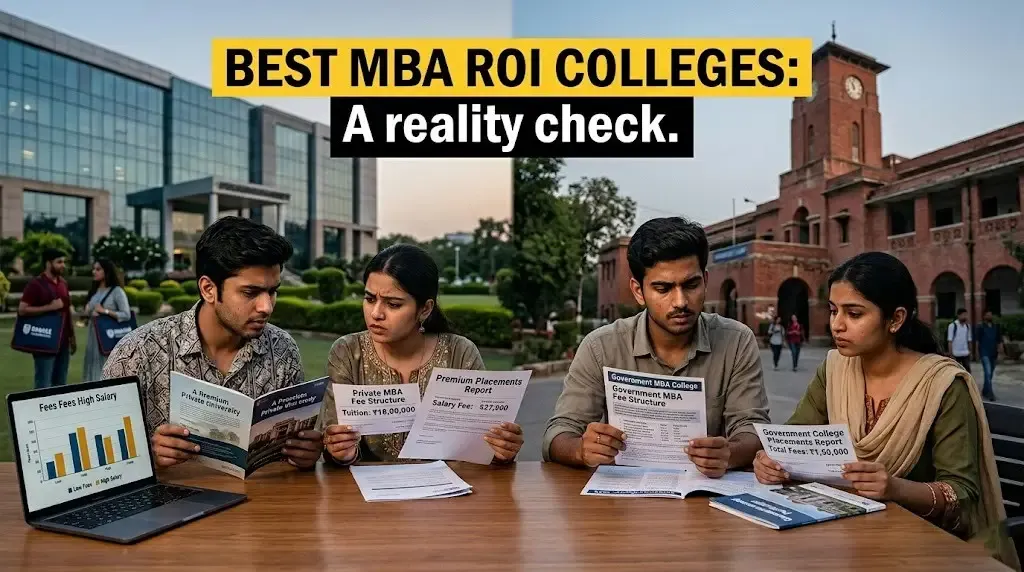
MBA Colleges With Lowest Fees & Highest Salaries in India
MBA has become one of the most expensive degrees in India.
Some business schools now charge fees higher than ₹25–30 lakh for two years. Add hostel, living expenses, laptops, certifications, and city costs - and students often graduate with massive financial pressure.
That’s why ROI has become one of the biggest discussions among MBA aspirants.
And honestly, students are asking the right question now:
If two colleges offer similar salaries, why pay drastically different fees?
Interestingly, some of India’s strongest MBA ROI colleges are not the most expensive ones. A few government B-schools and IIT management departments quietly offer exceptional placement packages while charging relatively low fees. :contentReference[oaicite:0]{index=0}
What Makes an MBA College High ROI?
| Factor | Why Students Care |
|---|---|
| Total Fees | Lower financial burden |
| Average Package | Career starting salary |
| Median Salary | More realistic outcome |
| Placement Consistency | Recruiter trust matters |
| Brand Value | Long-term career impact |
Students increasingly compare fees against median salary instead of blindly chasing rankings alone.
1. FMS Delhi - Probably the Best MBA ROI in India
Whenever MBA ROI discussions happen, one name appears almost immediately:
Faculty of Management Studies (FMS), Delhi University.
FMS became famous because its fees remain extremely low compared to the salaries students receive after graduation.
Recent reports place FMS fees around ₹2–2.5 lakh for the full MBA while average placement packages crossed ₹34 LPA. :contentReference[oaicite:1]{index=1}
| FMS Delhi Highlights | Approximate Figure |
|---|---|
| Total MBA Fees | ₹2–2.5 Lakh |
| Average Package | ₹34 LPA+ |
| Median Package | ₹31 LPA approx. |
| Main Recruiters | Consulting, finance, tech firms |
That fee-to-salary ratio is why many CAT aspirants consider FMS one of the smartest MBA choices financially. :contentReference[oaicite:2]{index=2}
2. JBIMS Mumbai - Strong Salary, Lower Cost
Jamnalal Bajaj Institute of Management Studies (JBIMS) is another college known for strong ROI.
Its fees remain significantly lower than most premium private MBA colleges while placements continue performing strongly.
Reports place JBIMS fees around ₹8 lakh with average salaries crossing ₹22–26 LPA in recent cycles. :contentReference[oaicite:3]{index=3}
Mumbai’s finance ecosystem helps heavily here because students gain strong exposure to banking, consulting, and corporate hiring networks.
3. TISS Mumbai - Extremely Affordable for HR Careers
TISS Mumbai is technically not a traditional MBA in the standard sense, but its HR and management-related programs have exceptional reputation.
Its fees are surprisingly low compared to placement quality.
Several ROI-focused MBA reports repeatedly mention TISS because students often spend below ₹2 lakh while securing excellent HR placements afterward. :contentReference[oaicite:4]{index=4}
| Why TISS Stands Out | Student Advantage |
|---|---|
| Low Fees | Minimal education debt |
| Strong HR Reputation | Excellent recruiter trust |
| Industry Exposure | Good internship ecosystem |
| Mumbai Location | Corporate access advantage |
4. IIT MBA Programs Quietly Offer Excellent ROI
Many students still underestimate IIT MBA departments.
But IIT Delhi, IIT Bombay, IIT Kharagpur, and IIT Madras increasingly deliver strong placement outcomes with fees much lower than top private B-schools. :contentReference[oaicite:5]{index=5}
IIT Delhi’s DMS program especially receives strong attention because fees remain around ₹12 lakh while average packages reportedly crossed ₹23 LPA. :contentReference[oaicite:6]{index=6}
| IIT MBA College | Approximate Fees | Average Package |
|---|---|---|
| IIT Delhi (DMS) | ₹12 Lakh | ₹23–25 LPA |
| IIT Bombay (SJMSOM) | ₹14–15 Lakh | ₹25 LPA+ |
| IIT Kharagpur (VGSoM) | ₹11–12 Lakh | ₹22 LPA+ |
| IIT Madras (DoMS) | ₹11 Lakh approx. | ₹17–18 LPA |
These colleges often attract engineers who want strong analytics, consulting, operations, or tech-management careers.
5. SIMSREE and Delhi University MBA Programs
SIMSREE Mumbai, Delhi School of Economics (DSE), DFS Delhi, and DBE Delhi also appear frequently in low-fee high-ROI discussions.
Their government-backed structure keeps fees low while placement outcomes remain respectable compared to investment size. :contentReference[oaicite:7]{index=7}
Students focused heavily on ROI often prioritize these colleges over expensive Tier-2 private business schools.
Why Expensive MBA Colleges Still Exist
This is important too.
Higher fees do not automatically mean bad ROI.
Top IIMs, ISB, XLRI, SPJIMR, and MDI still offer exceptional networking, branding, recruiter quality, alumni access, and long-term career acceleration.
Many students willingly pay higher fees because the brand value can influence career growth for years.
But students increasingly calculate whether the salary difference justifies the investment gap.
What MBA Aspirants Should Compare Carefully
| Important Metric | Why It Matters |
|---|---|
| Median Package | More realistic than highest salary |
| Total Cost | Includes hostel and living expenses |
| Education Loan Burden | Impacts post-MBA flexibility |
| Industry Alignment | Consulting, finance, tech, HR etc. |
| Alumni Network | Long-term career support |
Students are becoming far more financially aware now compared to earlier MBA generations.
Conclusion
The Indian MBA market is changing quickly.
Students no longer blindly assume the most expensive MBA automatically creates the best career outcome.
Colleges like FMS Delhi, JBIMS, TISS Mumbai, and IIT MBA departments proved that strong placements and low fees can exist together. :contentReference[oaicite:8]{index=8}
At the same time, premium institutions still maintain enormous brand value and recruiter strength.
The smartest MBA decision now depends less on hype and more on one question:
How much career value are you getting for the money you spend?

Written by
MonishMonish is an education writer covering exams, student rights, academic awareness, and other education-related topics, with practical guidance for students.