
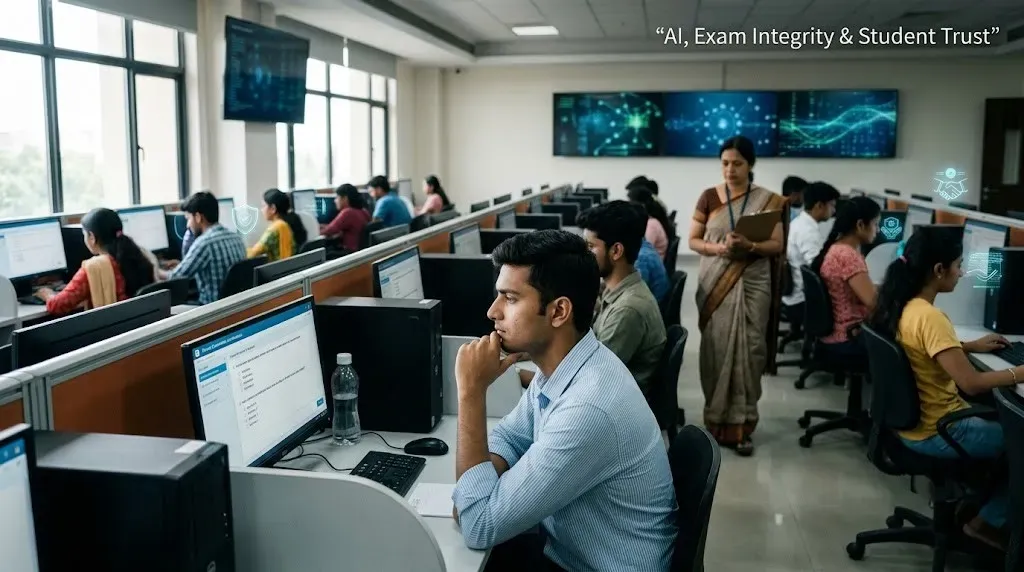
India’s Education System Faces a New Challenge: AI, Exam Integrity and Student Trust
Artificial intelligence is becoming an increasingly visible part of education. Students can use AI tools to explain difficult concepts, generate ideas, practise questions, summarise information and assist with research. At the same time, the technology has created a difficult question for educational institutions: how can assessments measure a student's own knowledge and skills when AI can produce answers within seconds?
For India's education system, the issue goes beyond technology. It involves academic integrity, fairness, assessment design and student trust. Institutions need to find a balance between preventing misuse of AI and ensuring that students can learn to use a technology that is increasingly becoming part of the modern workplace.
How AI Is Changing Student Learning
AI can make learning more accessible by providing explanations, examples and practice material according to a student's needs. A learner struggling with a programming concept, mathematical problem or difficult academic topic can use AI as an additional source of explanation.
| Potential Use of AI | Possible Educational Benefit |
|---|---|
| Concept explanations | Students can receive additional explanations when a topic is difficult. |
| Practice questions | Students can practise concepts and identify areas that need improvement. |
| Writing assistance | AI can help students organise ideas and improve drafts when used appropriately. |
| Programming support | Students can receive examples and explanations while learning to code. |
The Exam Integrity Problem
The same technology that can help students learn can also be misused. If a student submits AI-generated work as their own or uses an unauthorised AI tool during an assessment, the resulting grade may not accurately represent the student's knowledge.
This creates a particular challenge for traditional assignments that rely heavily on written submissions. Institutions may need to reconsider how assessments are designed rather than relying only on tools that attempt to identify AI-generated content.
| Challenge | Why It Matters |
|---|---|
| AI-assisted cheating | Grades may not reflect a student's independent knowledge. |
| AI-generated assignments | Traditional written assignments can become harder to evaluate for genuine learning. |
| Detection limitations | AI-detection systems should not automatically be treated as definitive proof of misconduct. |
| Unequal access | Differences in access to technology can create additional fairness concerns. |
Why Student Trust Matters
Academic integrity depends not only on rules but also on trust between students and institutions. Students need to understand what forms of AI use are allowed, while institutions need transparent policies that are applied consistently.
If students are unsure whether using AI for brainstorming, editing, research or explanations is permitted, they may unintentionally violate academic rules. Clear guidelines can reduce this uncertainty and encourage responsible use.
Should Colleges Ban AI Completely?
A complete ban may not address the underlying challenge because AI tools are becoming part of many professional and academic environments. Instead, institutions can distinguish between authorised and unauthorised use. For example, an assignment may permit AI-assisted brainstorming while requiring students to disclose how AI was used and demonstrate their own understanding of the final work.
| Assessment Approach | How It Can Help |
|---|---|
| Oral presentations | Students must explain their ideas and demonstrate understanding. |
| Viva examinations | Teachers can directly assess conceptual knowledge. |
| Practical projects | Students can demonstrate how they apply knowledge to real problems. |
| Process-based assessment | Drafts, research notes and development stages can provide evidence of learning. |
What Students Should Do
Students should treat AI as a learning assistant rather than a replacement for their own thinking. Before using an AI tool for an assignment or assessment, they should check their institution's academic-integrity policy and understand whether AI assistance is permitted.
| Good Practice | Why It Helps |
|---|---|
| Verify AI-generated information | AI can produce inaccurate or incomplete information. |
| Understand the final answer | Students remain responsible for the work they submit. |
| Follow college rules | Prevents accidental violations of academic-integrity policies. |
| Disclose AI use when required | Creates transparency between students and institutions. |
The Future of Assessment in India
The growing availability of AI is likely to encourage educational institutions to rethink how student learning is evaluated. Rather than measuring only the ability to reproduce information, assessments can increasingly focus on reasoning, application, creativity, practical skills and the ability to explain decisions.
India's education system therefore faces a challenge as well as an opportunity. AI can make learning more accessible and personalised, but its responsible use requires clear rules, better assessment methods and open communication. Maintaining student trust will be just as important as adopting new technology.