
IIT Bombay Puts 8-Year Cap on PhD: What It Means for Research Students
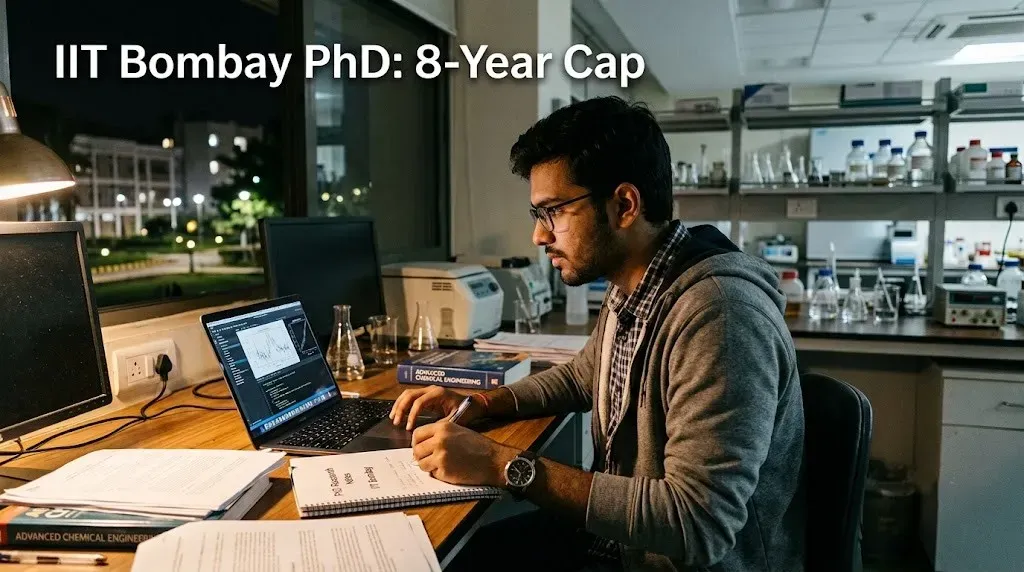
IIT Bombay Puts 8-Year Cap on PhD: What It Means for Research Students
IIT Bombay has put a firm outer limit on the time students can remain registered for a PhD. Under the institute's current PhD rules, registration can be extended up to a maximum of eight years for most categories of students, after which the registration is cancelled automatically. External and College Teacher category students have a higher maximum of 10 years.
The change matters because a PhD does not always move at the pace of a normal degree. Laboratory failures, delayed experiments, data collection, publication requirements or a change in research direction can add months to a project. IIT Bombay's own rules still provide a process for seeking extensions before the maximum period is reached, so the eight-year figure should be understood as the outer boundary rather than an automatic eight-year course duration.
| Point | What the rule means |
|---|---|
| Maximum registration period | Most PhD categories can reach a maximum of 8 years from the date of joining. |
| External and College Teacher category | The maximum period is higher, at 10 years. |
| After the maximum period | Registration is cancelled automatically under the stated rules. |
For a new research scholar, the practical lesson is fairly simple. Waiting until the final year to deal with unfinished work is risky. IIT Bombay's rules require students who need an extension to follow the prescribed academic process, and the latest rule document links longer registration with academic progress requirements such as APS and pre-synopsis milestones.
There is a positive side to the tighter timeline. A long-running PhD can become financially and academically difficult for both the student and the department. A defined endpoint creates pressure to identify stalled research earlier, review supervision problems and decide whether a project needs to be narrowed before too much time is lost.
The difficult part will be distinguishing genuine delay from poor planning. Some research questions simply need repeated experiments or long observation periods. A student working on a theoretical project may have a very different completion path from someone dependent on laboratory equipment, external data or field research.
Students joining IIT Bombay should therefore track their research milestones well before the final registration year. Keeping the supervisor, department committee and required academic presentations aligned becomes especially important when a project starts slipping behind schedule.
Written by
Palak PatelEducation writer Palak Patel covers the latest education news, board exam updates, results, and career opportunities.