
Degrees Losing Value in India as Placements Become Harder
Degrees Losing Value in India as Placements Become Harder
For years, Indian students were told something very simple:
“Get a degree and life will settle automatically.”
That formula worked reasonably well earlier. A college degree often guaranteed at least some level of stability, especially for middle-class families trying to secure safer careers for their children.
But things have changed quietly.
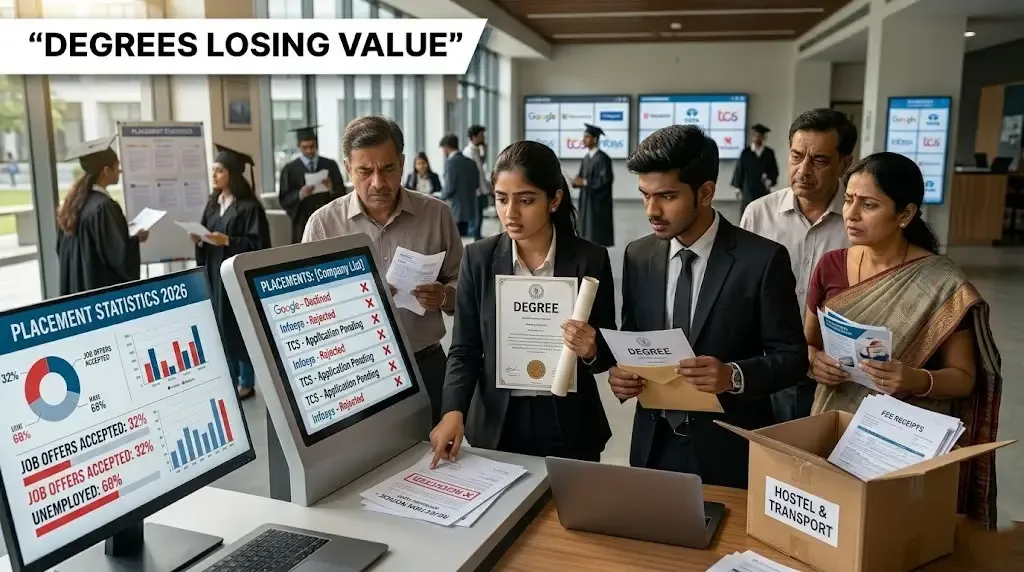
Today, thousands of graduates are finishing degrees only to discover weak placements, low salaries, or industries demanding completely different skills than what colleges actually teach.
The uncomfortable reality is that not all degrees hold the same value anymore.
Some are still respected and linked to strong demand. Others are slowly becoming oversaturated because too many students are entering the same fields while job creation struggles to keep up.
Why Students Feel Degrees Are Losing Value
| Major Problem | What Students Experience |
|---|---|
| Oversupply of Graduates | Too many degree holders competing for limited jobs |
| Weak Placements | Low salary offers or no campus hiring |
| Outdated Curriculum | Industry skills not taught properly |
| Skill-Based Hiring | Companies focusing more on portfolios and practical work |
| Automation | Repetitive jobs shrinking slowly |
This does not mean degrees are becoming useless entirely.
But the market is clearly separating “high-demand specialized degrees” from generic degrees with weaker industry alignment.
1. Generic MBA Programs Are Facing Pressure
MBA still sounds prestigious in India. Families often treat it like a guaranteed salary upgrade.
But the placement gap between top MBA colleges and average private institutes has become massive.
Elite institutes still attract strong recruiters. Lower-tier MBA colleges often struggle to provide meaningful opportunities.
Many students now graduate with large education loans and average sales roles paying far less than expected.
| MBA Type | Current Placement Reality |
|---|---|
| Top B-Schools | Still strong demand |
| Average Private MBA Colleges | Highly inconsistent placements |
| Distance MBA | Limited employer value in many sectors |
The degree itself is not the issue. The oversupply of average MBA programs is.
2. Traditional BTech Degrees Without Skills
Engineering still produces huge numbers of graduates every year in India.
But companies increasingly complain that many students lack practical problem-solving ability, communication skills, or real project experience.
That’s why placement differences between colleges are becoming extreme.
Students from strong institutes with coding culture and internship exposure still do well. Others struggle badly despite holding the same degree title.
Repetitive coding tasks are also becoming easier to automate through AI-assisted development tools.
| BTech Situation | Impact on Students |
|---|---|
| Strong Coding Skills | Good placement opportunities |
| Theory-Only Learning | Weak employability |
| No Internships | Limited recruiter interest |
| Outdated Labs | Poor industry readiness |
Many recruiters now care more about GitHub projects, internships, and actual technical ability than marks alone.
3. Some Traditional Arts Degrees Are Struggling
This topic becomes controversial quickly, but students themselves are already discussing it openly.
Certain general BA programs now face serious placement limitations unless students build additional skills alongside the degree.
The problem is not intelligence or talent. It is industry alignment.
Many students complete degrees without clear career direction afterward.
That often pushes graduates toward competitive exams simply because campus placement options remain limited.
Fields like media, digital marketing, UX writing, psychology, and communication still create opportunities - but students usually need portfolios, internships, or specialization beyond the degree itself.
4. Degrees Dependent on Memorization Are Weakening
Industries increasingly reward adaptability now.
Degrees built heavily around rote memorization without practical application are facing pressure because information itself is easily accessible online.
Companies want people who can solve problems, communicate clearly, work with technology, and adapt quickly.
Simply reproducing textbook theory is becoming less valuable.
This shift explains why certifications, internships, portfolios, freelancing, and practical projects now influence hiring so heavily.
Placement Trends Students Are Noticing
Students across many campuses report similar patterns during placement season.
| Trend | What It Means |
|---|---|
| Mass Recruiters Dominating | Lower average salary packages |
| Fewer Core Jobs | Engineering students moving into IT roles |
| Higher Competition | More students chasing limited openings |
| Skill-Based Hiring | Projects matter more than marks |
| Internship Importance | Experience becoming essential |
Many colleges still advertise huge placement numbers, but students are increasingly asking deeper questions now:
What is the median salary?
How many students were actually placed?
How many got core jobs instead of generic support roles?
That shift in awareness is important.
Degrees Still Holding Strong Value
While some degrees face declining placement confidence, others continue to remain relatively stable because industry demand stays strong.
| Degree Area | Why Demand Remains Strong |
|---|---|
| Healthcare | Human-centered work remains essential |
| Cybersecurity | Growing digital threat landscape |
| Law | Complex regulation and human negotiation |
| Data Science | High analytics demand |
| Skilled Technical Trades | Hands-on work difficult to automate |
The strongest career paths now usually combine formal education with practical skills.
The Bigger Problem Nobody Wants to Admit
Part of the issue is that colleges expanded faster than industry demand.
India now produces massive numbers of graduates every year, but not enough high-quality jobs grow at the same speed.
So degrees alone no longer create automatic differentiation.
That’s why students increasingly feel pressure to build personal brands, side projects, certifications, networking profiles, freelancing experience, or startup ideas while still studying.
College is slowly becoming just one layer of employability instead of the entire package.
Conclusion
Degrees are not disappearing in importance.
But the era where any degree automatically guaranteed stable placements is clearly weakening.
Students now need stronger practical skills, industry exposure, communication ability, and adaptability alongside formal education.
The degrees losing value fastest are usually the ones disconnected from actual market demand.
And the students succeeding today are often the ones treating college as a starting point, not the complete solution.

Written by
MonishMonish is an education writer covering exams, student rights, academic awareness, and other education-related topics, with practical guidance for students.