
Careers in Climate Technology: Skills, Jobs and Future Scope
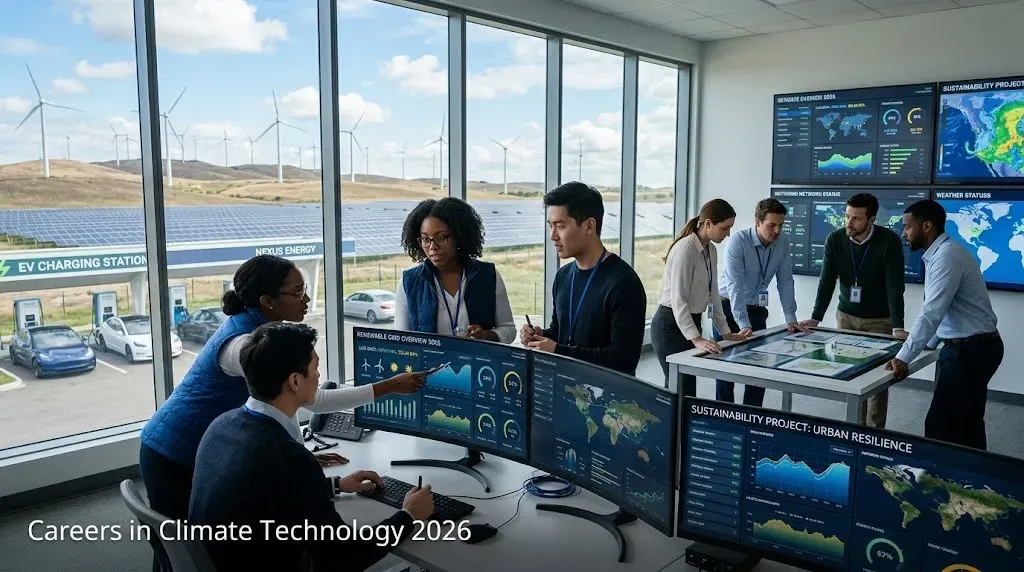
Careers in Climate Technology Skills Jobs and Future Scope
Climate technology has quietly become one of the fastest growing career sectors. Companies are investing in clean energy, electric mobility, carbon management, smart agriculture and climate data platforms. The result is a growing demand for professionals who understand both technology and sustainability.
The biggest misconception is that climate technology jobs are only for environmental science graduates. In reality, software developers, engineers, data analysts, finance professionals and management graduates are entering the industry in large numbers.
What exactly is Climate Technology
Climate technology includes products and services that help reduce greenhouse gas emissions or help communities adapt to climate change. It covers renewable energy, carbon capture, electric vehicles, green buildings, climate analytics, sustainable manufacturing and precision agriculture.
Most in demand climate technology jobs
| Job Role | Main Skills | Growing Industries |
|---|---|---|
| Climate Data Analyst | Python, GIS, Data Analytics | Research and Consulting |
| Renewable Energy Engineer | Solar and Wind Systems | Energy Companies |
| Carbon Accounting Specialist | ESG Reporting, Sustainability | Corporate Sector |
| EV Infrastructure Engineer | Electrical Engineering | Electric Mobility |
| Climate Risk Consultant | Risk Analysis, Finance | Banking and Insurance |
| Sustainability Manager | Project Management | Manufacturing |
| Green Building Consultant | Energy Efficiency | Construction |
| Climate AI Engineer | Machine Learning | Climate Startups |
The skills employers are actually looking for
Technical knowledge alone is rarely enough. Companies increasingly prefer candidates who can combine programming, engineering or business skills with sustainability concepts. Learning Python, data visualization, ESG reporting, carbon accounting, GIS tools and AI applications can significantly improve job prospects.
Communication skills also matter because many climate professionals work with governments, investors, scientists and business leaders on the same projects.
One trend many students miss
Many graduates prepare only for renewable energy jobs. However, one of the fastest growing hiring areas is climate software. Startups are building platforms that monitor emissions, calculate carbon footprints, optimize energy consumption and help companies comply with sustainability regulations. This creates opportunities for computer science, data science and software engineering graduates who may never work inside a laboratory.
Who should consider this career
| Background | Suitable Career Path |
|---|---|
| Computer Science | Climate AI and Data Platforms |
| Mechanical Engineering | Renewable Energy Systems |
| Electrical Engineering | Electric Vehicles and Smart Grids |
| Civil Engineering | Green Infrastructure |
| Commerce and MBA | ESG and Sustainability Consulting |
| Environmental Science | Climate Policy and Research |
Future scope in India
India's expansion of renewable energy, electric mobility, green hydrogen, sustainable manufacturing and climate finance is expected to create thousands of new jobs over the next decade. Government initiatives along with private investment are encouraging startups and established companies to develop climate focused technologies.
Global companies are also setting carbon reduction targets, increasing demand for professionals who understand sustainability reporting, emissions measurement and climate risk management.
Questions students usually ask
Do I need an environmental science degree?
No. Graduates from engineering, computer science, commerce, economics and management are increasingly entering climate technology roles.
Is coding useful in climate technology?
Yes. Python, SQL, machine learning, GIS and data visualization are valuable skills for climate analytics, smart energy systems and emissions tracking.
Are salaries competitive?
Entry level salaries vary by role and employer, but professionals with technical expertise and sustainability knowledge generally see strong career growth as demand for climate technology continues to rise.
Climate technology is no longer a niche industry. It sits at the intersection of engineering, software, finance and environmental science. Students who develop interdisciplinary skills today are likely to find themselves in one of the most resilient and rapidly expanding job markets of the coming decade.

Written by
Palak PatelEducation writer Palak Patel covers the latest education news, board exam updates, results, and career opportunities.
Comments
No comments yet. Be the first!