
Best Emerging Courses in India Nobody Knew About a Few Years Ago
Best Emerging Courses in India Nobody Knew About a Few Years Ago
Career trends in India are changing faster than most school counselors can keep up with.
A few years ago, nearly every student conversation revolved around the same options - engineering, MBBS, MBA, CA, or government jobs.
Now completely different industries are growing quietly in the background.
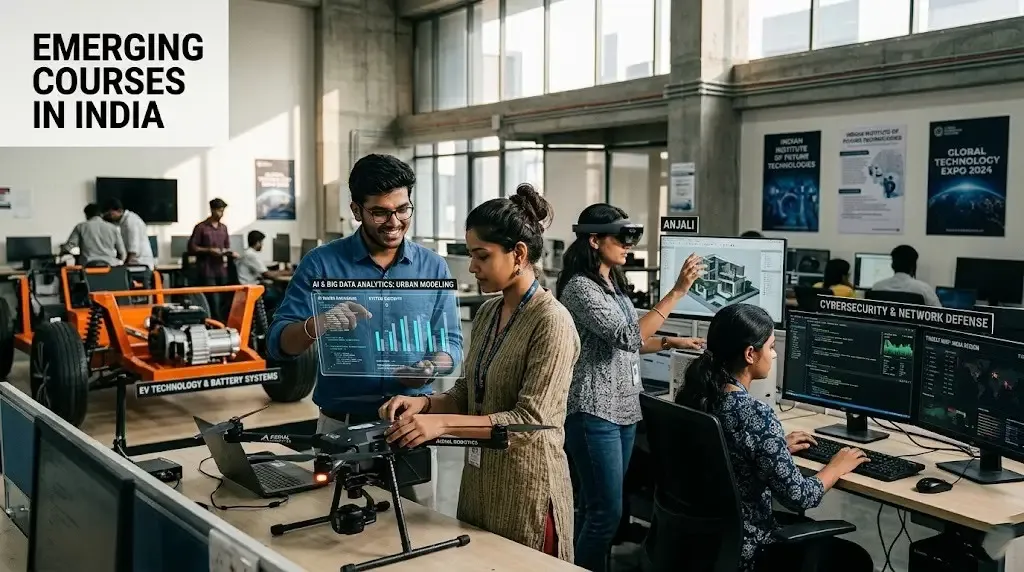
AI systems need regulation. Electric vehicles need engineers. Companies are desperate for cybersecurity experts. Drone technology is moving beyond military use into logistics, farming, mapping, and surveillance.
The interesting part is that many of these fields barely existed in mainstream college discussions not long ago.
Students who notice these shifts early often gain a major advantage because competition is still lower compared to overcrowded traditional paths.
Quick Comparison of Emerging Courses
| Course | Main Industry | Demand Growth | Best For |
|---|---|---|---|
| AI Ethics | Artificial Intelligence | Growing Fast | Tech + Policy Students |
| Cybersecurity | Digital Security | Very High | Tech Students |
| Drone Technology | Aviation & Automation | High | Engineering & Robotics |
| EV Engineering | Electric Vehicles | Very High | Mechanical & Electrical Students |
| Data Analytics | Business & Technology | Very High | Math & Tech Students |
1. AI Ethics
Most students know about artificial intelligence now.
Very few know about AI Ethics.
This field focuses on the human side of AI systems - fairness, privacy, bias, accountability, and responsible usage.
As AI becomes more powerful, governments and companies increasingly worry about misuse, misinformation, surveillance, and biased decision-making.
That creates demand for professionals who understand both technology and ethics.
This area combines law, psychology, philosophy, technology, and policy thinking together.
| AI Ethics Work Areas | Typical Responsibility |
|---|---|
| AI Policy | Regulation and governance |
| Ethical Auditing | Checking AI bias and fairness |
| Privacy Compliance | Data protection standards |
| Responsible AI Research | Human-centered AI systems |
Students interested in technology but also social impact often find this field surprisingly interesting.
2. Cybersecurity
Cybersecurity stopped being a niche field the moment almost everything became digital.
Banks, hospitals, startups, universities, ecommerce companies, and even governments now face regular cyber threats.
That means skilled cybersecurity professionals are constantly needed.
The interesting part is that cyber attacks are becoming more advanced because attackers also use automation and AI tools.
So companies want people who can think unpredictably and respond quickly under pressure.
| Cybersecurity Role | Main Focus |
|---|---|
| Ethical Hacker | Finding security weaknesses |
| Security Analyst | Threat monitoring |
| Cloud Security Engineer | Protecting cloud systems |
| Digital Forensics Expert | Investigating cyber attacks |
Unlike many overcrowded tech fields, cybersecurity still has a noticeable talent shortage.
3. Drone Technology
A lot of students still associate drones mainly with cameras or military use.
But drone technology is expanding rapidly into agriculture, mapping, surveillance, logistics, disaster management, infrastructure inspection, and delivery systems.
India’s growing interest in domestic drone manufacturing and automation has created demand for trained professionals in this sector.
This field mixes electronics, robotics, aviation systems, GPS technology, and AI-driven automation.
Some colleges now offer specialized drone programs, while others include drone modules inside engineering courses.
| Drone Industry Use | Example Application |
|---|---|
| Agriculture | Crop monitoring and spraying |
| Construction | Site mapping and inspection |
| Logistics | Delivery systems |
| Security | Surveillance operations |
Students interested in robotics, hardware, or automation often enjoy this field because it feels far more hands-on than traditional classroom theory.
4. EV Engineering
Electric vehicles changed the automotive industry much faster than many expected.
Traditional automobile engineering focused heavily on combustion engines. EV engineering shifts attention toward batteries, charging systems, power electronics, electric motors, and smart mobility systems.
As electric vehicles grow across India, companies increasingly need engineers trained specifically for EV technologies.
This includes manufacturing, battery systems, maintenance, charging infrastructure, and energy management.
| EV Engineering Area | Main Focus |
|---|---|
| Battery Technology | Energy storage systems |
| Power Electronics | Electrical control systems |
| Charging Infrastructure | EV charging networks |
| Vehicle Automation | Smart mobility systems |
Mechanical and electrical engineering students increasingly specialize in EV-focused subjects because traditional automotive industries are changing rapidly.
5. Data Analytics
Almost every company now collects huge amounts of data.
The problem is that most organizations still struggle to interpret it properly.
That’s why data analytics became one of the fastest-growing career fields across industries.
Retail companies analyze customer behavior. Banks study financial patterns. Healthcare systems track patient data. Sports teams even use analytics for performance decisions.
Students with mathematics, statistics, business, or programming interest often enter this field.
| Analytics Skill | Common Industry Use |
|---|---|
| Excel & Dashboards | Business reporting |
| SQL | Database analysis |
| Python | Automation and analytics |
| Visualization Tools | Decision-making insights |
One reason data analytics remains attractive is that demand exists beyond just tech companies.
Why Emerging Courses Matter Now
Traditional degrees are not disappearing.
But industries increasingly reward specialization tied to real market demand.
Students entering newer fields early often benefit because:
| Advantage | Why It Helps |
|---|---|
| Lower Competition | Fewer trained professionals available |
| Higher Demand Growth | Industries expanding rapidly |
| Better Salary Potential | Specialized skills command value |
| Future Relevance | Strong alignment with modern industries |
That said, students should still research carefully before chasing “trending” courses blindly.
Some colleges aggressively market futuristic programs without proper faculty, labs, or industry exposure.
The course title alone does not guarantee career success.
Conclusion
The Indian education landscape is changing quietly but rapidly.
Fields like AI Ethics, Cybersecurity, Drone Technology, EV Engineering, and Data Analytics barely appeared in mainstream student conversations not long ago.
Now they are shaping some of the fastest-growing industries.
Students who pay attention to emerging sectors early often position themselves better for future opportunities compared to those following overcrowded traditional paths without clear demand.
The smartest approach now is not simply choosing a famous degree.
It’s understanding where industries are actually moving.

Written by
MonishMonish is an education writer covering exams, student rights, academic awareness, and other education-related topics, with practical guidance for students.