Best Books Recommended by UPSC Toppers for Civil Services Preparation
Walk into any UPSC coaching library and you'll see shelves packed with hundreds of books claiming to be essential for Civil Services preparation. That's part of the problem. Many beginners end up collecting study material instead of actually studying it.
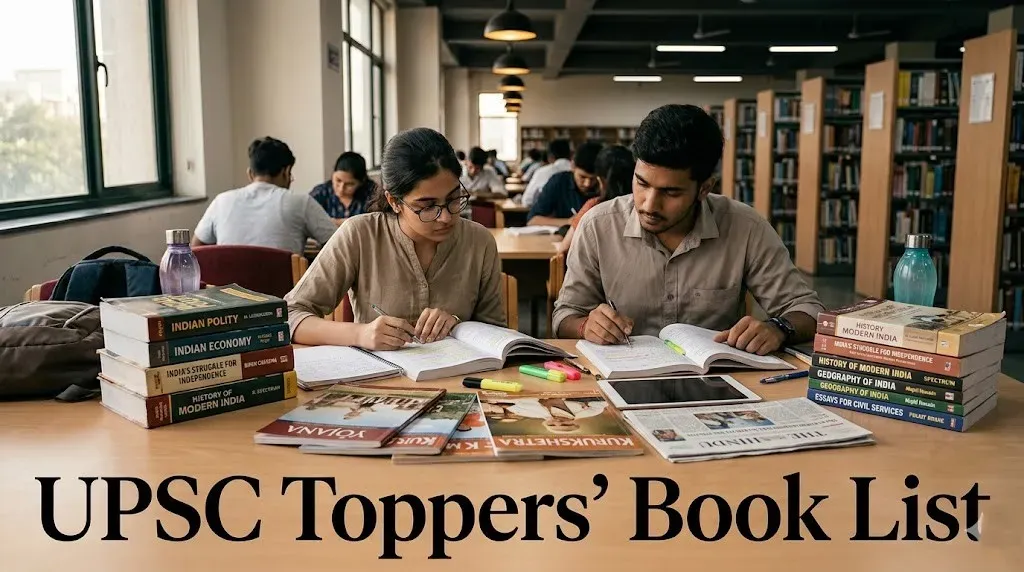
Interestingly, most UPSC toppers don't recommend dozens of books. In fact, many of them repeatedly stress the importance of limiting resources and revising the same trusted books multiple times. The goal isn't to read everything-it's to master the right material.
UPSC Toppers' Recommended Books at a Glance
| Subject | Recommended Book | Author/Publisher |
|---|---|---|
| Polity | Indian Polity | M. Laxmikanth |
| Modern History | A Brief History of Modern India | Spectrum Publications |
| Ancient & Medieval History | Old NCERT History Books | NCERT |
| Geography | Certificate Physical and Human Geography | G.C. Leong |
| Economy | Indian Economy | Ramesh Singh |
| Environment | Environment | Shankar IAS Academy |
| Current Affairs | The Hindu / Indian Express | Newspapers |
Start with NCERT Books
If there's one piece of advice almost every topper gives, it's this: don't skip NCERTs. These books build the foundation needed for understanding advanced topics later.
Subjects such as History, Geography, Economics, Political Science, and Sociology should ideally be covered through Class 6 to 12 NCERT textbooks before moving on to reference books.
Indian Polity by M. Laxmikanth
Ask UPSC aspirants to name one must-read book and this title will probably come up first. Laxmikanth's Indian Polity is considered the standard resource for governance, constitutional provisions, Parliament, judiciary, and political institutions.
Many toppers revise this book multiple times because questions from Polity regularly appear in both Prelims and Mains.
Spectrum for Modern History
Modern Indian History is one of the highest-scoring areas in UPSC Prelims. Spectrum's concise presentation makes it easier to revise important events, movements, and personalities associated with India's freedom struggle.
For many aspirants, this book becomes the primary source for modern history preparation.
Best Books for Geography and Environment
| Subject | Book | Why Toppers Recommend It |
|---|---|---|
| Physical Geography | G.C. Leong | Strong conceptual clarity |
| Indian Geography | NCERT Geography | Foundation building |
| Environment | Shankar IAS Environment | Comprehensive coverage |
Economy Preparation Resources
Economics can seem intimidating at first, especially for students from non-commerce backgrounds. Toppers often recommend beginning with NCERT Economics textbooks and then moving to Ramesh Singh's Indian Economy for broader coverage.
Following the Union Budget and Economic Survey also helps connect theoretical concepts with current developments.
Current Affairs Matter More Than Ever
No UPSC book list is complete without current affairs. Most toppers rely on a combination of newspapers, monthly current affairs magazines, government reports, and PIB updates.
The key isn't reading every news item. Instead, focus on topics linked to governance, economy, environment, international relations, science, and social issues.
Common Mistake: Too Many Books
One of the biggest mistakes beginners make is purchasing every recommended book they come across. UPSC preparation is less about collecting resources and more about revising them repeatedly.
Several successful candidates have admitted that they cleared the exam with a limited set of books that they revised multiple times rather than constantly switching resources.
Final Thoughts
UPSC preparation can feel overwhelming, but the experience of toppers shows that success doesn't require an endless library. A focused approach built around NCERTs, Laxmikanth, Spectrum, G.C. Leong, Ramesh Singh, and reliable current affairs sources is often enough to cover a large portion of the syllabus.
The real challenge isn't finding the perfect book. It's staying consistent, revising regularly, and learning how to apply what you read in the examination.