
Are Colleges Secretly Replacing Teachers With AI?
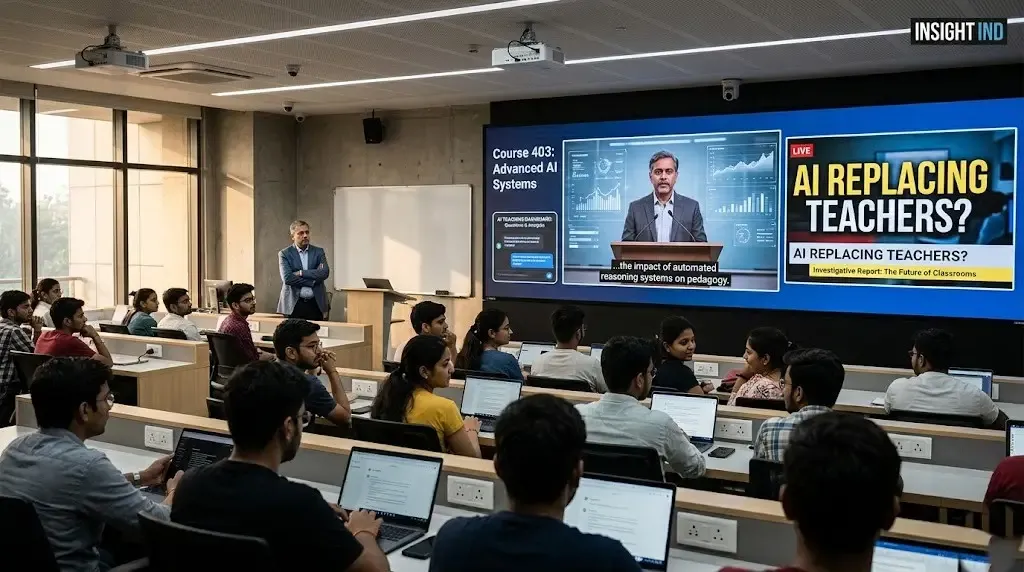
Are Colleges Secretly Replacing Teachers With AI?
Something strange is happening quietly inside classrooms.
Students increasingly watch recorded lectures instead of live teaching. Assignments get evaluated through automated systems. Notes are generated using AI tools. ChatGPT explains concepts faster than some professors. AI tutors answer doubts instantly at midnight when faculty are unavailable.
And because this shift is happening gradually, many people barely notice how deeply AI already entered education.
Now students are asking an uncomfortable question:
Are colleges slowly replacing teachers with AI?
The answer is complicated.
No, professors are not disappearing overnight. But colleges are absolutely experimenting with automation, digital learning systems, AI-powered support tools, and scalable teaching models that reduce dependence on traditional classroom methods.
And honestly, the trend is accelerating faster than many educators expected.
How AI Is Already Entering Colleges
| AI Usage Area | What Colleges Are Doing |
|---|---|
| Recorded Lectures | Reducing repeated classroom teaching |
| AI Chatbots | Student doubt-solving systems |
| Automated Notes | AI-generated summaries and materials |
| Assignment Evaluation | Automation-assisted checking |
| Virtual Tutors | 24/7 AI learning support |
Many colleges present this as “technology-enhanced learning.”
Critics sometimes describe it differently.
1. Recorded Lectures Are Becoming Normal
Students increasingly notice a pattern.
Instead of interactive teaching, some colleges rely heavily on pre-recorded lecture systems, presentation slides, or online learning portals.
In theory, this sounds efficient.
One recorded lecture can teach thousands of students repeatedly without requiring live faculty sessions every time.
From a business perspective, that scalability looks attractive.
But students often complain that recorded content feels impersonal and repetitive.
Many say the classroom experience starts feeling closer to content consumption than actual learning.
| Traditional Teaching | AI/Digital Teaching Shift |
|---|---|
| Live interaction | Pre-recorded lectures |
| Classroom discussions | Automated learning portals |
| Teacher mentorship | Chatbot assistance |
| Personal explanations | AI-generated answers |
The convenience is real. But so are the concerns.
2. Students Already Use ChatGPT More Than Faculty Sometimes
This part is impossible to ignore now.
Many students openly admit they ask ChatGPT for explanations before asking professors.
Why?
Because AI tools respond instantly, explain concepts repeatedly without judgment, simplify difficult topics, and remain available anytime.
For coding, mathematics, assignments, presentations, communication help, and even interview preparation, AI tools became part of daily student life.
Some professors privately acknowledge this too.
Students often arrive in class already having explored topics independently through AI systems.
3. Colleges Face Financial Pressure Too
This is another uncomfortable reality.
Hiring experienced professors costs money.
Maintaining large teaching staff across departments becomes expensive, especially for private institutions facing intense competition.
AI systems, recorded content, centralized digital platforms, and hybrid learning models can reduce operational pressure.
That economic incentive matters.
| Why Colleges Use AI | Institution Benefit |
|---|---|
| Scalable Content | Same lecture reused repeatedly |
| Automation | Reduced manual workload |
| 24/7 Support | Student assistance anytime |
| Lower Operational Cost | Less dependency on large faculty teams |
This does not necessarily mean colleges want zero teachers.
But AI clearly changes how many faculty roles operate.
4. Some Professors Are Adapting Instead of Fighting AI
Interestingly, not all educators oppose this shift.
Some professors actively integrate AI tools into teaching.
They use ChatGPT for:
- Lesson planning
- Assignment ideas
- Research summaries
- Presentation support
- Coding demonstrations
- Student engagement tools
For these educators, AI becomes an assistant rather than a replacement.
The strongest teachers increasingly focus on mentorship, critical thinking, discussion, and practical guidance - areas where humans still matter heavily.
5. Students Fear Degrees Becoming “Content Subscriptions”
This fear appears repeatedly in online discussions.
Some students worry colleges may slowly transform into expensive platforms that mostly deliver digital content while charging full tuition fees.
Especially after the online learning boom, students became more skeptical about paying huge amounts for lectures they could theoretically watch online.
That’s why students increasingly ask:
If most teaching becomes digital anyway, what exactly are colleges charging for?
The answer usually becomes:
- Brand value
- Placements
- Networking
- Peer environment
- Degree certification
- Campus experience
Not necessarily the lectures themselves anymore.
6. AI Still Cannot Fully Replace Great Teachers
This part matters too.
Excellent professors do far more than explain syllabus topics.
They mentor students, challenge assumptions, build confidence, encourage curiosity, and guide careers.
AI still struggles badly with emotional intelligence, mentorship, leadership inspiration, and nuanced human interaction.
Students often remember passionate teachers for years.
Recorded videos rarely create that kind of impact.
| Human Teacher Strength | Why It Still Matters |
|---|---|
| Mentorship | Career and life guidance |
| Motivation | Emotional connection |
| Critical Thinking | Deep classroom discussion |
| Adaptability | Understanding student struggles |
7. The Real Shift May Be Hybrid Education
The future probably does not look like “AI replaces all teachers.”
Instead, colleges seem to be moving toward hybrid systems where:
- AI handles repetitive tasks
- Recorded content teaches basics
- Professors focus on discussion and mentorship
- Automation supports administration
- Students learn partly independently
That model allows colleges to scale education more efficiently while still keeping human faculty involved.
At least for now.
Conclusion
AI is already transforming Indian colleges much faster than many students or professors expected.
Recorded lectures, ChatGPT support, automated systems, AI tutors, and digital learning platforms are quietly reshaping how education works.
Colleges are not completely replacing teachers yet.
But they are absolutely reducing dependence on traditional teaching methods in multiple areas.
The biggest question now is not whether AI will enter classrooms.
That already happened.
The real question is how far colleges will go before students start feeling they are paying human-level fees for increasingly automated education.

Written by
MonishMonish is an education writer covering exams, student rights, academic awareness, and other education-related topics, with practical guidance for students.