
3-Year Bachelor’s Degrees Gain Popularity: Could Shorter Degrees Come to India?
3-Year Bachelor’s Degrees Gain Popularity: Could Shorter Degrees Come to India?
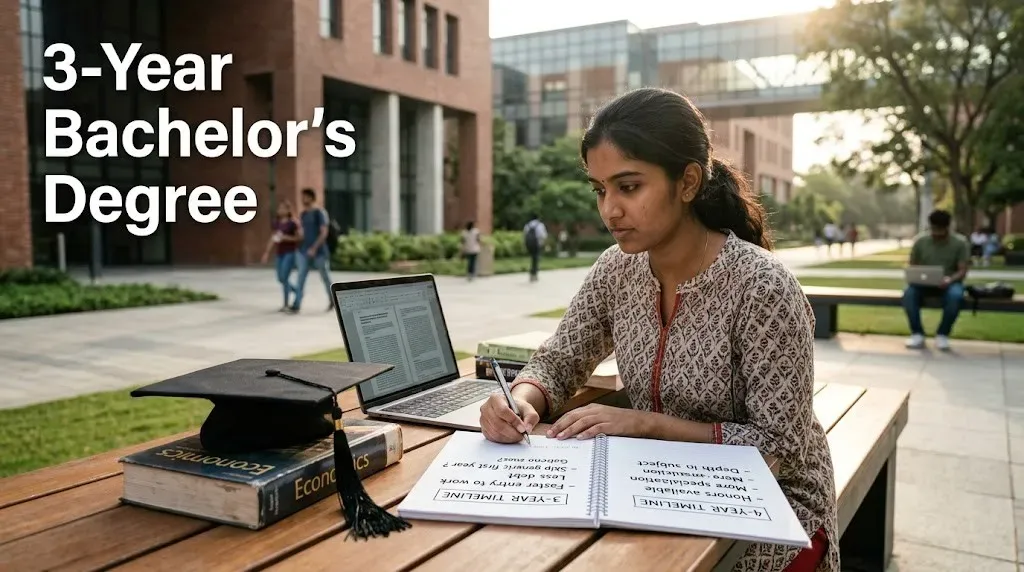
Three-year bachelor’s degrees are getting a fresh look in the US, where some colleges have started offering programmes that require fewer credits than the traditional four-year degree. The attraction is obvious for students worried about tuition and living costs, and for those who want to enter the workforce a year earlier. But India presents a different situation because three-year bachelor’s degrees already form part of the country’s higher-education structure.
Under the National Education Policy 2020, an undergraduate degree can have a three- or four-year duration. A student completing three years can receive a Bachelor’s degree, while the four-year multidisciplinary route is the preferred option in the policy because it provides more room for multidisciplinary learning and research.
| Route | What it offers |
|---|---|
| 3-year Bachelor’s | A full undergraduate degree after three years of study under the NEP framework. |
| 4-year Bachelor’s | The longer multidisciplinary route, with additional scope for major-minor combinations and research. |
| 2-year exit | Students meeting the applicable requirements can receive a diploma after two years. |
| 1-year exit | A certificate can be awarded after the first year under the multiple-entry and exit framework. |
So the real question for India is not whether a shorter bachelor’s degree could suddenly arrive. It is how universities will balance the existing three-year route with the four-year model being promoted through NEP. The government’s own multiple-entry and exit guidelines explicitly describe a Bachelor’s degree after three years and a four-year programme as another option.
International recognition is another reason the debate matters. UK ENIC revised its comparison approach in September 2025 and now assesses most Indian three-year bachelor’s degrees carrying 120 or more credits as comparable to a UK Bachelor degree, while four-year Indian degrees with 160 or more credits are compared with a UK Bachelor (Honours) degree. The distinction could matter to students planning postgraduate study overseas.
The US discussion shows why simply cutting one year from a degree is not automatically a win. Some new three-year programmes there reduce the total number of credits from the conventional 120 to around 90. Critics have raised concerns about academic depth, employer acceptance and progression to graduate school, particularly in subjects that require substantial practical or professional preparation.
For Indian students, the four-year option has one clear advantage when research is the goal. The extra year gives universities more space for advanced coursework, interdisciplinary study and a research component. A student planning a research-heavy career therefore has a different reason to choose four years than someone who wants to graduate quickly and start working. The choice needs to follow the student's next step, not simply the shorter number on the course brochure.
There is also a financial angle that gets less attention. Saving one academic year can mean lower tuition and one fewer year of rent, transport and living expenses. For a student who already knows that a three-year qualification meets the eligibility requirements for the job or postgraduate programme they want, that difference can be substantial.
India therefore does not need to wait for a new “short-degree” revolution. The policy framework is already built around flexibility. The bigger change will come from how consistently universities implement the options and how employers, professional bodies and overseas universities treat each degree pathway.

Written by
Palak PatelEducation writer Palak Patel covers the latest education news, board exam updates, results, and career opportunities.