
Private vs Government College ROI Analysis in India
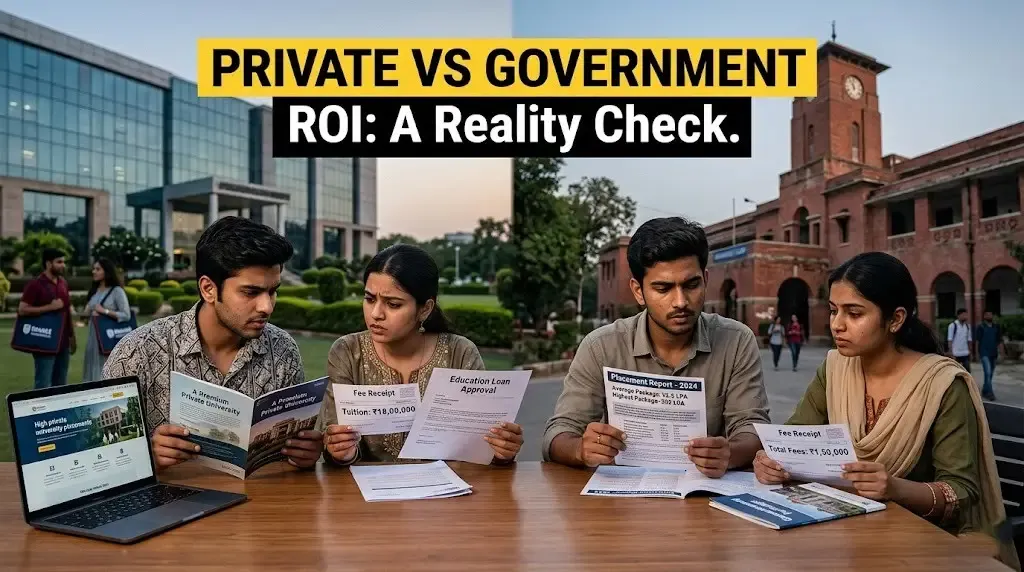
Private vs Government College ROI Analysis in India
College decisions in India are no longer only about prestige.
Students and parents now increasingly calculate return on investment before taking admission.
And honestly, that shift makes sense.
Private college fees have exploded in many cities. Hostel charges, transport, exam fees, laptops, coaching, certifications, and living expenses push total education costs even higher.
Meanwhile, placement outcomes often remain unpredictable.
So families naturally compare:
Is paying lakhs for a private college actually worth it when some government colleges cost far less?
The answer is not completely simple because both systems have strengths and weaknesses.
But ROI discussions are becoming impossible to ignore now.
What ROI Means in College Education
| ROI Factor | Why It Matters |
|---|---|
| Total Fees | Direct financial burden |
| Placement Quality | Career starting point |
| Average Salary | Recovery of investment |
| Internship Exposure | Industry readiness |
| Long-Term Growth | Career progression value |
Students increasingly realize that a beautiful campus alone does not automatically create strong ROI.
1. Government Colleges Usually Win on Affordability
This is the biggest advantage government colleges hold.
Even top government institutions often cost dramatically less than premium private universities.
For middle-class families, that difference matters enormously.
| Expense Type | Government Colleges | Private Colleges |
|---|---|---|
| Tuition Fees | Usually lower | Often significantly higher |
| Hostel Costs | More affordable | Can become expensive |
| Hidden Charges | Generally lower | Students complain more frequently |
| Education Loan Pressure | Lower risk | Higher dependency sometimes |
Students graduating with lower debt pressure naturally gain more financial flexibility early in their careers.
2. Private Colleges Usually Offer Better Infrastructure
This is where private institutions often stand out.
Modern campuses, air-conditioned classrooms, digital infrastructure, hostels, sports facilities, innovation labs, and branding are usually stronger in premium private colleges.
Government colleges sometimes struggle with outdated facilities, slower administration, or infrastructure maintenance problems.
However, students increasingly ask an important question:
Does premium infrastructure actually improve placements enough to justify massive fees?
That debate has become central to modern college discussions.
3. Placement Reality Depends More on College Tier Than Ownership
This part is important.
Top government colleges often dominate ROI because of strong placements combined with low fees.
But lower-tier government colleges may still struggle with industry exposure and recruiter quality.
Similarly, some elite private universities produce excellent placements while many Tier-3 private colleges face criticism over weak ROI.
| College Type | Typical ROI Trend |
|---|---|
| Top Government Colleges | Usually excellent ROI |
| Elite Private Universities | Strong but expensive |
| Tier-3 Private Colleges | Mixed or weak ROI |
| Lower-Tier Government Colleges | Affordable but placement variability |
Ownership alone no longer decides outcomes completely.
4. Students Increasingly Care About Median Salary
Earlier, students focused mainly on highest package advertisements.
Now they increasingly ask about median salaries because they reveal more realistic student outcomes.
Some colleges advertise huge international packages even though only one or two students receive them.
Meanwhile the average student may receive a far smaller offer.
Students researching ROI carefully now compare:
- Total education cost
- Median salary
- Placement percentage
- Location expenses
- Career growth opportunities
This makes admissions far more data-driven than before.
5. Government Colleges Often Benefit From Stronger Peer Groups
This advantage gets discussed less publicly.
Competitive entrance exams naturally filter many government college admissions.
That creates stronger peer competition and networking environments in many cases.
Students often push each other toward coding, internships, startups, competitive programming, research, or government exams.
Peer environment quietly influences placements more than many families realize.
6. Private Colleges Often Focus More on Placement Training
Private colleges usually invest heavily in placement preparation systems.
Students commonly receive:
- Aptitude training
- Soft skill development
- Mock interviews
- Resume preparation
- Placement drives
Some government colleges remain more academically independent and expect students to prepare themselves.
This difference benefits students who need structured placement support.
However, students also complain that placement training sometimes becomes repetitive and overly generic.
7. ROI Changes Completely Based on Student Effort
This is probably the biggest truth students discover later.
Even expensive colleges cannot guarantee success for students who remain passive.
And motivated students from modest colleges often outperform others through:
| Self-Growth Strategy | Career Impact |
|---|---|
| Internships | Practical exposure |
| Coding Projects | Improves employability |
| Freelancing | Real work experience |
| Networking | Referral opportunities |
| Online Certifications | Modern skill building |
The internet reduced dependence on college reputation more than many institutions expected.
When Private Colleges Make Sense
| Situation | Why Private Colleges May Help |
|---|---|
| Strong branded private university | Better recruiter network |
| Industry-oriented programs | Modern practical exposure |
| International collaboration | Global opportunities |
| Students needing structured support | Placement-focused environment |
When Government Colleges Offer Better ROI
| Advantage | Why Students Prefer It |
|---|---|
| Lower Fees | Less financial pressure |
| Competitive Peer Group | Stronger motivation |
| Higher ROI Potential | Good salaries with lower investment |
| Government Reputation | Strong long-term credibility |
Conclusion
The private vs government college debate in India is ultimately becoming an ROI conversation.
Students no longer judge colleges only through campus photos, advertisements, or brand hype.
They increasingly compare fees, placement quality, internship opportunities, peer groups, and actual salary outcomes.
Top government colleges still offer some of the strongest ROI in the country.
But strong private universities can also create excellent opportunities if students fully utilize them.
The biggest mistake now is choosing a college emotionally without understanding the long-term financial and career impact.
Because in today’s market, ROI matters almost as much as the degree itself.

Written by
MonishMonish is an education writer covering exams, student rights, academic awareness, and other education-related topics, with practical guidance for students.