
Students Paying Lakhs for Degrees That Lead to ₹18K Salaries
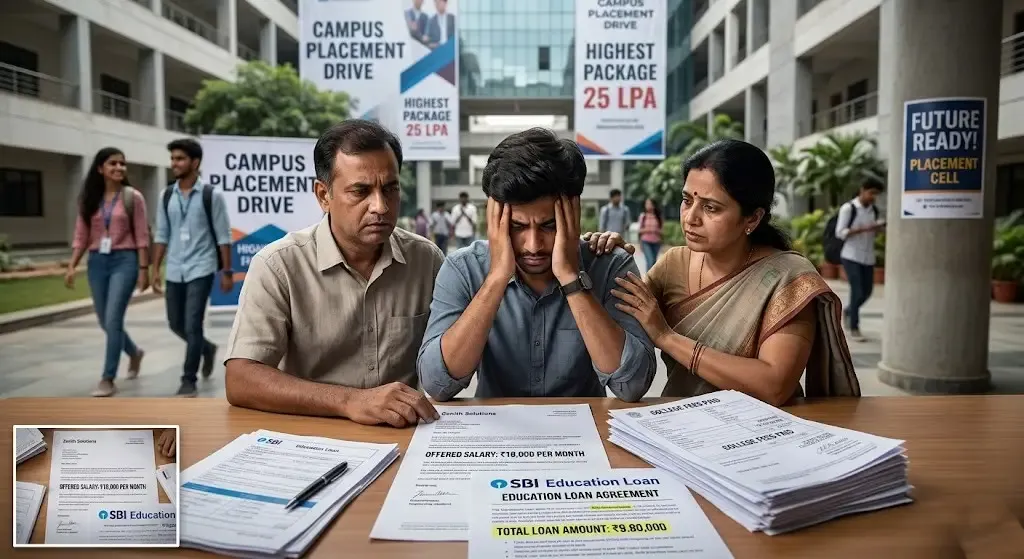
Students Paying Lakhs for Degrees That Lead to ₹18K Salaries
Something feels badly broken in Indian education right now.
Families spend years saving money for college admissions. Parents take loans. Students move cities. Lakhs disappear into tuition fees, hostels, transport, laptops, coaching, exam charges, and “mandatory certifications.”
Then graduation finally arrives.
And many students receive job offers paying ₹18,000–25,000 per month.
That moment creates a shock thousands of families quietly experience every year.
Because when students calculate the total money spent versus actual starting salaries, the return on investment often looks painfully weak.
This is no longer just a student frustration.
It’s becoming a national conversation.
The Growing ROI Crisis in Indian Education
| Education Expense | Typical Cost Range |
|---|---|
| Private College Tuition | ₹5–15 Lakh+ |
| Hostel & Living Costs | ₹2–5 Lakh |
| Laptop & Certifications | ₹50K–₹2 Lakh |
| Transport & Miscellaneous | ₹50K–₹1 Lakh |
| Total Investment | Often ₹10 Lakh+ |
Now compare that with the salary many freshers actually receive.
That gap is why ROI discussions exploded across student communities recently.
1. Placement Advertisements Create Unrealistic Expectations
This is one of the biggest reasons students feel disappointed.
Colleges aggressively market highest packages everywhere during admission season.
Huge banners display ₹30 LPA, ₹40 LPA, even international salary offers.
Parents naturally assume strong placement outcomes are common.
But students inside campuses often describe a completely different reality.
The majority may receive much lower offers while only a tiny number secure those famous packages.
| Placement Marketing | What Students Often Experience |
|---|---|
| Highest Package Promotions | Exceptional cases only |
| 100% Placement Claims | Many students still unplaced |
| Top Recruiter Logos | Limited hiring numbers |
| Premium Campus Image | Average salary outcomes |
This expectation mismatch becomes emotionally difficult for families who sacrificed heavily financially.
2. ₹18K Salary Feels Smaller Than Students Expect
On paper, ₹18,000 per month may not sound terrible initially.
But reality changes quickly once students move to metro cities.
Rent, food, transport, internet, electricity, and daily expenses reduce savings dramatically.
| Monthly Expense | Approximate Impact |
|---|---|
| PG or Shared Rent | ₹6K–₹12K |
| Food | ₹3K–₹6K |
| Transport | ₹1K–₹3K |
| Utilities & Internet | ₹1K–₹2K |
| Remaining Savings | Often very limited |
Students who imagined financial independence after graduation often realize they still depend partly on family support.
3. Engineering and MBA Students Feel This Pressure Strongly
Engineering and MBA degrees especially dominate ROI debates.
Not because these degrees are useless.
But because the gap between fees and average outcomes widened heavily in many institutions.
Students from top colleges still secure excellent opportunities.
The problem appears more sharply in lower-tier private institutions where fees remain high but placement quality varies massively.
Some graduates openly admit they could have learned similar practical skills online at far lower cost.
4. Education Loans Make the Pressure Worse
This part becomes emotionally difficult for many families.
Students graduating with education loans often feel trapped accepting low-paying jobs simply because EMI pressure starts quickly.
Some delay higher studies, entrepreneurship, relocation, or career experimentation because repayment becomes priority.
| Loan Pressure Effect | Student Impact |
|---|---|
| Forced Job Acceptance | Less career flexibility |
| Delayed Financial Independence | Family pressure continues |
| Stress & Anxiety | Mental health impact |
| Reduced Risk-Taking | Harder to explore startups or freelancing |
This is why students increasingly discuss ROI before admissions instead of blindly chasing branded campuses.
5. Students Now Compare Degrees Against Skills
This shift is becoming huge.
Students increasingly compare expensive degrees with alternative paths like:
- Freelancing
- Online certifications
- Skill bootcamps
- Remote work
- Coding platforms
- Content creation
- AI-based careers
Some students now ask directly:
If employers care mostly about skills eventually, why spend ₹10 lakh for weak placements?
That question is making colleges uncomfortable.
6. Not All Colleges Have Poor ROI
This part matters too.
Top government colleges and elite institutions still produce strong ROI because fees remain relatively controlled compared to placement quality.
Students from top IITs, IIMs, NITs, FMS, and certain government colleges often recover educational investment much faster.
The real crisis appears mainly in:
- Overpriced Tier-3 private colleges
- Weak placement ecosystems
- Outdated curriculum
- Mass recruiter dependency
- Low practical exposure
That’s where the financial mismatch becomes most visible.
Parents Are Becoming More Skeptical Too
Families now research colleges differently compared to earlier years.
Instead of only asking:
“Is the campus good?”
They increasingly ask:
- What is the median package?
- How many students remain unplaced?
- What is the actual in-hand salary?
- Are placements core or sales jobs?
- What is the total 4-year cost?
This financial awareness is changing admission decisions rapidly.
How Students Can Protect Themselves
| Smart Decision Strategy | Why It Helps |
|---|---|
| Research Median Salaries | More realistic outcome |
| Check Total Cost | Avoids hidden expense shock |
| Focus on Skill Building | Improves employability |
| Talk to Current Students | Gets honest reality |
| Compare ROI Carefully | Prevents long-term regret |
Conclusion
India’s education system is entering a major ROI crisis.
Students and parents are no longer blindly accepting expensive degrees as automatic pathways to success.
The gap between education cost and actual salary outcomes became too visible to ignore.
Some colleges still provide excellent opportunities and strong career growth.
But many students now realize that degree value depends heavily on placements, practical skills, internships, and industry relevance - not just campus marketing.
And honestly, this growing skepticism may finally force colleges to focus more on actual career outcomes instead of only admission hype.

Written by
MonishMonish is an education writer covering exams, student rights, academic awareness, and other education-related topics, with practical guidance for students.