
Real Placement Reality of Tier-3 Colleges in India
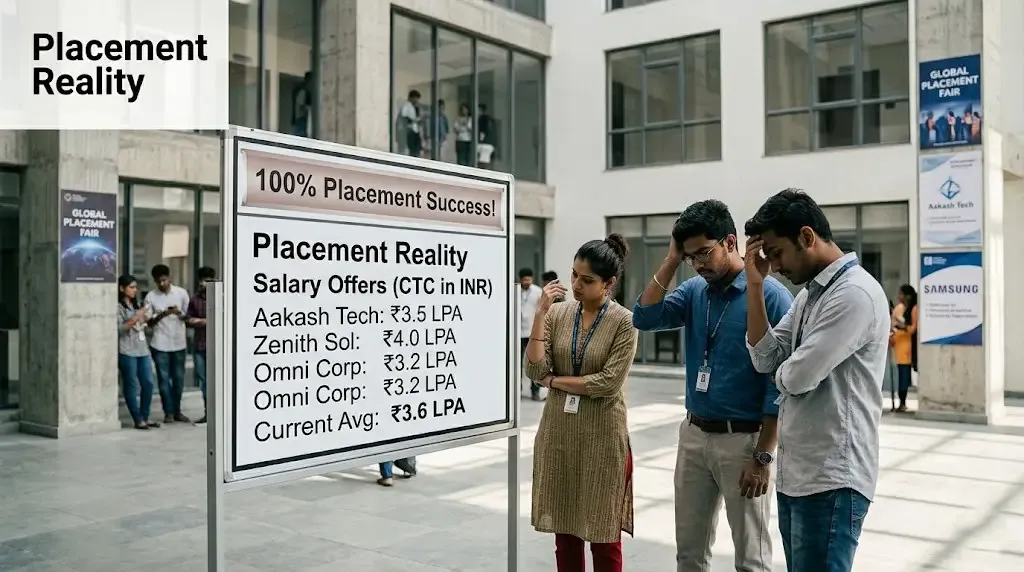
Real Placement Reality of Tier-3 Colleges in India
Every admission season in India feels strangely similar.
Huge placement banners appear outside campuses. Colleges advertise “100% placement assistance,” giant international packages, and photos of students standing beside luxury company logos.
Parents feel relieved. Students feel hopeful.
Then final year arrives.
And for many students inside Tier-3 colleges, the actual placement situation looks very different from the marketing brochures.
Some colleges genuinely try hard to bring companies. But many students quietly discover that “placement” can mean almost anything - unpaid internships, low-paying sales jobs, support roles unrelated to the degree, or mass recruiter hiring with minimal salary growth.
This gap between advertised placements and actual student outcomes has become one of the most discussed topics in engineering and private college circles.
What Colleges Advertise vs What Students Experience
| College Advertisement | Common Student Reality |
|---|---|
| 100% Placement | Many students remain unplaced |
| Highest Package Highlighted | Only 1–2 students may get it |
| Top Company Logos | Limited hiring or internships only |
| Industry Ready Students | Weak practical training |
| Excellent ROI | Average salaries often stay low |
The problem is not that every Tier-3 college is terrible.
The real issue is that placement statistics are often presented in ways that sound far stronger than the ground reality students actually face.
1. The “Highest Package” Illusion
This is probably the most common marketing tactic.
A college advertises one extremely high package everywhere - social media, hoardings, admission seminars, newspaper ads.
But students inside the campus often point out something important:
That package may belong to just one student out of thousands.
Meanwhile, the majority may receive much smaller offers or no offers at all.
| Placement Metric | What Actually Matters More |
|---|---|
| Highest Package | Mostly marketing value |
| Average Package | More useful but still broad |
| Median Package | Most realistic indicator |
| Total Students Placed | Shows actual placement reach |
Students are becoming smarter about this now. Many actively ask for median salary numbers because they reveal a far more honest picture.
2. Mass Recruiters Dominate Placements
In many Tier-3 engineering colleges, a large percentage of placements come from mass recruiters.
These companies often hire students in bulk for support, testing, operations, or entry-level IT roles.
The salaries are usually much lower than what students imagined during admission.
And because competition is huge, students often accept these offers simply to avoid leaving campus unplaced.
| Placement Type | Typical Situation |
|---|---|
| Mass Recruiters | Large hiring with moderate salaries |
| Core Companies | Very limited openings |
| Startup Hiring | High risk but sometimes better learning |
| Internship-Based Offers | Conversion not always guaranteed |
Mechanical, civil, and electrical students especially complain that many eventually move into generic IT or support jobs because core industry hiring remains limited.
3. “Placement Training” Often Becomes Repetitive
Almost every college now advertises placement preparation programs.
But students frequently describe these sessions as repetitive aptitude practice, basic communication classes, and generic motivational lectures.
The deeper issue is practical exposure.
Many students graduate without strong internships, real projects, modern tools, or industry-level experience.
Recruiters notice that quickly during interviews.
This is one reason companies increasingly test coding ability, problem-solving, communication, and practical execution directly instead of trusting marks alone.
4. Some Placements Are Barely Relevant to the Degree
This frustrates students quietly.
An engineering student may spend four years studying technical subjects only to receive placement opportunities mostly in sales, customer support, BPO, or non-core operations.
Now, there is nothing wrong with these jobs themselves.
But students often feel disappointed because the career path looks very different from what was promised during admission.
The mismatch between degree specialization and available jobs has become increasingly common.
5. Off-Campus Hiring Is Becoming More Important
Interestingly, many strong students from Tier-3 colleges eventually get better opportunities off-campus than through college placements.
This usually happens because they independently build skills through:
| Skill Strategy | Why It Helps |
|---|---|
| Coding Projects | Shows practical ability |
| Internships | Builds industry experience |
| LinkedIn Networking | Creates referral opportunities |
| Freelancing | Builds real work exposure |
| Certifications | Adds specialized skills |
Some students now openly say the internet helped their career more than their actual college curriculum.
Why Students Still Join Tier-3 Colleges
Despite all these problems, lakhs of students still take admission in Tier-3 colleges every year.
The reasons are practical.
Not everyone gets into IITs, NITs, or elite private universities. Many families also prioritize affordability, location, or immediate admission availability.
And honestly, not every Tier-3 college produces bad outcomes.
Some students still build excellent careers from these campuses because they aggressively focus on self-learning and practical skills.
The biggest difference usually comes from individual effort and peer environment.
What Students Should Ask Before Taking Admission
Students are becoming more careful now while researching colleges.
| Important Question | Why It Matters |
|---|---|
| What is the median package? | Shows realistic salaries |
| How many students remain unplaced? | Reveals placement reach |
| Which companies hire regularly? | Shows consistency |
| Are jobs core or non-core? | Checks career relevance |
| How strong are internships? | Important for future hiring |
Current students usually provide more honest answers than advertisements or admission counselors.
Conclusion
The placement reality of many Tier-3 colleges in India sits somewhere between opportunity and marketing.
Some colleges genuinely help students build careers. Others rely heavily on exaggerated placement claims and selective statistics.
The biggest mistake students make is assuming college alone will guarantee employment.
Today, placements increasingly depend on internships, projects, communication skills, networking, and self-learning outside classrooms.
For students entering Tier-3 colleges, the safest mindset now is simple:
Use the college as a platform, not as the entire career plan.

Written by
MonishMonish is an education writer covering exams, student rights, academic awareness, and other education-related topics, with practical guidance for students.