Is College Even Worth It Anymore in India?
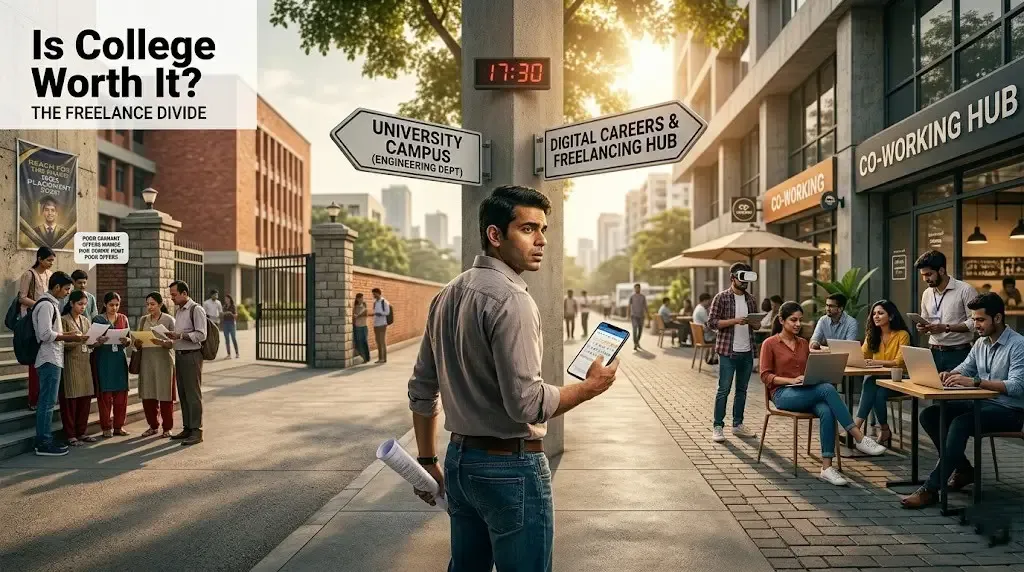
Is College Even Worth It Anymore in India?
A few years ago, asking whether college was worth it would have sounded ridiculous.
For most Indian families, college was considered the default path to stability, respect, and financial security.
Now the conversation feels very different.
Students see freelancers earning online without degrees. Developers learning from YouTube instead of classrooms. Content creators building businesses from bedrooms. AI tools automating repetitive work. Remote jobs hiring based on portfolios instead of marks.
At the same time, college fees keep rising while placement outcomes in many institutions remain inconsistent.
So naturally, students are starting to ask uncomfortable questions.
If skills matter more than marks now, does the degree itself still matter?
And if freelancing or self-learning can create income faster, is spending four years in college still the smartest option?
Why Students Are Questioning College More Than Before
| Traditional Promise | Modern Student Reality |
|---|---|
| Degree guarantees job security | Placements often inconsistent |
| College teaches career skills | Students learn online independently |
| High fees mean better outcomes | ROI often unclear |
| Marks matter most | Skills and portfolios matter heavily |
| Campus jobs are primary path | Freelancing and remote work growing |
The education system is not collapsing.
But expectations around college are definitely changing.
1. Degrees Still Matter in Many Careers
This part often gets ignored online.
Some careers still absolutely require formal degrees.
You cannot realistically become a doctor, lawyer, architect, chartered accountant, or licensed engineer purely through YouTube tutorials.
Regulated professions still depend heavily on formal qualifications.
| Career Field | Degree Importance |
|---|---|
| Medicine | Essential |
| Law | Essential |
| Government Jobs | Usually mandatory |
| Corporate Finance | Strongly preferred |
| Research & Academia | Critical |
For these paths, college remains highly valuable because the degree itself acts as a gatekeeper.
The bigger debate is happening in industries where skills can be demonstrated directly.
2. Skills Are Starting to Matter More Than College Brands
In technology, design, content creation, marketing, editing, and freelancing-heavy industries, recruiters increasingly focus on practical work.
A strong portfolio now sometimes beats a famous college name.
Students are noticing this quickly.
Some self-taught developers build better projects than engineering students. Some video editors learn faster online than through media courses. Some digital marketers gain clients before graduation itself.
This shift is making students rethink traditional education timelines.
| Skill-Based Industry | What Employers Usually Check |
|---|---|
| Software Development | Projects and coding ability |
| Design | Portfolio quality |
| Content Creation | Audience and consistency |
| Digital Marketing | Campaign results and analytics |
| Freelancing | Client work and reputation |
For many students, this creates a difficult question:
If the internet already teaches the skills, what exactly are they paying colleges for?
3. Freelancing Changed Student Thinking
This is probably one of the biggest mindset shifts happening right now.
Earlier, earning money usually started after graduation.
Now students see freelancers making income while still studying.
Video editors, coders, writers, designers, social media managers, and automation specialists often start with small clients online and slowly build careers independently.
Some eventually earn more than traditional entry-level jobs.
Of course, freelancing is not as easy as social media makes it look.
Income can become unstable. Competition is intense. Clients can disappear suddenly. And many beginners struggle badly before getting consistent work.
Still, the existence of alternative earning paths changed how students think about college entirely.
4. The Real Problem Is ROI
Students are not rejecting education itself.
They are questioning return on investment.
When colleges charge massive fees but provide average placements, frustration becomes understandable.
Many students now compare:
| Traditional College Path | Alternative Skill Path |
|---|---|
| 4-year degree | 1–2 years skill building |
| Large education expenses | Lower learning cost online |
| Placement uncertainty | Freelance income possibility |
| Theory-heavy learning | Practical project focus |
This comparison does not automatically make freelancing better.
But it explains why so many students feel uncertain about traditional education paths now.
5. College Still Provides Things the Internet Cannot Fully Replace
Despite all the criticism, college still offers important advantages.
Networking matters.
Campus life matters.
Peer groups matter.
Internships, alumni networks, competitions, mentorship, exposure, communication growth, and social development are difficult to fully replicate alone at home.
Many successful freelancers and founders still benefited heavily from college environments even if they later moved beyond traditional jobs.
The problem is that not every college provides these advantages equally.
6. The Smartest Students Often Combine Both Paths
This is becoming increasingly common.
Students attend college while simultaneously building skills online.
They do internships early. Learn coding from external platforms. Build freelance profiles. Create content. Work on projects. Network on LinkedIn. Explore AI tools independently.
Instead of depending entirely on the degree, they treat college as one layer of career development.
That hybrid approach seems to work far better in today’s market.
Who Should Definitely Still Go to College?
| Student Situation | Why College Still Helps |
|---|---|
| Professional careers | Degrees legally required |
| Need structured environment | Provides discipline and guidance |
| Strong campus opportunities | Networking and internships matter |
| Government exam goals | Graduation often mandatory |
| Unsure career direction | College provides exploration time |
Conclusion
College is not becoming useless.
But the automatic guarantee attached to degrees is clearly fading.
Today, students who rely only on classroom learning often struggle more than those combining degrees with practical skills.
Freelancing, online learning, AI tools, and remote work have changed the career landscape permanently.
The smartest students now are not choosing between college and skills.
They are learning how to use both together.
And honestly, that balance probably matters more now than the degree itself.

Written by
MonishMonish is an education writer covering exams, student rights, academic awareness, and other education-related topics, with practical guidance for students.