
How to Choose Between Multiple Career Options After Graduation
Stop Guessing: A Data-Driven Guide to Your First Big Career Move
Graduating in 2026 feels like being handed a 100-page menu when you’re already starving—it’s overwhelming. With AI rewriting job descriptions weekly and "green careers" exploding, the old advice of "just follow your passion" feels a bit thin. The truth is, the average person spends over 90,000 hours working; letting someone else make this decision for you is the biggest mistake you can make.
Instead of applying randomly to every job on LinkedIn, you need a system to filter the noise. Here is how to use professional frameworks like Ikigai and Weighted Decision Matrices to move from "I don't know" to "I have a plan."
1. The Ikigai Filter: Finding Your "Reason to Wake Up"
The Japanese concept of Ikigai helps you find the intersection of four critical circles. If you pick a path that only hits one or two, you’ll likely end up bored, broke, or burnt out.
| The Four Circles | Why It Matters for Your Career |
|---|---|
| What You Love | Prevents burnout and keeps you curious during tough weeks. |
| What You’re Good At | Leverages your natural strengths to help you climb the ladder faster. |
| What the World Needs | Connects you to high-growth sectors like Sustainability or AI. |
| What You Can Be Paid For | Ensures your lifestyle goals and financial independence are met. |
2. The Weighted Decision Matrix: A "Math" Way to Choose
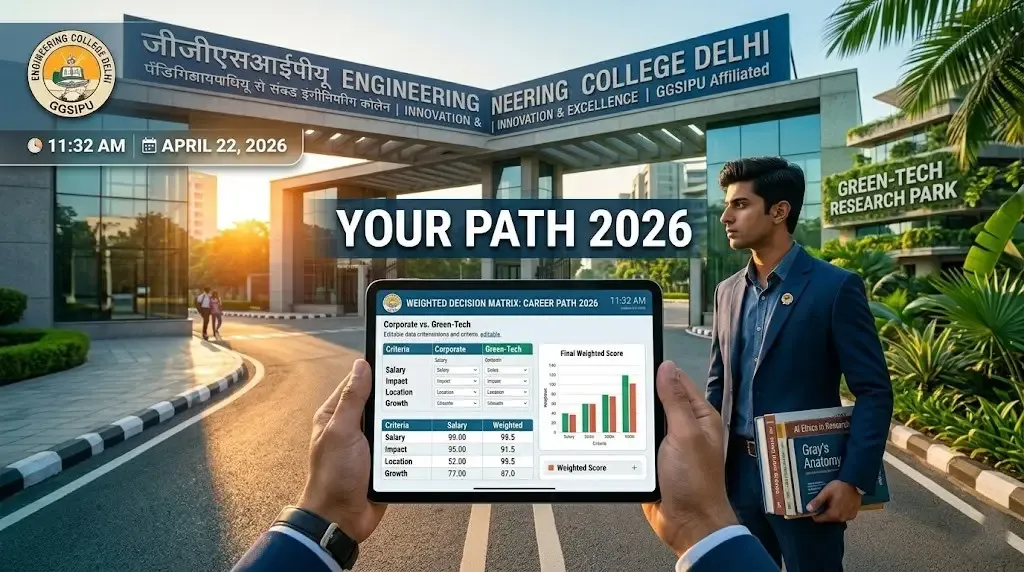
When you have three great job offers or paths (e.g., Data Science vs. Finance vs. NGO work), stop using pros and cons lists. Use a Weighted Decision Matrix to see which one actually wins on your own terms.
- List your criteria: Salary, Work-Life Balance, Growth Potential, and Brand Value.
- Assign Weights: Give each a score from 1–5 based on what matters most *to you* right now. (If you need money to pay off loans, Salary might be a 5).
- Score Each Option: Rate each career path 1–5 on how well it meets those criteria.
- Multiply & Total: The path with the highest total score is your objective winner.
3. Avoid the "Random Application" Trap
A common 2026 blunder is the "spray and pray" method—sending the same generic resume to 50 different industries. Employers can see through this immediately. Instead, target mid-sized or growing companies where you can have more impact early on, rather than just obsessing over "Big Tech" names.
2026 High-Growth Sectors for Your Shortlist
| Industry | Growth Rate (Est. 2030) | Core Skills Needed |
|---|---|---|
| AI & Data Science | 15%+ | SQL, Python, Analytical Thinking |
| Sustainability / Green Energy | 10–12% | ESG Analysis, Project Management |
| FinTech & Analytics | High Demand | Financial Modeling, Risk Analysis |
| Healthcare Operations | Steady Growth | Process Optimization, Communication |
Conclusion: Your Career is a Prototype
Remember that your first choice isn't a life sentence; it’s a prototype. The job market is more dynamic than ever, and "course-correcting" is a skill in itself. Use the O*NET Online or professional career assessments to gather data, run your decision matrix, and then commit 100% to the winner for at least 18 months. The best way to know if a career works is to actually do it—not just think about it.

Written by
Palak PatelEducation writer Palak Patel covers the latest education news, board exam updates, results, and career opportunities.
Comments
No comments yet. Be the first!