
Average Package vs Actual In-Hand Salary Reality in India
Average Package vs Actual In-Hand Salary Reality in India
Almost every college placement advertisement in India focuses on one thing:
“Highest package.”
Students hear numbers like ₹12 LPA, ₹18 LPA, or even ₹40 LPA and naturally assume life is completely sorted after placement.
Then the first salary arrives.
And suddenly many freshers realize something nobody properly explained earlier:
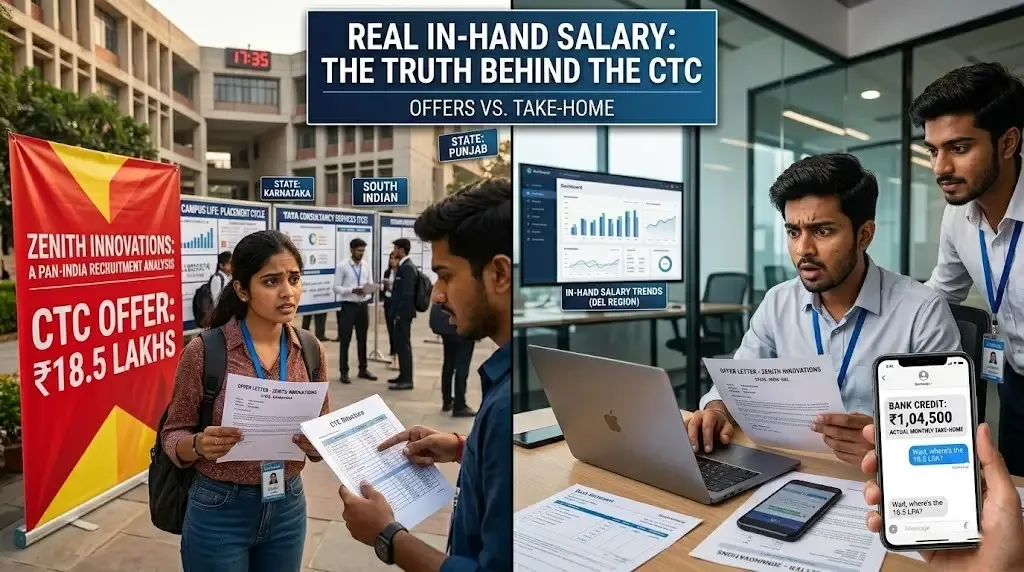
CTC and actual in-hand salary are not the same thing.
In fact, the difference can sometimes feel shockingly large.
This confusion has become extremely common among engineering, MBA, and private college students because colleges aggressively market placement packages while rarely explaining salary structures clearly.
What Students Think vs Salary Reality
| What Students Hear | What Often Happens |
|---|---|
| ₹10 LPA package | Monthly in-hand may feel much lower |
| Joining bonus included | One-time payment only |
| Stock options included | May not convert into immediate cash |
| Retention bonus shown | Paid only after certain years |
| International package hype | Very limited student selection |
This is why students increasingly ask for “actual in-hand salary” instead of just CTC figures.
1. What Exactly Is CTC?
CTC stands for “Cost to Company.”
It represents the total amount a company spends on an employee annually.
But companies often include multiple components inside CTC that do not directly appear in monthly salary.
| CTC Component | Meaning |
|---|---|
| Basic Salary | Main fixed pay |
| HRA | House rent allowance |
| PF Contribution | Retirement deduction |
| Bonus | May depend on performance |
| Insurance | Company-provided benefits |
| Stock Options | Potential future value |
So when colleges advertise a huge package, students often assume all of it becomes direct monthly income, which is rarely true.
2. Why In-Hand Salary Feels Smaller
The actual monthly salary reaching a fresher’s bank account depends on multiple deductions.
This is where many students get surprised.
| Common Deduction | Why It Happens |
|---|---|
| Provident Fund (PF) | Retirement savings deduction |
| Professional Tax | Applicable in some states |
| Income Tax | Based on tax slab |
| Insurance Deductions | Company policy benefits |
| Variable Pay Delays | Paid quarterly or yearly sometimes |
Freshers expecting their “annual package divided by 12” often realize quickly that the actual number looks very different.
3. Average Package Statistics Can Be Misleading
This is another major source of confusion.
Many colleges proudly advertise average packages, but students increasingly question how those numbers are calculated.
For example:
If a few students receive extremely high offers while many receive moderate salaries, the average package may look far stronger than the actual student experience.
That’s why median salary is becoming more important now.
| Placement Metric | What It Really Shows |
|---|---|
| Highest Package | Top exceptional offer only |
| Average Package | Can be distorted by high salaries |
| Median Package | More realistic student outcome |
| In-Hand Salary | Actual monthly earning reality |
Students are becoming much smarter about placement statistics because social media discussions exposed these differences heavily.
4. Tech Companies Often Include Variable Components
This happens a lot in software placements.
A company may advertise a ₹15 LPA package, but the structure could include:
- Fixed salary
- Performance bonus
- Joining bonus
- Stock options
- Retention bonus
Some components may not even be guaranteed immediately.
Stock options especially sound exciting during placements, but their real value depends on company growth, vesting timelines, and future liquidity.
Freshers usually care more about stable monthly income than theoretical future valuation.
5. City Expenses Change Salary Reality Further
This is another thing students underestimate badly.
A ₹50,000 monthly salary may sound huge initially.
Then the student moves to Bengaluru, Mumbai, Gurgaon, or Hyderabad and starts paying:
| Common Expense | Monthly Impact |
|---|---|
| Rent or PG | Major expense in metro cities |
| Food | Regular daily spending |
| Transport | Metro, cabs, fuel costs |
| Internet & Utilities | Additional monthly expenses |
| Social Expenses | Unexpected lifestyle spending |
Suddenly the salary feels far smaller than expected.
This is why location matters heavily while evaluating placement offers.
6. Students Now Prefer Transparency Over Hype
Interestingly, students are no longer impressed only by giant package numbers.
They increasingly ask questions like:
What is the fixed salary?
What is the median package?
How many students actually got placed?
What is the real monthly in-hand amount?
These questions reflect growing awareness around placement marketing.
How Freshers Should Evaluate Offers Properly
| Important Check | Why It Matters |
|---|---|
| Fixed Salary | Shows stable guaranteed income |
| Variable Pay Portion | May not be fully guaranteed |
| Location Cost | Impacts savings heavily |
| Bond Conditions | Important for flexibility |
| Career Growth | Long-term value matters too |
A smaller package with better growth and lower living costs can sometimes become financially smarter than a flashy CTC in an expensive city.
Conclusion
The difference between average package and actual in-hand salary has become one of the biggest reality checks for fresh graduates in India.
Placement advertisements often focus on impressive CTC numbers, but real financial life depends on deductions, bonuses, taxes, city expenses, and salary structure details.
Students are slowly becoming more aware of this gap now.
And honestly, that awareness is healthy.
Because understanding real earning potential matters far more than simply chasing the biggest placement headline.

Written by
MonishMonish is an education writer covering exams, student rights, academic awareness, and other education-related topics, with practical guidance for students.