
The “Fake Placement Package” Industry in India
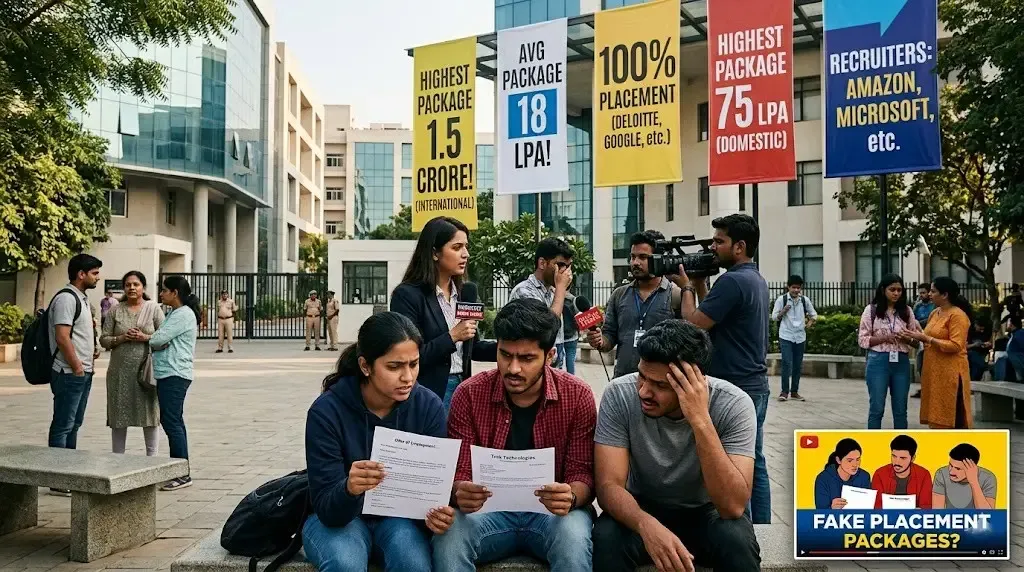
The “Fake Placement Package” Industry in India
Every year during college admission season, the same headlines appear everywhere.
“Student gets ₹1 crore package.”
“Highest package reaches ₹52 LPA.”
“100% placements achieved.”
For students and parents, these numbers create excitement instantly.
After all, placement statistics heavily influence admission decisions in India. Families often judge a college’s entire value through salary figures and recruiter names.
But once students actually enter campuses, many slowly discover something uncomfortable:
The reality behind placement marketing often looks very different from the advertisements.
That gap has now become one of the biggest controversies in Indian higher education.
How Placement Marketing Usually Works
| Marketing Claim | What Students Often Discover Later |
|---|---|
| Highest Package Headlines | Very few students receive them |
| 100% Placement Claims | Definitions vary heavily |
| Top Recruiter Logos | Limited hiring numbers sometimes |
| International Packages | Rare and highly exceptional cases |
| Average Salary Figures | Can be distorted by outliers |
This does not mean every placement report is fake.
But students increasingly believe many colleges present placement data in the most attractive way possible while hiding weaker realities.
1. Highest Package Marketing Dominates Admissions
The “highest package” became one of the most powerful education marketing tools in India.
Colleges know giant salary numbers create emotional reactions.
A ₹50 LPA banner spreads across social media instantly even if only one student achieved it.
Parents naturally assume overall placement quality must be excellent.
But many students later realize the majority of offers inside campuses look nowhere close to those headline figures.
| Placement Statistic | Why It Can Mislead |
|---|---|
| Highest Package | Represents only top exceptional case |
| International Package | Different cost-of-living context |
| Average Package | High offers can inflate numbers |
| Placement Percentage | Internships or low-paying roles may count |
This is why students increasingly ask for median salary instead of highest package.
2. Average Salary Figures Often Hide Huge Gaps
This is another major issue.
If a few students secure massive offers while hundreds receive moderate salaries, the average package can still look impressive statistically.
For example:
One extremely high package may influence the entire average more than students realize.
Meanwhile the median salary - which shows the middle student outcome - often tells a more realistic story.
Students discussing placements online now focus heavily on median figures because they feel less manipulated.
3. “100% Placement” Claims Confuse Students
Students increasingly question what “100% placement” actually means.
Does it mean:
- Every student got a job?
- Only eligible students got jobs?
- Internships counted too?
- Very low-paying jobs included?
- Off-campus offers included?
Different colleges use different definitions.
That ambiguity creates mistrust.
Some students claim colleges pressure them to accept weak offers simply to maintain placement statistics.
Others say certain low-salary roles exist mainly to improve placement percentages publicly.
4. Social Media Exposed Placement Reality Faster
This shift became huge recently.
Earlier, colleges controlled most placement narratives.
Now students openly discuss reality on:
- Quora
- Telegram groups
- YouTube reviews
- Anonymous student forums
Students compare offer letters, salary structures, recruiter quality, and actual campus experiences publicly.
That transparency made it harder for institutions to rely only on marketing headlines.
| What Students Now Research | Why It Matters |
|---|---|
| Median Salary | More realistic placement outcome |
| In-Hand Salary | Actual earning reality |
| Core vs Sales Roles | Job quality difference |
| Placement Eligibility Rules | Who actually qualifies |
| Student Reviews | Unfiltered campus experience |
5. International Packages Sound Bigger Than They Really Are
This is another controversial topic.
International packages create massive headlines because the salary numbers look enormous after currency conversion.
But students often forget that living expenses abroad can also become extremely high.
Additionally, some international roles involve temporary contracts or highly specialized hiring situations not accessible to most students.
Still, colleges use these numbers heavily because they attract attention instantly.
6. The Real Problem Is Expectation vs Reality
Most students do not expect millionaire salaries immediately.
The bigger frustration comes from expectation mismatch.
Students enter believing the average placement environment looks similar to marketing materials.
Then they discover:
- Heavy competition internally
- Limited recruiter openings
- Mass recruiter dependency
- Low in-hand salaries
- Off-campus struggle
- Placement eligibility filters
That realization creates disappointment and regret for many families who invested heavily financially.
7. Some Colleges Still Have Genuine Strong Placements
This part matters too.
Not all placement reports are misleading.
Top IITs, IIMs, NITs, elite government colleges, and some genuinely strong private universities still maintain excellent recruiter networks and strong salary outcomes.
The issue appears more strongly in lower-tier institutions trying to compete aggressively for admissions.
That’s where marketing hype and actual placement reality often drift far apart.
How Students Should Evaluate Placements Properly
| Better Placement Metric | Why It Helps |
|---|---|
| Median Salary | Shows typical student outcome |
| Placement Percentage Transparency | Reduces misleading claims |
| Actual Recruiter Hiring Volume | Measures company seriousness |
| Alumni Career Growth | Long-term career value |
| Student Discussions | More honest reality check |
Conclusion
The “fake placement package” debate reflects a much larger issue inside Indian education.
Students and parents are no longer satisfied with flashy marketing alone.
They increasingly want transparency, realistic salary data, median packages, recruiter quality, and actual career outcomes.
Social media and student communities made placement discussions far more open than before.
And honestly, that transparency may force colleges to market education more responsibly in the future.
Because students now understand one important thing:
The biggest placement headline rarely represents the average student reality.

Written by
MonishMonish is an education writer covering exams, student rights, academic awareness, and other education-related topics, with practical guidance for students.