
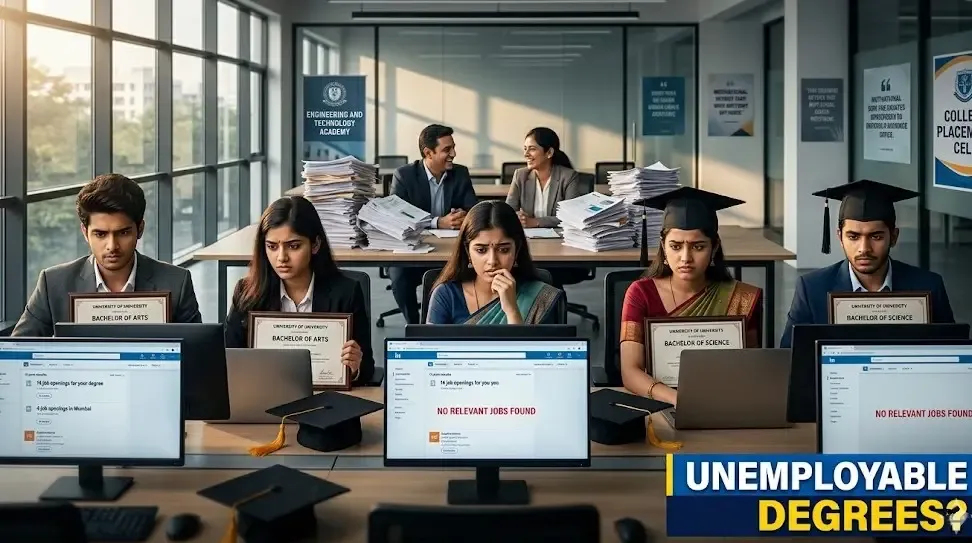
India’s New “Unemployable Degree” List
India’s New “Unemployable Degree” List
Something changed quietly in the Indian job market.
Earlier, simply having a degree was often enough to secure interviews and stable career opportunities.
Now recruiters increasingly care about skills, portfolios, internships, certifications, communication ability, and practical execution.
And because of that shift, some traditional degrees are struggling badly in today’s hiring environment.
Students are noticing it. Parents are noticing it. Recruiters openly discuss it on LinkedIn now.
The uncomfortable reality is this:
Some degrees produce far more graduates than the market currently needs.
Others still teach outdated curriculum while industries move toward AI, automation, cybersecurity, cloud systems, analytics, and practical digital skills.
That mismatch is creating what many students now call the “unemployable degree” problem.
Why Some Degrees Are Losing Job Value
| Main Problem | Career Impact |
|---|---|
| Oversupply of Graduates | Extreme competition |
| Outdated Curriculum | Weak industry relevance |
| Low Practical Training | Poor employability |
| Automation Pressure | Reduced entry-level hiring |
| Weak Placement Ecosystem | Limited recruiter interest |
Importantly, this does not mean every graduate from these courses becomes unemployed.
Many still succeed through self-learning, networking, internships, freelancing, and specialization.
But hiring trends clearly show some degrees now face tougher market conditions than before.
1. Generic Engineering Degrees From Weak Colleges
Engineering remains one of India’s most popular career paths.
But the placement gap between top colleges and average colleges has become massive.
Students from weaker Tier-3 engineering institutions often struggle because industries increasingly expect practical coding, AI familiarity, internships, and project portfolios.
Mechanical, civil, and electronics graduates especially complain about limited core opportunities.
| Engineering Hiring Problem | What Students Experience |
|---|---|
| Too Many Graduates | Heavy placement competition |
| Weak Skill Alignment | Recruiters reject resumes quickly |
| Mass Recruiter Dependency | Lower salary offers |
| Limited Core Industry Hiring | Students shift fields |
This is why students increasingly combine engineering with AI, cloud computing, cybersecurity, or data analytics skills.
2. Basic MBA Degrees Without Strong Brand Value
The MBA market changed dramatically.
Top IIMs and elite business schools still perform strongly.
But generic MBA degrees from weaker institutions increasingly face placement pressure because recruiters now expect specialization, internships, communication ability, and practical business understanding.
Many graduates discover that “MBA” alone no longer guarantees management-level salaries.
Some even enter roles paying salaries very close to undergraduate placements.
3. Traditional Degrees With Heavy Theory Focus
Several traditional degrees still rely heavily on memorization-based teaching.
Meanwhile recruiters increasingly prioritize:
- Practical projects
- Problem-solving ability
- Communication skills
- Software tool familiarity
- Industry exposure
- Portfolio quality
This mismatch creates employability problems.
Students often complete degrees successfully but still struggle during interviews because the market evolved faster than classroom learning.
4. Degrees Facing Automation Risk
AI and automation are quietly changing hiring patterns.
Repetitive entry-level tasks across industries increasingly face software replacement pressure.
| Area Under Automation Pressure | Why Hiring Slows |
|---|---|
| Basic Administrative Work | Automation software handles operations |
| Routine Support Roles | AI chat systems growing |
| Simple Coding Tasks | AI-assisted development increasing |
| Basic Data Processing | Automation tools replacing manual work |
This does not mean jobs disappear completely.
But low-skill repetitive roles are becoming less stable long-term.
5. LinkedIn Hiring Trends Show Skill Shift Clearly
Recruiter demand increasingly favors candidates with modern technical capabilities.
Job descriptions now repeatedly mention:
- AI familiarity
- Cloud platforms
- Cybersecurity
- Data analytics
- Digital marketing
- Automation tools
- Communication skills
Students graduating without these capabilities often struggle more during hiring cycles.
This explains why some degree holders feel “qualified” academically but still remain unemployable practically.
6. Students Are Starting to Regret Blind Degree Decisions
This pattern appears repeatedly online.
Many students now admit they selected degrees based on:
- Family pressure
- Social prestige
- Friend choices
- Cutoff availability
- College marketing hype
Instead of actual industry demand.
Later, when placements become difficult, regret discussions explode across Reddit, LinkedIn, Quora, and student forums.
That’s why students now research ROI and hiring trends far more aggressively than before.
Degrees That Still Show Stronger Demand
| Growing Career Area | Why Recruiters Want It |
|---|---|
| Cybersecurity | Rising digital threat landscape |
| AI & Data Analytics | Automation and data-driven business |
| Cloud Computing | Enterprise infrastructure demand |
| Healthcare | Long-term workforce demand |
| EV & Renewable Tech | Emerging industrial growth |
Students increasingly combine traditional education with these specialized skill areas to stay competitive.
The Real Problem Is Employability
Recruiters increasingly repeat the same concern:
The issue is not only unemployment.
It is unemployability.
Many graduates still lack:
- Communication ability
- Practical exposure
- Internship experience
- Portfolio work
- Industry-relevant technical skills
That explains why two students with the same degree can experience completely different career outcomes.
Conclusion
India’s hiring market is changing rapidly.
Degrees that once guaranteed stable careers now face growing pressure from automation, oversupply, and skill-based recruitment systems.
Students can no longer depend only on classroom learning or degree titles.
Practical skills, internships, networking, AI familiarity, communication ability, and adaptability increasingly matter just as much - sometimes more.
The biggest mistake now is choosing a course without understanding where industries are actually moving.
Because in today’s market, employability matters far more than the degree alone.

Written by
MonishMonish is an education writer covering exams, student rights, academic awareness, and other education-related topics, with practical guidance for students.