
Education Loan Trap in India: What Students Are Not Told
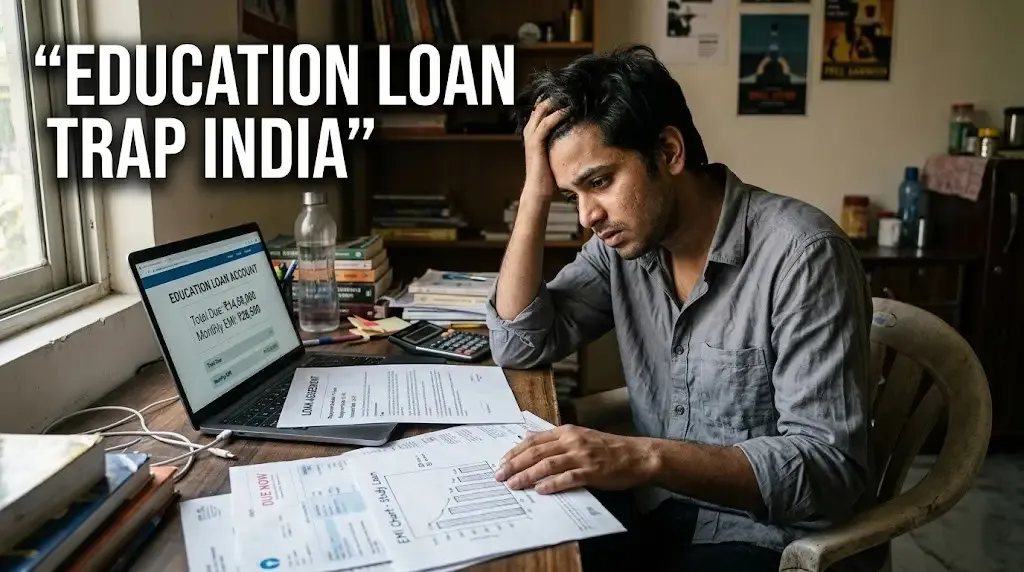
Loans Look Like Opportunity - Until Repayment Starts
Education loans are marketed as a simple solution: study now, pay later. Sounds perfect. But for many students in India, this turns into a long-term financial trap.
The problem is not the loan itself. The problem is how students take it without understanding the full picture.
Where the trap begins
Most students take loans based on one assumption - “I will get a good job after graduation.” But reality is unpredictable. Jobs are not guaranteed, especially in average colleges or low-demand courses.
Once repayment starts, pressure builds quickly.
EMIs don’t wait for your career to settle. Interest keeps increasing, and suddenly, you are not choosing jobs - you are forced to take whatever pays.
Hidden problems most students ignore
| Issue | What It Means |
|---|---|
| High Interest | Total repayment becomes much higher than the loan amount |
| Moratorium Period | Interest still accumulates during study time |
| Job Uncertainty | No guarantee of income after graduation |
| Pressure on Family | Parents often become co-borrowers |
Study abroad makes it riskier
Many students take huge loans for foreign education. If everything goes right, it works. But if something goes wrong - visa issues, job delays, or low salary - the loan becomes a heavy burden.
One common mistake
Students focus only on college admission, not on return on investment (ROI).
Before taking a loan, you should ask:
• What is the average salary after this course?
• How long will it take to repay the loan?
• What if I don’t get a job immediately?
• Is there a safer, more affordable option?
If you skip these questions, you are taking a financial risk without a plan.
When does an education loan make sense?
• When the course has strong job demand
• When the college has proven placement records
• When you have a backup plan
Final thought
An education loan is not free money. It’s a responsibility that can follow you for years.
Use it carefully, not emotionally.
Because in the end, your degree should create freedom - not financial pressure.

Written by
MonishMonish is an education writer covering exams, student rights, academic awareness, and other education-related topics, with practical guidance for students.