
Courses With Highest Unemployment Rate in India
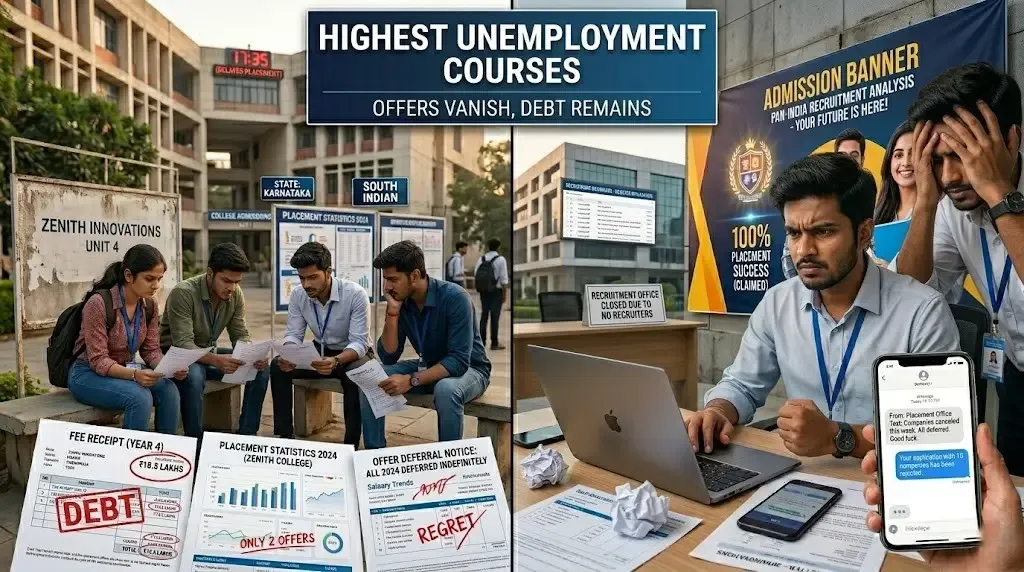
Courses With Highest Unemployment Rate in India
For years, students in India were told one simple thing:
“Get a degree and life becomes secure.”
That promise feels far weaker now.
Across multiple sectors, graduates are struggling to find stable jobs even after spending lakhs on college education.
Some courses produce far more graduates than the market can absorb. Others suffer because industries changed faster than university curriculums. In some fields, automation and AI are reducing entry-level opportunities completely.
The uncomfortable reality is this:
Not all degrees carry equal career value anymore.
And students are slowly becoming more aware of that gap.
Why Some Courses Face Higher Unemployment
| Main Problem | Impact on Students |
|---|---|
| Too Many Graduates | Heavy competition for limited jobs |
| Outdated Curriculum | Weak industry readiness |
| Low Practical Exposure | Employability problems |
| Automation | Reduced entry-level hiring |
| Weak Placement Ecosystem | Students depend on off-campus job search |
Importantly, this does not mean every graduate from these courses remains unemployed.
Many students still succeed through internships, networking, self-learning, and skill specialization.
But statistically, some degrees clearly face tougher job markets than others.
1. Traditional Engineering Degrees From Weak Colleges
Engineering still produces successful careers for many students.
But India also has one of the world’s largest engineering graduate populations.
The problem becomes worse in lower-tier colleges where practical training, internships, and industry exposure remain weak.
Mechanical, civil, and electronics graduates especially complain about limited core job openings.
Many eventually shift toward IT support, sales, preparation for government exams, or completely unrelated work.
| Engineering Issue | Student Reality |
|---|---|
| Oversupply of Graduates | Heavy placement competition |
| Weak Tier-3 Placements | Mass recruiters dominate |
| Limited Core Jobs | Students shift industries |
| Outdated Labs | Low practical readiness |
This is one reason students increasingly focus on coding, AI, cybersecurity, and data-related skills alongside engineering.
2. Generic MBA Degrees
MBA once carried enormous prestige in India.
Top MBA institutes still create strong outcomes. But generic MBA degrees from weaker colleges increasingly struggle with placement quality.
Many students realize later that simply having “MBA” on a resume is not enough anymore.
Companies now care more about communication skills, internships, specialization quality, and practical business understanding.
Some MBA graduates complain they entered sales-heavy roles with salaries not very different from undergraduate placements.
3. Basic B.Sc Degrees Without Specialization
Traditional science degrees face another difficult problem.
Many students complete B.Sc programs without clear specialization or career planning.
After graduation, they often discover limited direct job opportunities unless they pursue:
- M.Sc
- Research
- Teaching
- Competitive exams
- Technical specialization
The degree alone frequently does not create strong employability immediately.
| B.Sc Challenge | Common Student Concern |
|---|---|
| Limited Direct Hiring | Few campus placements |
| Low Industry Exposure | Weak professional networking |
| Further Education Pressure | Higher dependency on post-graduation |
| Skill Gap | Need for technical certifications |
4. Degrees Focused Only on Theory
This problem cuts across multiple streams.
Students increasingly complain that some courses remain heavily theory-focused while industries demand practical execution skills.
Recruiters now test:
- Projects
- Communication
- Software tools
- Problem-solving ability
- Internship experience
Degrees that fail to build these capabilities often leave students struggling during placements.
This gap between university curriculum and industry demand has become one of the biggest employability issues in India.
5. Courses Facing Automation Pressure
Automation and AI are quietly changing hiring patterns.
Repetitive entry-level tasks are increasingly being automated across industries.
This affects certain jobs more heavily than others.
| Area Under Pressure | Why Hiring Changes |
|---|---|
| Basic Data Entry | Automation tools replacing manual work |
| Simple Coding Tasks | AI-assisted development growing |
| Routine Support Work | Chatbots reducing repetitive roles |
| Generic Administrative Roles | Digital systems handling operations |
This does not mean jobs disappear completely.
But low-skill repetitive work is becoming harder to rely on long-term.
6. Students Increasingly Regret Choosing Courses Blindly
One trend appears repeatedly across student discussions online.
Many students admit they selected courses based on:
- Family pressure
- Social status
- Friend circles
- Cutoff availability
- Marketing hype
Instead of actual industry demand.
That decision often creates frustration later when placements become difficult.
Students are now researching ROI, placement quality, and future demand much more carefully than before.
Courses With Better Employment Trends Right Now
| Growing Area | Why Demand Exists |
|---|---|
| Cybersecurity | Rising digital threats |
| AI & Data Analytics | Industry automation growth |
| Cloud Computing | Enterprise tech demand |
| EV Engineering | Electric vehicle expansion |
| Healthcare | Long-term workforce demand |
Students increasingly combine traditional degrees with these modern skill areas to improve employability.
The Bigger Problem Is Employability, Not Just Degrees
Many recruiters repeatedly say the same thing:
The issue is not only unemployment.
It is unemployability.
Some graduates struggle because they lack communication skills, practical exposure, internships, or modern technical abilities.
This explains why two students with the same degree can experience completely different career outcomes.
Conclusion
Some courses in India clearly face tougher employment conditions than others due to oversupply, weak curriculum alignment, and changing industry demand.
But the degree alone no longer decides career success completely.
Students who build practical skills, internships, networking, and adaptability alongside education usually perform much better than those relying only on classroom learning.
The biggest mistake now is choosing a course blindly without understanding where industries are actually moving.
Because in today’s market, employability matters far more than the degree title alone.

Written by
MonishMonish is an education writer covering exams, student rights, academic awareness, and other education-related topics, with practical guidance for students.