
AI Cheating, Paper Leaks and Marking Errors: Why Exam Trust Is Becoming a Global Issue
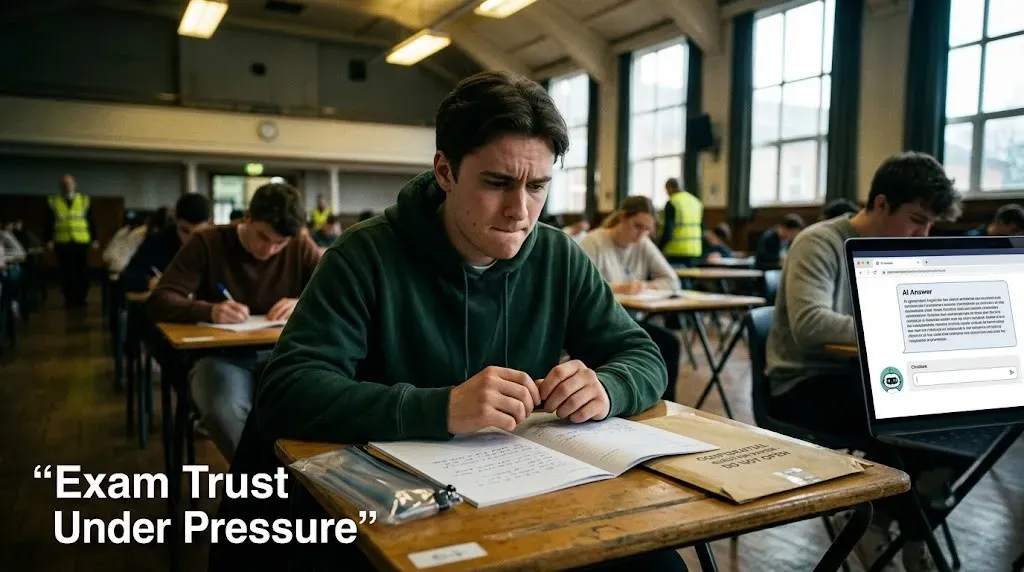
An exam is supposed to give students a level playing field. In 2026, that basic promise is being tested from several directions. Students have been caught using generative AI in assessments, confidential papers have been stolen before exams, and digital marking systems have produced results that students and parents have challenged.
The problem is appearing in very different forms. At Brown University in the US, one professor reported unusually high scores on a take-home exam and later found evidence suggesting widespread AI-assisted cheating. The average score fell sharply when the next test was conducted in person. The incident has added to concerns that conventional take-home assessments are becoming harder to trust when students have unrestricted access to generative AI.
AI detection creates another complication. A 2026 study comparing widely used detection tools found substantial differences in their ability to identify AI-generated work, while another recent evaluation of 13 detectors found that their performance remained inadequate for high-stakes academic decisions. That leaves institutions with an uncomfortable choice. Trusting a detector too much can create false accusations, while ignoring AI use can make an assessment unfair.
| Problem | Why it damages trust |
|---|---|
| AI-assisted cheating | A high score can become difficult to interpret when the institution cannot tell how much of the work came from the student. |
| Paper leaks | Students who prepare honestly can lose an advantage when confidential questions reach candidates before the scheduled exam. |
| Marking errors | Even a secure exam becomes questionable when a correct answer is scanned, marked or recorded incorrectly. |
Paper security remains a very old problem with increasingly modern consequences. Cambridge International confirmed that an AS and A Level Mathematics paper was shared prematurely during its June 2026 examination series. The board used assessed marks to protect students who had followed the rules and said exam security threats were affecting examination bodies more broadly. Students can read the official Cambridge update for details.
India has seen the same trust problem in another form. In 2026, large numbers of students challenged school-leaving exam results after complaints about digital marking, including reports of blurred scans, missing pages and answers that had not been properly checked. More than 400,000 students reportedly requested copies of their answer sheets, turning what should have been a routine results process into a national controversy.
Paper leaks have also pushed India to strengthen its legal response. Parliament passed the Public Examinations (Prevention of Unfair Means) Amendment Bill in July 2026, expanding the framework dealing with organised malpractice in public examinations. The government's official backgrounder on the amendment explains the changes.
There is a bigger lesson here. Adding another piece of software does not automatically solve an assessment problem created by people, incentives and weak procedures. A secure question-paper chain can still be followed by a flawed marking system. A sophisticated AI detector can still misjudge a student's work. A perfectly designed digital platform can still fail if nobody checks what happens when the technology produces an unexpected result.
That is why some universities and schools are experimenting with assessments that require students to explain their own work, defend a solution verbally or complete important parts of an assignment under supervision. These methods are harder to outsource completely to AI and give teachers another way to judge whether the student actually understands the material.
The difficult question for education systems now is how much technology should sit between a student's work and the final grade. The answer will probably vary by subject, but one principle is becoming harder to ignore: students need to trust that the same rules apply before they can trust the marks they receive.