
“100% Placement” Claims Investigated
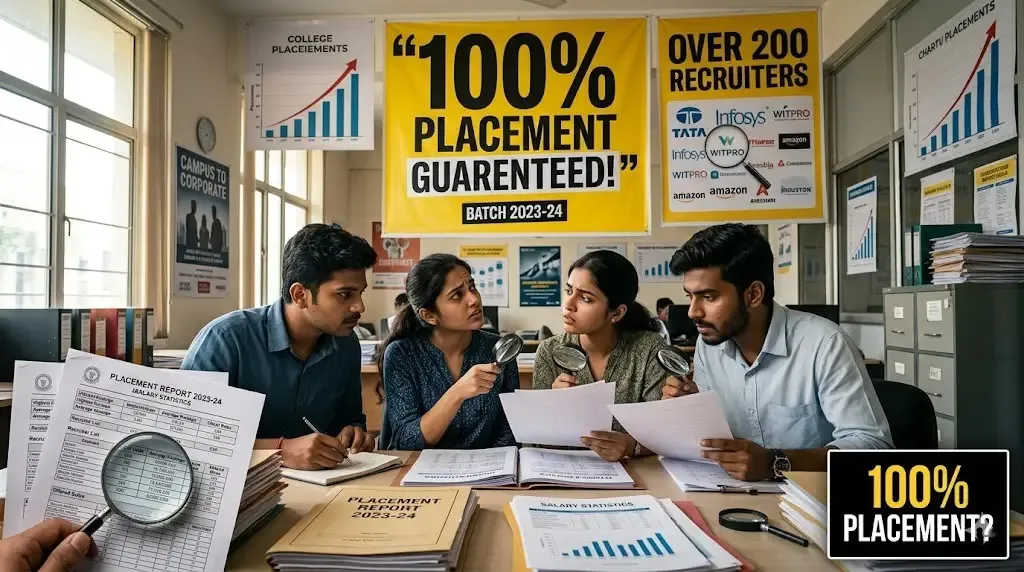
“100% Placement” Claims Investigated
“100% Placement Guaranteed.”
That line appears everywhere during college admission season in India.
Billboards. Instagram ads. Newspaper campaigns. Education fairs. Campus brochures.
For parents and students, the message sounds simple:
Take admission here, and your career is basically secured.
But once students actually enter campuses, many begin hearing a very different story from seniors.
Some discover placement eligibility rules they never knew existed. Others realize only certain departments receive strong recruiter attention. Many learn that “100% placement” can mean very different things depending on how colleges define it.
So the real question becomes:
What do these placement claims actually mean?
And how should students verify them properly?
Why Placement Claims Matter So Much
In India, placements often influence admissions more than curriculum itself.
Families see education primarily as a financial investment.
So placement statistics become one of the biggest trust signals colleges use during admissions.
| Why Students Focus on Placements | Reason |
|---|---|
| Education ROI | Families invest lakhs in degrees |
| Job Security | Career pressure after graduation |
| Loan Repayment | Salary impacts financial recovery |
| Social Expectations | Placements define “successful college” image |
That pressure creates powerful incentives for aggressive placement marketing.
1. “100% Placement” Does Not Always Mean Every Student Got a Job
This is the biggest misunderstanding students face.
Different colleges calculate placement percentages differently.
Sometimes “100% placement” may refer only to:
- Eligible students
- Students who registered for placements
- Specific departments
- Certain courses only
- Students above GPA cutoffs
That changes the meaning completely.
For example, if weaker-performing students become ineligible early, the final percentage can still appear extremely high publicly.
| Placement Term | Possible Reality |
|---|---|
| 100% Placement | Only eligible students counted |
| Top Recruiters | Limited hiring volume sometimes |
| Average Package | Inflated by top offers |
| International Package | Rare exceptional case |
This is why students increasingly ask for raw placement data instead of only marketing headlines.
2. Eligibility Criteria Quietly Eliminate Many Students
This part rarely appears in advertisements.
Companies visiting campuses often set strict criteria like:
- Minimum CGPA
- No active backlogs
- Attendance requirements
- Communication skills
- Aptitude screening
- Coding rounds
As a result, not every student actually gets equal placement opportunity.
Some students become effectively excluded from major placement drives early in the process.
But admission advertisements rarely discuss this openly.
3. Average Salary Can Hide Huge Differences
Students now increasingly understand why average package numbers can mislead.
If a few students receive very large salaries, the overall average rises sharply even when most offers remain moderate.
That’s why median salary often matters more.
| Statistic Type | What It Shows |
|---|---|
| Highest Package | Best exceptional outcome |
| Average Package | Can be influenced by outliers |
| Median Package | More realistic student experience |
| In-Hand Salary | Actual earning reality |
Students researching placements seriously now focus heavily on median salary data.
4. Recruiter Logos Can Also Be Misleading
Many colleges display giant company logos during admissions.
Students naturally assume these companies hire heavily every year.
But sometimes:
- Only a few students were selected
- The company visited years earlier
- Hiring happened only once
- Internships counted too
This does not make the claims completely false.
But it can create unrealistic expectations about recruiter activity.
5. Students Now Use Reddit and LinkedIn for Reality Checks
Social media changed placement transparency massively.
Students now verify placement reality through:
- Reddit discussions
- LinkedIn alumni profiles
- YouTube reviews
- Telegram groups
- Quora experiences
- Direct senior conversations
This crowdsourced information often reveals placement experiences more honestly than official brochures.
That’s why online student communities became extremely influential during admissions.
6. Placement Quality Matters More Than Placement Percentage
This is another important shift.
Students increasingly care about:
- Role quality
- Career growth
- Skill relevance
- Work culture
- Salary stability
- Actual in-hand pay
instead of only placement percentage itself.
Because technically, a student getting a low-paying unrelated job still counts as “placed” statistically.
That distinction matters enormously.
7. Some Colleges Do Maintain Genuine Strong Placements
This part matters too.
Not every placement claim is misleading.
Top IITs, IIMs, NITs, reputed government colleges, and certain genuinely strong private universities maintain excellent recruiter ecosystems consistently.
The biggest concerns usually appear in heavily marketed lower-tier institutions competing aggressively for admissions.
That’s where transparency questions become strongest.
How Students Should Verify Placement Claims
| What to Check | Why It Matters |
|---|---|
| Median Salary | More realistic outcome |
| Placement Eligibility Rules | Who actually gets opportunities |
| Department-Wise Placements | Huge variation may exist |
| LinkedIn Alumni Profiles | Real career tracking |
| Senior Student Feedback | Ground-level reality |
Conclusion
The “100% placement” debate reflects a larger issue in Indian education marketing.
Students and parents increasingly want transparency instead of only promotional headlines.
Placement percentages alone no longer tell the full story.
Students now care about eligibility rules, median salaries, recruiter consistency, role quality, and long-term career growth.
And honestly, that shift is healthy.
Because education decisions involving lakhs of rupees deserve more than billboard statistics and giant package banners.

Written by
MonishMonish is an education writer covering exams, student rights, academic awareness, and other education-related topics, with practical guidance for students.